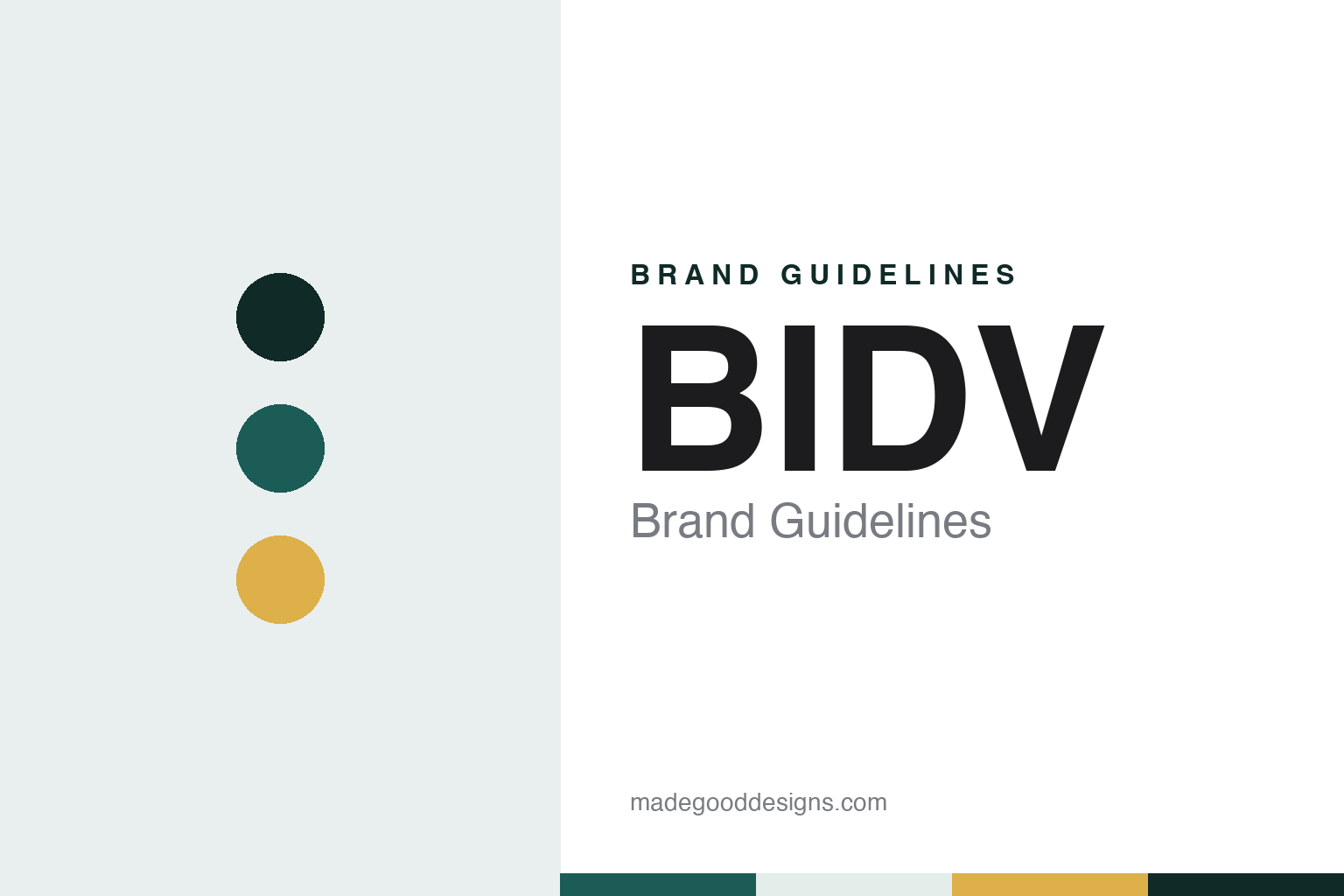
BIDV Brand Guidelines
A 1957 construction bank, renamed twice and now in emerald and blossom yellow.
Aa
Two constants: an emerald green and blossom yellow palette and a geometric banking sans register. Abstract homage — not a BIDV product or mark; no logo, card or signage is reproduced.
Kiến thiết
A bank built to fund construction.
BIDV is the short name of the Joint Stock Commercial Bank for Investment and Development of Vietnam, in Vietnamese Ngân hàng TMCP Đầu tư và Phát triển Việt Nam, with its head office in Hanoi. English Wikipedia dates its founding to 26 April 1957, as the Bank for Construction of Vietnam — Ngân hàng Kiến thiết Việt Nam. Vietnamese Wikipedia says its main task in those years was to allocate state budget capital for basic construction, and the bank says it handled the management and allocation of capital for building projects.
The bank has carried four names. On 24 June 1981 it was moved from the Ministry of Finance to the State Bank of Vietnam and renamed the Bank for Investment and Construction of Vietnam, according to the bank and both Wikipedia editions. Vietnamese Wikipedia describes the change as the start of a shift from handing out budget funds towards lending. In 1990 a government decision, numbered 401/CT, renamed it the Bank for Investment and Development of Vietnam; English Wikipedia gives the date as 14 November 1990.
According to Vietnamese Wikipedia, BIDV began operating as a commercial bank in 1995, after its budget-allocation work and part of its staff passed to a department of the Ministry of Finance. The same article says retail banking began in the early 1990s with deposit-taking from households, and that the bank built a group of subsidiaries and joint ventures around banking, insurance and financial investment, with branches and representative offices abroad.
Colour
Equitisation, a listing and Hana Bank.
In January 2007 the government announced that it would sell a minority stake in BIDV and three other banks, English Wikipedia says. Vietnamese Wikipedia dates BIDV’s initial public offering, an auction of shares, to 28 December 2011; the bank became a joint-stock commercial bank on 1 May 2012, and its shares began trading under the code BID on 24 January 2014. The bank describes the change as equitisation carried out at the government’s direction.
The foreign partner came in 2019. The bank says that on 11 November 2019, in Hanoi, it announced South Korea’s Hana Bank as its strategic shareholder, owning 15 percent of its charter capital, and calls it the largest M&A deal with a strategic investor in Vietnamese banking; English Wikipedia gives the same description. Tuoi Tre News reported in August 2026 that BIDV was the last of the three listed state-owned banks to bring in a major foreign strategic investor, and that KEB Hana Bank now holds 14.21 percent after it declined to take part in two recent private placements.
The state keeps control. Vietnamese Wikipedia classes BIDV as a joint-stock company in which the State Bank of Vietnam holds a controlling stake, and lists it with Agribank, Vietcombank and VietinBank as one of the four large banks known in Vietnam as the “Big 4.” In October 2026 Fintech News, citing Reuters, reported government holdings of 76.73 percent in BIDV, and a state capital plan approved on 27 October 2026 that sets a floor of at least 65 percent by 2030.
Vietnamese Wikipedia lists the bank’s subsidiaries as including LaoViet Bank in Laos, the securities firm BSC, the insurer BIC, a leasing company run with Sumitomo Mitsui Trust and the Bank for Investment and Development of Cambodia. The bank groups its work under banking, insurance, securities and financial investment. In April 2021, Vietnamese Wikipedia says, the BIDV system had about 190 branches, a presence in all 63 provinces of Vietnam and operations in six other countries.
Typography
Design and documentation.
Banks in Malaysia and Vietnam tend to present themselves through a bold wordmark or a short set of initials, often set in a single strong colour. Red, green, blue and orange recur across the sector, and many names work in two languages at once: a Malay or Vietnamese name for home customers and an English form or abbreviation for markets, filings and overseas branches. Several of the banks in this guide are known chiefly by initials that began as the names of older holding companies or merged institutions.
In Malaysia, Islamic banking usually sits beside the conventional bank as a range of its own, often run through a separate subsidiary with Shariah-compliant deposits, financing and cards. Public Bank, for example, says it began Islamic banking in 1993 and moved that business into Public Islamic Bank in 2008, while RHB offers its Islamic products through RHB Islamic Bank. RHB’s Sinar Credit Card-i, launched in November 2026, shows the “-i” suffix some Malaysian banks use for Islamic products.
Bank websites in both countries are organised around everyday tasks: deposits and savings accounts, home and vehicle loans, cards, QR payments and mobile apps. In Malaysia the national QR standard, DuitNow QR, was launched by PayNet in July 2019, according to Public Bank, whose own site lists DuitNow QR and its MyPB app under mobile banking. Photography tends to show branches, city skylines, head-office towers and customers at counters or on phones rather than abstract imagery.
Much of how these banks describe themselves appears in formal documents. Listed banks publish annual reports and, increasingly, sustainability reports, and their corporate websites group these with investor pages, milestone timelines and anniversary campaigns. This guide draws on those pages, on encyclopedia entries and on dated press reports, and marks where a fact rests on a bank’s own word.
Aa
A geometric banking sans with full Vietnamese diacritics. (Specimen set in Lexend, a sans STAND-IN; NOT the BIDV logo.)
BIDV
Five petals in emerald and yellow.
BIDV’s current identity was launched on 26 April 2022, the bank’s 65th anniversary, according to Vietnamese Wikipedia. The article describes the new logo as a stylised five-petal yellow apricot blossom — the hoa mai flower — with a five-pointed star at its centre, and says the number five is read in Eastern culture as a number of growth.
The same article names the colours. The main brand colour is an emerald green, which it links to vitality, sustainable growth and the idea of a green bank; the supporting colour is the yellow of the apricot blossom, which it describes as the colour of dawn and of the finance sector. The green and yellow on this page are our own tones, chosen to sit close to that description.
The bank’s website carries the identity into its everyday products. Personal customers are pointed to the BIDV SmartBanking app, businesses to BIDV Direct and BIDV iBank, and merchants to POS, online and QR payment acceptance. For 2025 the bank set out the motto “Responsibility – Streamlining – Efficiency – Accelerating Transformation” and the aim of a “Large – Strong – Green” bank, according to its leadership message.
For a design guide, BIDV shows how a bank founded to fund construction can turn a national flower into a modern mark, with one green carrying its branches, apps and reports. Compare Vietcombank, the Hanoi foreign-trade bank equitised in 2008, and VietinBank. For this guide we use an emerald green, a deep teal ink and a blossom yellow with a sans, an unofficial interpretation; no product or logo is reproduced.
Explore & save
Keep BIDV’s identity on hand — save it to a board in the Made Good inspiration library.
BIDV identity set
Pin the BIDV emerald and blossom yellow palette and the geometric banking sans register to your own board.