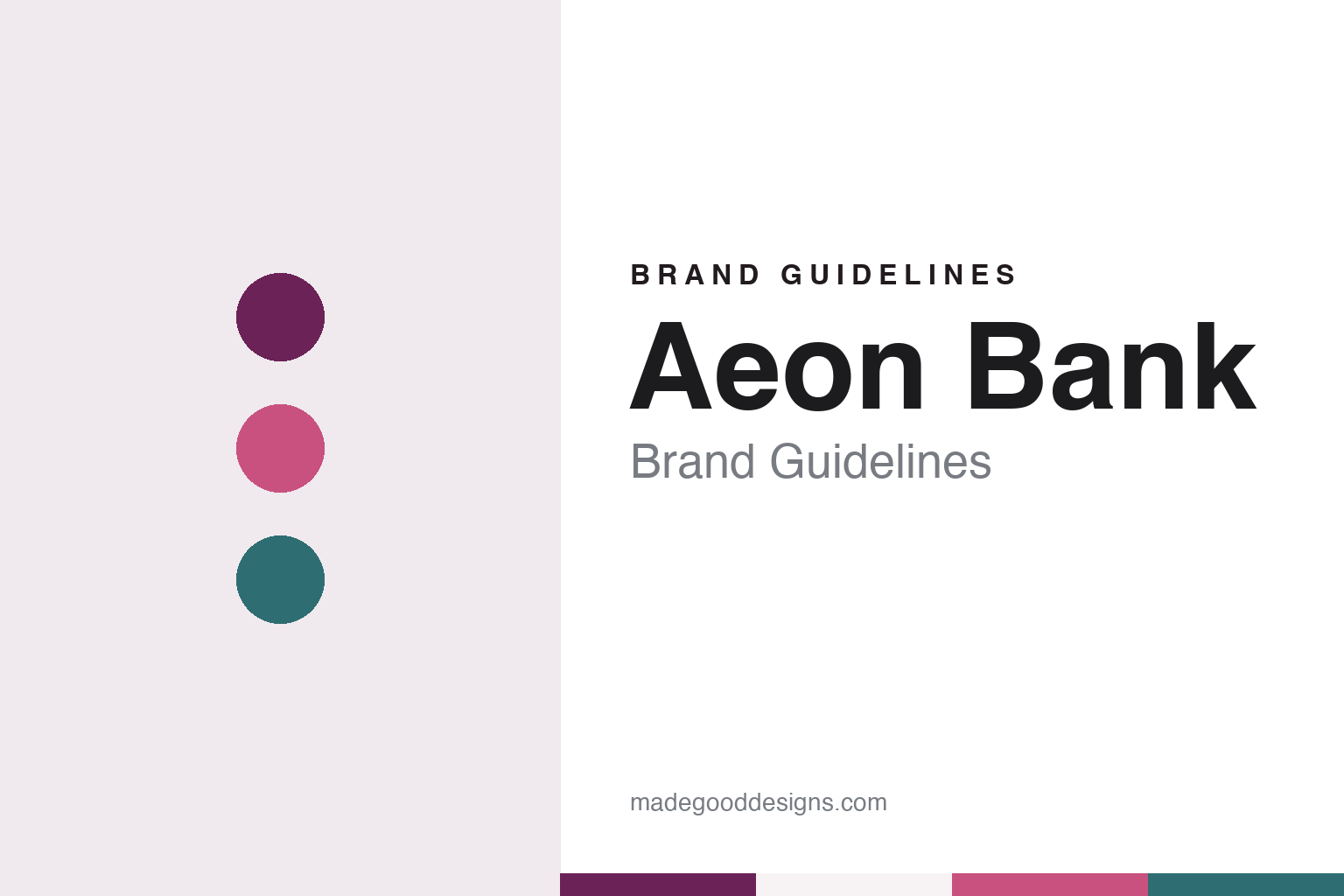
Aeon Bank Brand Guidelines
In-store branches, WAON cards and birthstone branch names.
Aa
Two constants: a plum, pink and teal on white palette and a rounded Japanese sans register. Abstract homage — not an Aeon Bank product or mark; no card, machine or logo is reproduced.
AEON Financial Project
A retailer opens a bank on its own.
Aeon Bank is the bank of Japan’s Aeon retail group. Japanese Wikipedia says Aeon announced its entry into banking on 10 March 2006 and set up a wholly owned preparatory company, AEON Financial Project, on 15 May 2006; when the licence pre-screening ended, the company took the name Aeon Bank on 5 October 2007, and it received its banking licence on 11 October 2007. The same article says Aeon decided to found the bank on its own rather than with a partner bank, and that a share issue on 19 October 2007 brought in 16 financial institutions and trading companies while leaving Aeon as the largest shareholder, with 36%. Japanese Wikipedia also places it as the second retail-led bank in Japan, after Seven Bank.
The opening was covered as news. J-CAST News reported on 23 October 2007 that the bank, aiming to open on 29 October, had agreed ATM tie-ups with 51 financial institutions including Japan Post Bank and regional banks, and that its own 461 machines stood at 275 locations, among them Aeon shopping centres. Japanese Wikipedia records that account applications began at around 220 shopping centres on 20 October and that the bank opened on 29 October 2007 with those ATMs and its first two staffed in-store branches, in the Jusco Shinagawa Seaside store and the Aeon Tsudanuma shopping centre. Investment trusts followed in November, card loans in December, and insurance and housing loans in January 2008.
Colour
A bank counter inside the mall.
Where Seven Bank built its business around ATMs, Aeon Bank put staff inside the mall. Japanese Wikipedia describes the in-store branch as the core of the model: staffed counters in Aeon group shopping centres offering face-to-face service, selling housing loans, insurance and investment products as well as deposits, with hours matched to the shopping centre, generally 9am to 9pm every day, weekends and holidays included. The article counts 140 in-store branches on 31 March 2019, about four in ten of them in the Kanto region, and says that since October 2017 all of them have been run directly by the bank. It gives the ATM count as 6,855 across all 47 prefectures at the end of March 2025, mostly in Aeon group stores, with a few in places such as airport terminals.
The card is the other constant. Every account holder receives the Aeon Bank Card, a cash card that, Japanese Wikipedia says, works together with Aeon’s WAON electronic money; no passbook is issued. In February 2009 came Aeon Card Select, which joins a credit card, the cash card and WAON in one, and in July 2016 a JCB debit version called CASH+DEBIT. One small naming device stands out: branches that hold personal accounts are named after birthstones or birth flowers, and each customer is assigned one by birth month. The brand slogan quoted by Japanese Wikipedia translates as “a bank with ideas.”
The ATM network was opened up step by step. According to Japanese Wikipedia, the bank put its machines in major JR West stations from April 2008, the first sites outside the Aeon group; a strategic ATM alliance with Mizuho Bank from December 2013 lifted the number of usable card types to more than 600; Lawson ATMs were connected in October 2014; and from September 2018 a smartphone app allowed deposits and withdrawals without a card. In November 2024 the bank took over the credit card business of Fuji Card Service.
Typography
Japan’s digital and retail-group banks.
Japan’s internet and retail-group banks present themselves mostly through screens rather than branches. Sony Bank opened in 2001 with a service website, MONEYKit, instead of a branch network, and Rakuten Bank, which began in 2000 as eBANK Corporation, calls itself an internet-only bank. Their pages are organised around everyday tasks: deposits in yen and foreign currencies, card and home loans, investment trusts and, more and more, apps and account opening by smartphone.
Many carry the name of a larger consumer group. Rakuten Bank took its parent’s name in 2010, and Sony Bank belongs to Sony Financial Group. The banks set a Japanese name beside a Latin one — 楽天銀行 with Rakuten Bank, ソニー銀行 with Sony Bank — so the same name has to work in two scripts on cards, apps and statements.
Cash is still part of the picture, and it is reached through other companies’ machines. Rather than building large ATM networks of their own, these banks connect to machines in convenience stores and other banks: Rakuten Bank’s 2010 tie-ups with E-net and Lawson put its cards into FamilyMart, Ministop and Lawson stores, and Sony Bank’s history lists connections with Seven Bank, Lawson, E-net and Aeon Bank. Card faces have become a place for character illustration, as with Sony Bank’s PlayStation and PEANUTS designs.
Behind the consumer pages sits a more formal layer of disclosure sections, press releases and investor documents. This guide sets out what can be checked about each bank — who set it up, who owns it and when its name changed — and marks clearly what rests on the bank’s own word.
Aa
A rounded Japanese sans for a bank that meets customers on a shopping trip. (Specimen set in M PLUS Rounded 1c, a sans STAND-IN; NOT the Aeon Bank logo.)
Aeon Bank
A bank inside a financial group.
The bank grew by taking on other businesses. Japanese Wikipedia says the Deposit Insurance Corporation of Japan chose Aeon Bank in September 2011 as the final acquirer of the business of the failed Incubator Bank of Japan; that business, held in the meantime by a bridge bank renamed Aeon Community Bank, was merged into Aeon Bank on 31 March 2012, bringing corporate banking with it. On 1 January 2013 Aeon Bank became a wholly owned subsidiary of Aeon Credit Service, which handed its credit card business to the bank on 1 April 2013 and renamed itself Aeon Financial Service, the group’s financial holding company. A 2019 restructuring placed the bank under an intermediate holding company; after that company merged into Aeon Financial Service on 1 May 2026, the bank again became its direct subsidiary, according to the same article.
Investment accounts changed hands in 2024. A press release from Monex Securities dated 4 January 2024 says Aeon Bank had moved its investment trust custody accounts to Monex and would act as its intermediary, widening the range of funds on offer and opening share and ETF trading to its customers, with seminars by Monex staff held in Aeon Bank branches.
For a design guide, Aeon Bank shows a bank identity built around a shopping trip: a counter open as long as the mall, a cash card that doubles as store money, and branch names taken from birthstones and flowers. Compare the parent retailer in the AEON brand guidelines and the ATM-led model of Seven Bank. For this guide we use a mall plum, a bloom pink and a birthstone teal on card white with a rounded Japanese sans, an unofficial interpretation; no product or logo is reproduced.
Explore & save
Keep Aeon Bank’s identity on hand — save it to a board in the Made Good inspiration library.
Aeon Bank identity set
Pin the Aeon Bank plum, pink and teal palette and the rounded Japanese sans register to your own board.