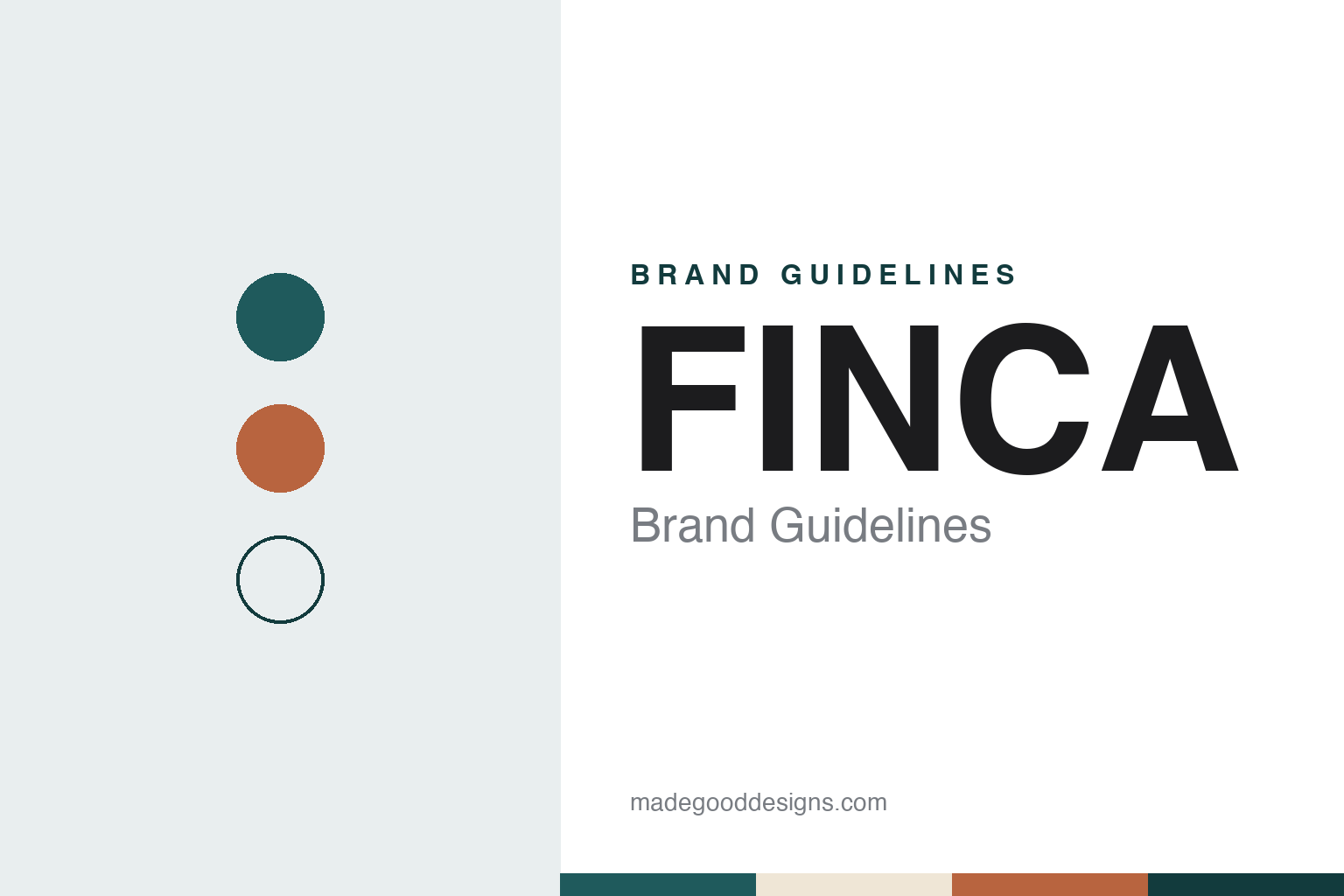
FINCA Brand Guidelines
The Washington nonprofit that put small loans in the hands of village banks.
Aa
Two constants: a teal, clay and sand palette and a plain grotesque sans register. Abstract homage — not a FINCA product or mark; no logo or wordmark is reproduced.
Five letters
A nonprofit named for community assistance.
FINCA began in 1984. Its founder, the American development economist John Hatch, set it up as a nonprofit called the Foundation for International Community Assistance, and the initials of that long name became the brand, according to English Wikipedia. Wikipedia’s article on Hatch says the idea came to him on a flight over the Andes on the way to a consulting job in Bolivia, and that he sketched the outline on in-flight napkins before landing in La Paz.
Hatch had by then spent two decades in development work, the same article says: as a Peace Corps volunteer in a barrio on the edge of Medellín, Colombia, from 1962, then supervising volunteers in Peru, and later as a consultant on more than 55 rural projects in Latin America, Africa and Asia. Wikipedia summarises the lesson he drew from that work as a wish for an organisation in which local communities, rather than outside consultants, ran their own projects. FINCA was his answer: a lending programme run by the borrowers’ own groups.
The organisation is headquartered in Washington, D.C., and Wikipedia describes it as a nonprofit microfinance organisation. Its list of country programmes, with the year each began, starts in the Americas — Haiti and Honduras in 1989, Nicaragua in 1992, Ecuador in 1994 and Guatemala in 1998 — and runs through Africa, with Uganda in 1992, Malawi in 1994 and Tanzania in 1998, to the former Soviet republics, where Kyrgyzstan followed in 1995 and Azerbaijan and Georgia in 1998. Later entries include Kosovo in 2000, Zambia in 2001, Jordan in 2007, Pakistan in 2013 and Nigeria in 2014.
Hatch stepped back from day-to-day work at the Washington headquarters in 2006 and stayed on as a board member, according to Wikipedia.
Colour
Twenty to thirty members, one ledger.
FINCA’s method is the village bank. English Wikipedia describes a village bank as a self-help group of some 20 to 30 members, mostly women, who meet weekly or monthly to take small working-capital loans, save and train together, and who run the group themselves: they elect their own leaders, choose members, write bylaws, keep the books and set fines for missed meetings. The article on Hatch describes FINCA’s version as a self-managed group of about 25 borrower-owners.
Wikipedia says early village-banking methods were pioneered by Grameen Bank and then developed by groups such as FINCA under Hatch. It also records the debate around the model. In FINCA’s version, members guarantee one another’s repayments, so a shortfall by one member is covered by the group; Wikipedia calls that form of joint liability controversial and notes that Grameen Bank’s founder, Muhammad Yunus, rejected formal joint liability in Grameen’s own groups. It adds that early hopes of village banks becoming fully self-financing were later dropped, and that most now work under the supervision of a local lender’s staff.
In October 2007 the actress Natalie Portman explained the model to students at Stanford Graduate School of Business, where she spoke about her work with FINCA, which she had then been doing for almost four years. The school’s report, by Margaret Steen, says FINCA set up village banks in remote areas, where a group of residents, usually women, set up the bank’s governance and decided who should receive loans. FINCA then served more than 500,000 clients, the report says, with more than 50,000 in each of Mexico, Ecuador and Azerbaijan.
Several country programmes later became regulated institutions. FINCA Uganda, working in the country since 1992, was licensed by the Bank of Uganda as a microfinance deposit-taking institution in 2004, English Wikipedia says, and remains a subsidiary of FINCA International; Wikipedia notes it introduced biometric technology in 2011.
Typography
How microfinance lenders present themselves.
Microfinance lenders present themselves less through products than through method. Grameen Bank’s website opens on its line “A bank for the poor” and describes loans made without collateral, with all transactions except disbursement handled at village-level centres. ASA International sets out the “ASA Model” on a page of its own, from the size of a branch to the rhythm of weekly or fortnightly collections. For these institutions the method is the brand.
Their websites are built around networks and products. They publish branch, client and village counts as dated figures, offer branch locators, and list named loans for small businesses, crops, livestock, housing and education, alongside savings accounts, pension schemes and insurance. Newer pages describe digital wallets and digital financial services, sometimes launched market by market. Where a lender’s pages show small shops, farms or field officers at work, this guide describes them in words rather than reproducing them.
Documentation is a large part of the look. Lenders publish annual reports, monthly reports, governance pages and pages on social performance or impact, and listed groups add investor sections and regulatory news. Regulators are part of the picture too: in Bangladesh, the economist Mustafa K Mujeri wrote in The Daily Star in 2025, non-governmental lenders are licensed by the Microcredit Regulatory Authority, set up under an act of 2006. Claims about what microcredit achieves are the lenders’ own, or those of prize committees and researchers, and are contested in the research literature.
This guide reads each lender from its own pages and from dated outside sources: who founded it, how its lending works, and how its name is used. The palettes here — warm oranges, greens and blues — are our own unofficial interpretations, not the lenders’ published values, and no logo, photograph or document is reproduced.
Aa
A plain grotesque sans for five capital letters. (Specimen set in Work Sans, a sans STAND-IN; NOT the FINCA logo.)
FINCA
Banks sold, start-ups backed.
Some of FINCA’s institutions have since changed hands. In Pakistan, FINCA Microfinance Bank was acquired in 2025 by ABHI, a financial technology company that began in 2021 with earned-wage-access services, Profit reported in November 2026; Mettis Global describes the buyers as a consortium of ABHI and TPL Corp. The former FINCA bank now operates as ABHI Microfinance Bank, which opened a public share offering in November 2026, according to Profit.
FINCA has also added an investment arm. FINCA Ventures runs an annual prize competition for start-ups; in 2025 it drew more than 300 applicants from across Africa in two categories, fintech for financial inclusion and climate-smart agriculture, Disrupt Africa reported in September 2025. The same report quoted Andrée Simon as FINCA’s global chief executive, saying African entrepreneurs were designing bold, locally grounded answers to complex problems.
The five capital letters stand for a long English title, and the same initials have been used by country lenders such as FINCA Uganda and by the investment programme. Wikipedia’s list of programmes spans the Caribbean, Central and South America, East and southern Africa, the Caucasus, Central Asia and the Middle East.
For a design guide, FINCA shows how a set of initials can carry a long institutional name across many countries and legal forms. Compare Kiva, another American name in small loans, and Grameen Bank, whose group lending shaped the field. For this guide we use a deep teal, a warm clay and sand with a sans, an unofficial interpretation; no product or logo is reproduced.
Explore & save
Keep FINCA’s identity on hand — save it to a board in the Made Good inspiration library.
FINCA identity set
Pin the FINCA teal, clay and sand palette and the plain grotesque sans register to your own board.