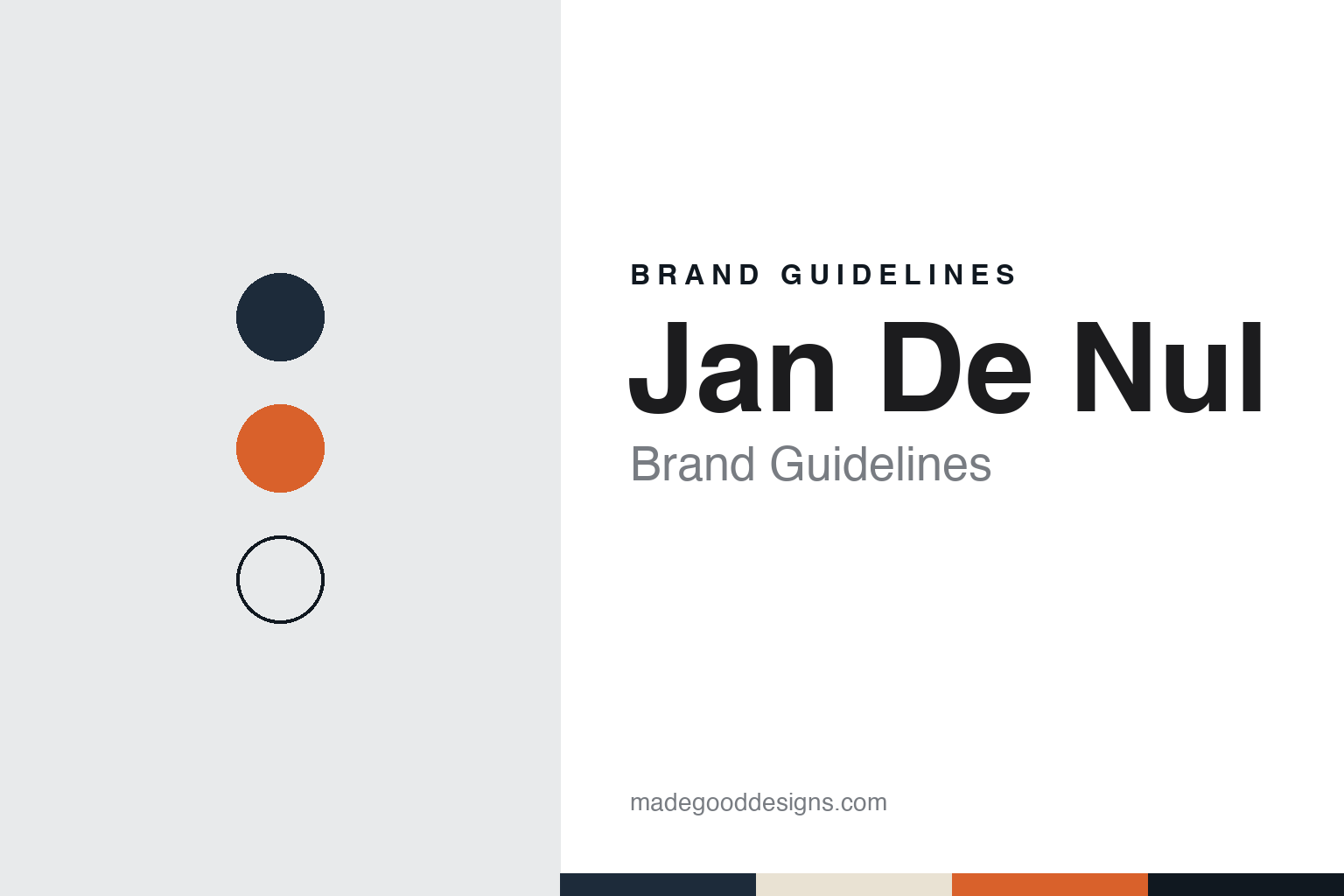
Jan De Nul Brand Guidelines
A six-generation family firm from Aalst that took up dredging in 1951.
Aa
Two constants: a navy, sand and orange palette and an engineering sans register. Abstract homage — not a Jan De Nul vessel, product or mark; no logo or livery is reproduced.
From Aalst
A joinery family, a civil engineer and a first dredger.
Jan De Nul traces its family business to 1849, when, the company says, Leo De Nul set up in Aalst, in East Flanders, as a building contractor and stair-maker. His son Frans and grandsons Isidoor and Gustaaf carried on a joinery workshop in the town, making stairs, windows and doors.
The company itself dates from 1938. English and Dutch Wikipedia both give that year and the village of Hofstade, near Aalst. The company says that Jan Frans Jozef De Nul, a newly qualified civil engineer, set up the limited company PVBA Jan De Nul with his father that year “to execute all types of public and private works,” and that its first major contract was a civil hospital and monastery at Ninove. In 1940, it says, the head office moved to the Tragel site in Aalst, which it went on to expand for decades. The sources used for this guide do not say how the company operated during the occupation of 1940–1944. The company’s own history picks up again in 1945, with larger civil works: buildings, roads, earthworks and part of the academic hospital in Ghent.
Dredging came in 1951. The company says it won its first dredging tender that year, for the reclamation of 530,000 cubic metres of material for the Brussels–Ostend motorway, and ordered its first cutter suction dredger, Jan Pieter I, named after the founder’s eldest son. Larger inland jobs followed: the widening of the Ghent–Terneuzen canal from 1954 and the Ring Canal around Ghent from 1959, for which, it says, the dismountable cutters Willem Blaeu and Peter Plancius were carried overland between sections.
Work abroad began with the trailing suction hopper dredger Sanderus, which, the company says, dredged the 12-kilometre access channel to Le Havre from 1968, its first job outside Belgium. Ports in Libya and Iran followed in the 1970s. The founder’s sons Jan Pieter and Dirk became managing director and director in 1978 and 1981, and in 2023 Julie De Nul, of the sixth generation, became chief executive, the company says. English Wikipedia describes the group as family-owned, with a financial headquarters in Luxembourg.
Colour
Hoppers, cutters and offshore wind.
Jan De Nul’s fleet carries names such as Mercator, Leonardo Da Vinci and Isaac Newton. The company says the rock cutter Leonardo Da Vinci joined in 1986 and that in 1990 it ordered the 11,750-cubic-metre hopper dredger JFJ De Nul, named after its founder. English Wikipedia counts a fleet of 95 vessels, among them 29 trailing suction hopper dredgers and 11 cutter suction dredgers, and lists the hoppers Cristóbal Colón and Leiv Eiriksson, the rock installation vessels Simon Stevin and Joseph Plateau, the cable layer Isaac Newton and the cutter Willem Van Rubroeck.
Its first offshore job, the company says, came in 1991, with dredging and backfilling at Zeebrugge for Statoil’s Zeepipe gas pipeline. The following year it became main contractor for the reclamation works at Chek Lap Kok, Hong Kong’s new airport, which it calls the biggest dredging contract of the 20th century; English Wikipedia dates the reclamation 1992–1995, and the company says it received the Belgian Export Oscar in 1992. In 1995 it won a concession for capital and maintenance dredging on the Río Paraná and Río de la Plata in Argentina, which it calls its longest-running project. Later work listed by English Wikipedia includes Palm Jebel Ali in Dubai, the Panama Canal expansion, the Suez Canal expansion of 2014–2015 and Princess Elizabeth Island, an artificial energy island built from 2024.
Since 2012 the group has built up an offshore wind business. The jack-up vessel Voltaire joined the fleet at the end of 2022, the company says, and the floating heavy-lift vessel Les Alizés was launched at the CMHI Haimen shipyard in China in January 2022, Offshore Energy reported. In February 2025 Offshore Wind reported that Les Alizés, delivered in January 2023, had installed 107 monopile foundations at the German wind farms Gode Wind 3 and Borkum Riffgrund 3 in 2024, was due to work on RWE’s Thor wind farm in Denmark, and would install monopiles at the Inch Cape wind farm in Scotland, with work expected to start in late 2025.
The group also grew by acquisition: the soil-remediation firm Envisan in 1996, which the company calls its first acquisition, the brownfield developer PSR in 2012 and the Ostend foundations contractor Soetaert in 2015. English Wikipedia names four business lines: Offshore Energy, Dredging Solutions, Construction Projects and Planet Redevelopment.
Typography
Design and documentation.
Towage, salvage and dredging firms present themselves first through their ships. A tug, a salvage vessel or a dredger is the most visible thing such a company owns, and the hull, the superstructure and the funnel carry much of the identity: reds, oranges and yellows, deep navies and blacks, painted to be read at a distance across a working harbour. Funnel marks are an old shorthand. In Rotterdam, Dutch Wikipedia notes, Smit’s ocean tugs once wore a blue band on a black funnel and its harbour tugs a red one, until a single emblem of two yellow chain links on light blue replaced both in 1971.
Names do similar work. A vessel name on the bow identifies a ship and its owner, and naming rules can be traced in the record: Smit named its early ocean tugs after seas before switching to the prefix “Smit,” and Svitzer’s tugs carry the company name first, as with Svitzer Barrington. For a designer, the bow is a lettering problem with a fixed format, repeated across hundreds of hulls.
Behind the ships sits a printed and online register. Fleet lists and specification sheets give each vessel’s length, beam, draught and bollard pull in a consistent grid; project pages describe port works, land reclamation, wreck removal and offshore wind installations with dates, places and the vessels used; and annual and sustainability reports set out ownership, fleets and results year by year.
The guides in this group read each firm through that record: founding, ownership changes, named vessels and dated projects, taken from encyclopaedias, company pages and trade press. Each pairs the history with an unofficial palette and a Google Fonts stand-in; no logo, funnel mark or livery is reproduced.
Aa
An engineering sans for a contractor’s register. (Specimen set in Archivo, a sans STAND-IN; NOT the Jan De Nul logo.)
World Builders
A new name for its people, the old name for the firm.
For most of its history the group’s public name has simply been the family name. In January 2025, the company says, it rebranded, and its more than 9,000 employees became known as “World Builders”; English Wikipedia also dates the rebrand to early 2025. The company describes its aim as shaping “water, land and energy” and calls its staff “Can-Do people,” while its website continues to carry the Jan De Nul name.
The group’s offices are at Hofstade, near Aalst. The company says it extended them in 2005 to a design by Samyn and Partners, and in 2026 opened a further extension, designed by Samyn and Partners with Jasper Eyers Architects and laid out for activity-based working. It also says a 2009 survey of 10,000 Belgians by the staffing firm Randstad named it the most attractive employer; English Wikipedia gives 2008 and 2009.
Its history page is built as a timeline of generations, from Leo De Nul’s workshop to the sixth generation, illustrated with family archive photographs, ship launches and an 1849 notice from the Aalst newspaper De Denderbode.
For a design guide, Jan De Nul shows how a family firm can carry six generations under one name and add a new name for its people without changing its own. Compare DEME, a Belgian dredging and offshore group, and Boskalis, a Dutch dredging company. For this guide we use a deep navy, a sand and a signal orange with a sans, an unofficial interpretation; no product or logo is reproduced.
Explore & save
Keep Jan De Nul’s identity on hand — save it to a board in the Made Good inspiration library.
Jan De Nul identity set
Save the Jan De Nul navy, sand and orange palette and the engineering sans register to your own board.