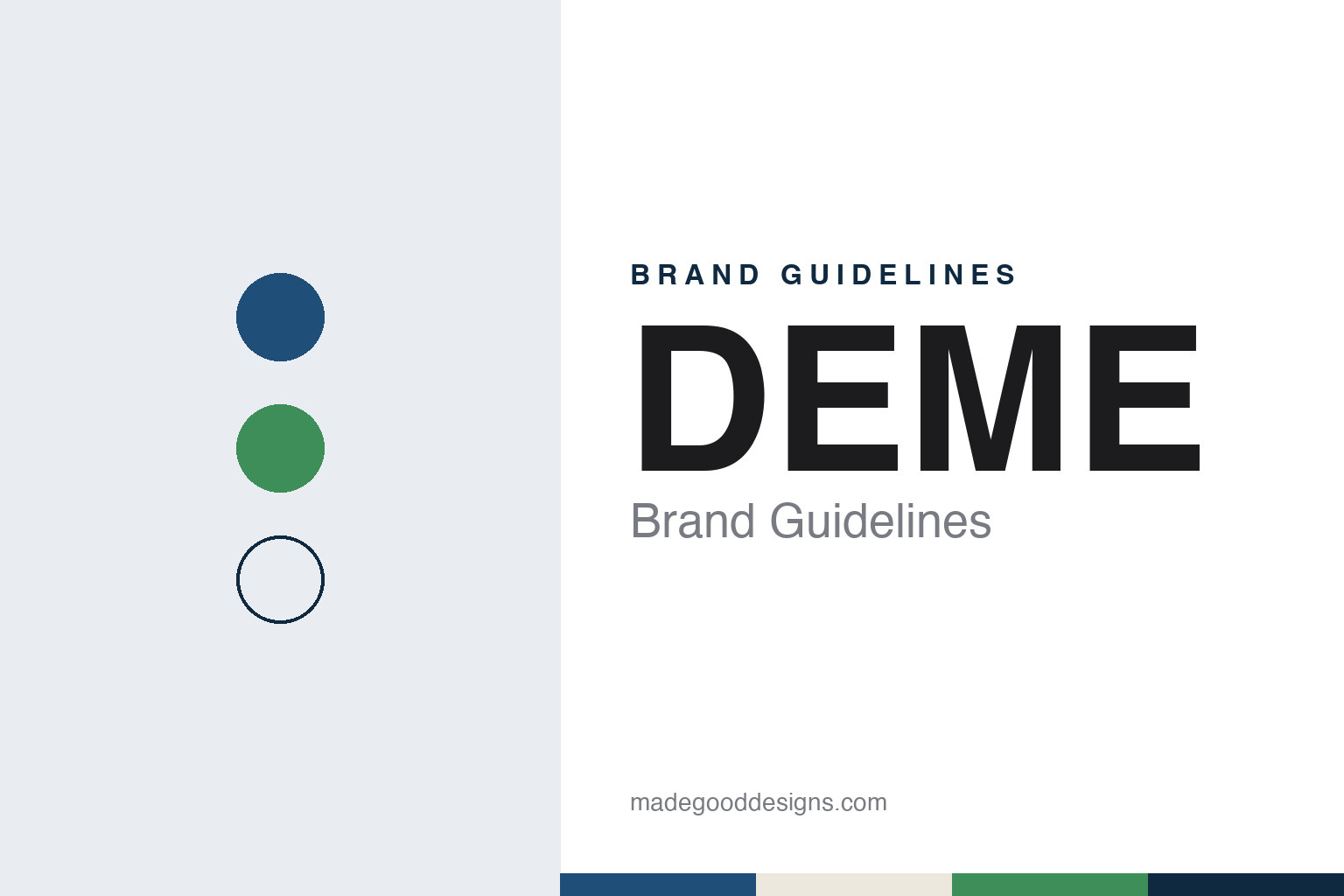
DEME Brand Guidelines
A Belgian dredging group whose mark sets water against land.
Aa
Two constants: a blue, green and sand palette and a marine sans register. Abstract homage — not a DEME vessel, product or mark; no logo or flag is reproduced.
Two dredgers
Dredging International and Decloedt, combined in 1991.
DEME, short for Dredging, Environmental and Marine Engineering, was formed in April 1991, Dutch Wikipedia says, when two Belgian dredging contractors, Dredging International and Baggerwerken Decloedt & Zoon, came together as one group. Its headquarters are in Zwijndrecht, in Belgium.
Its roots are older. English Wikipedia says Baggerwerken Decloedt had worked along the Belgian coast since 1875, the year French Wikipedia gives for its founding, and in 2026 the group marked a 150-year history, the trade site Dredgewire reported. Dredging International was itself a merger, dated 27 November 1974 by Dutch Wikipedia, of the dredging department of the Antwerp group Ackermans & van Haaren and the Société Générale de Dragage, incorporated in 1930. Sources differ on when Ackermans & van Haaren began: English Wikipedia gives 1852, French Wikipedia 1876. English Wikipedia says both predecessors worked on the main Belgian ports and on the channels of the North Sea and the Scheldt. The sources used for this guide do not say how its predecessors operated during the occupation of 1940–1944.
English Wikipedia says the De Cloedt family remained a major shareholder in Baggerwerken Decloedt & Zoon until 2000, and that Dredging International, the larger of the two founding companies, kept subsidiaries, branches and offices in countries from Spain and Portugal to India, Singapore, Australia and Brazil, as well as a holding in the Middle East Dredging Company.
French Wikipedia says Ackermans & van Haaren held 38% of DEME at the start and 50% by the end of the 1990s. Dutch Wikipedia says the Belgian construction group CFE later held all of DEME’s shares, until the two companies began trading separately on Euronext Brussels on 30 June 2022; it names Ackermans & van Haaren as the largest shareholder, followed by the French builder Vinci. Reporting in May 2025, gCaptain described DEME as listed on Euronext Brussels, with more than 5,800 employees.
Colour
Hoppers, cutters and wind installation ships.
DEME’s work falls into four segments, Dutch Wikipedia says: Offshore Energy, Dredging & Infra, Environmental and Concessions. The company’s website describes offshore energy, dredging, marine infrastructure and environmental works, plus concessions in offshore energy, maritime infrastructure, green hydrogen and deep-sea minerals, the last through its company Global Sea Mineral Resources. It says it has nearly 6,000 staff.
The fleet is the group’s public face. Dutch Wikipedia names Congo River, with a hopper volume of 30,000 cubic metres, as its largest trailing suction hopper dredger, and says the cutter suction dredger Spartacus, of 44,180 kilowatts, entered service in 2021. Dredgewire reported in October 2026 that Spartacus sailed from delivery straight to its first job, the Abu Qir development on Egypt’s Mediterranean coast, and that DEME had given a scale model of the ship to the Suez Canal Museum in Ismailia to mark seven decades of work on the canal, which began in 1955. English Wikipedia lists the cutter d’Artagnan, the heavy-lift vessel Orion, jack-up vessels including Innovation and Apollo, and the rock installation vessels Flintstone and Rolling Stone.
Offshore work grew through mergers and purchases. English Wikipedia says DEME Offshore was formed in 2019 from three earlier DEME companies, GeoSea, Tideway and A2Sea, and serves the wind and oil and gas industries. On 9 April 2025 DEME announced the purchase of the Norwegian offshore-wind installation contractor Havfram, and in May 2025 gCaptain reported the deal completed, with Havfram’s team joining DEME’s Offshore Energy segment and keeping its base in Oslo. Havfram was building two wind turbine installation vessels, gCaptain said; Dutch Wikipedia names them Norse Wind and Norse Energi and says they join the fleet in 2026.
Among the group’s projects, Dutch Wikipedia lists dredging on the Panama Canal, wind farms on the Thorntonbank off the Belgian coast and artificial islands off Abu Dhabi. In Antwerp, it says, DEME and Bopro won a contract to clean up the Petroleum-Zuid industrial site, later redeveloped as the Blue Gate business park.
Typography
Design and documentation.
Towage, salvage and dredging firms present themselves first through their ships. A tug, a salvage vessel or a dredger is the most visible thing such a company owns, and the hull, the superstructure and the funnel carry much of the identity: reds, oranges and yellows, deep navies and blacks, painted to be read at a distance across a working harbour. Funnel marks are an old shorthand. In Rotterdam, Dutch Wikipedia notes, Smit’s ocean tugs once wore a blue band on a black funnel and its harbour tugs a red one, until a single emblem of two yellow chain links on light blue replaced both in 1971.
Names do similar work. A vessel name on the bow identifies a ship and its owner, and naming rules can be traced in the record: Smit named its early ocean tugs after seas before switching to the prefix “Smit,” and Svitzer’s tugs carry the company name first, as with Svitzer Barrington. For a designer, the bow is a lettering problem with a fixed format, repeated across hundreds of hulls.
Behind the ships sits a printed and online register. Fleet lists and specification sheets give each vessel’s length, beam, draught and bollard pull in a consistent grid; project pages describe port works, land reclamation, wreck removal and offshore wind installations with dates, places and the vessels used; and annual and sustainability reports set out ownership, fleets and results year by year.
The guides in this group read each firm through that record: founding, ownership changes, named vessels and dated projects, taken from encyclopaedias, company pages and trade press. Each pairs the history with an unofficial palette and a Google Fonts stand-in; no logo, funnel mark or livery is reproduced.
Aa
A marine sans for a group of contractors. (Specimen set in Barlow, a sans STAND-IN; NOT the DEME logo.)
Creating land
A cutter head, a blue bar and a green one.
DEME’s slogan is “Creating land for the future,” and its company colours are blue and green, which English and Dutch Wikipedia both say stand for water and land. The logo shows the cutter head of a cutter suction dredger above a blue and green bar, according to the same articles. English Wikipedia adds that DEME’s operating companies share a common flag, colours and tagline, while each keeps its own identity, operating autonomy and legal structure.
The group is a collection of companies: Dredging International, Baggerwerken Decloedt & Zoon, DEME Offshore and DEME Environmental Contractors among them, according to English Wikipedia, which counted 71 companies, subsidiaries, branches and offices, and work in 42 countries in 2009. In 2026, Dredgewire reported, DEME was marking its 150th anniversary, and its website speaks of “150 years of experience.”
The company’s values page groups its message under three short phrases, “We care,” “We dare” and “We deliver,” and its website presents its work under the headings of offshore energy, dredging, marine infrastructure and environmental works.
For a design guide, DEME shows how a group of merged companies can share one mark, one flag and one pair of colours. Compare Jan De Nul, a family-owned Belgian dredging group, and Van Oord, a Dutch dredging company. For this guide we use a sea blue, a land green and a pale sand with a sans, an unofficial interpretation; no product or logo is reproduced.
Explore & save
Keep DEME’s identity on hand — save it to a board in the Made Good inspiration library.
DEME identity set
Save the DEME blue, green and sand palette and the marine sans register to your own board.