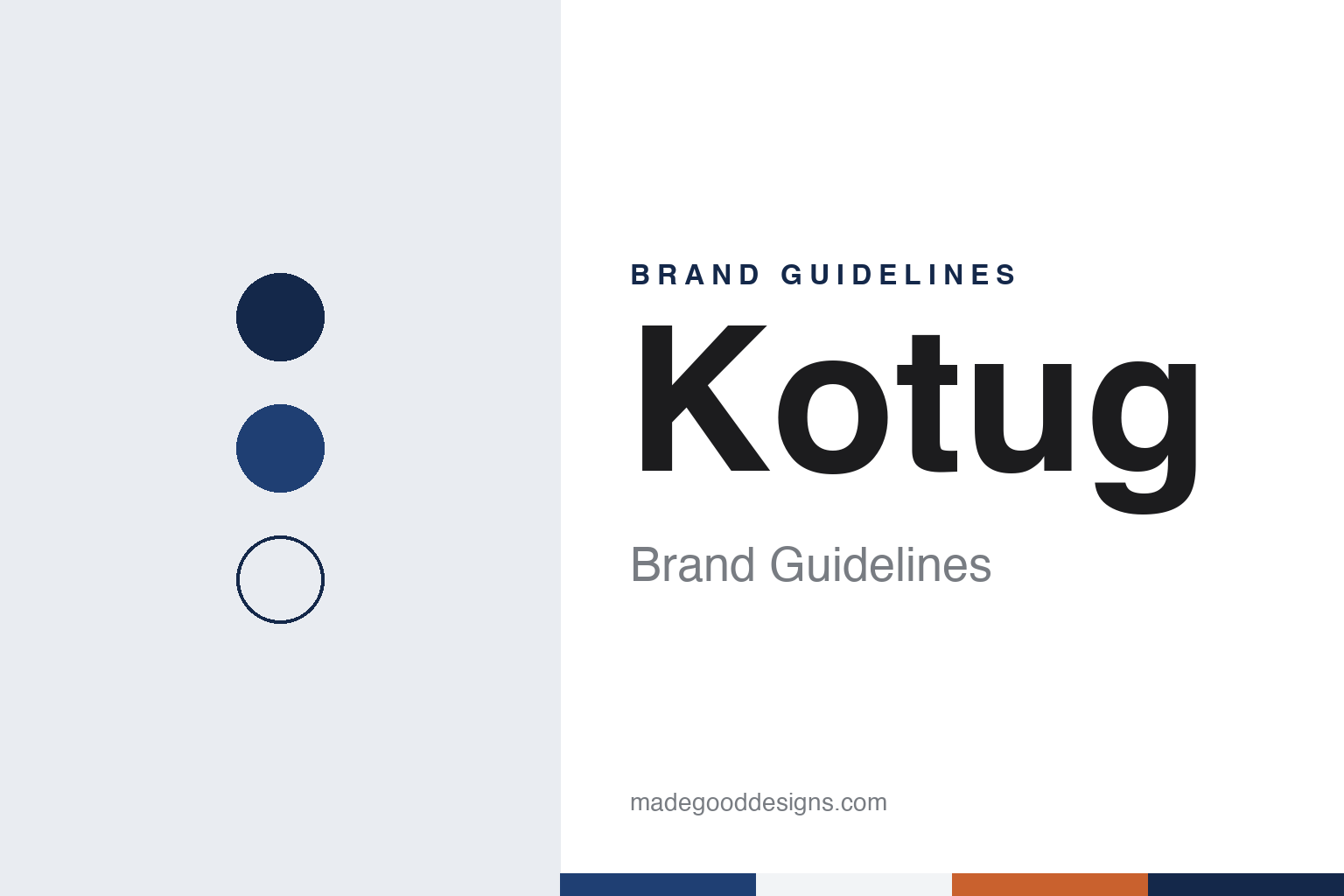
Kotug Brand Guidelines
A Rotterdam family towage company with a white K on its funnels.
Aa
Two constants: a funnel blue and white palette and a sturdy grotesque register. Abstract homage — not a Kotug vessel or mark; no funnel emblem, logo or livery is reproduced.
The Kooren tugs
Four generations of a Rotterdam towage family.
Kotug is a Rotterdam towage company run by the Kooren family, and it dates its roots to 1911, when, the company says, Antonie Kooren built his first tug. After working for the Rotterdam towage firms Stoomsleepdienst Maas and Rotterdamse Sleepdienst, he set up on his own and in 1919 bought a tug named “Corrie”. From that moment, the company’s history page says, a white “K” appeared on the funnels of the family’s tugs, which worked mainly in towage and dredging.
His son Adriaan Kooren registered as an independent towing agent, working mostly in offshore and dredging jobs, and in 1934 registered his own towage company, Sleepdienst Adriaan Kooren, and bought a third tug, “Brabantia”, later renamed “Antonie”. The company says the family kept its tugs “Frans” and “Adriaan” through the Second World War. The sources used for this guide do not say how the Kooren family’s towage businesses operated during the occupation of 1940–1945.
After the war, Antonie Kooren and his five sons joined forces in a tug company, with Adriaan working from a wooden office on the Boompjeskade in Rotterdam, the company says. From 1953 to 1986 Sleepdienst Adriaan Kooren carried out dredging transports as a main contractor on the Deltawerken, the Delta Works in Zeeland.
The third generation widened the map. In 1977 Ton Kooren started Ton Kooren International Marine Services, mainly for worldwide and deep-sea towage, and in 1986 he took over his father’s company; both were grouped with other family firms in a holding, Kooren International. In 1988 the family founded KOTUG International B.V., gradually merging the two companies, and began harbour towage in Rotterdam with a new fleet of Z-peller tugs from the United States. Ton Kooren’s son Ard-Jan Kooren, the fourth generation, has been president and chief executive since 2002, the company says.
Colour
Three thrusters, two forward and one aft.
Kotug’s signature vessel is the Rotortug. Its own website says Rotortug was established in 1996 as the shipbuilding and trading arm of KOTUG International, and describes a “patented triangular propulsion configuration” of three thrusters, two in the fore ship and one aft. In 2012, the same page says, Rotortug teamed up with the Canadian naval architect Robert Allan, whose team designed the Advanced Rotortug series; the company says a Rotortug can be built at any yard. In June 2018 The Maritime Executive described the layout the same way — three Z-drive thrusters, two forward and one aft — when it reported that a Kotug captain, at the ITS trade show in Marseille, had remotely piloted the miniature training Rotortug RT Borkum in Rotterdam, about 600 miles away, in what Kotug believed was the first long-distance remote-controlled tug operation.
The fleet names follow the type: Kotug’s Rotortugs carry the prefix RT. In January 2020, the company says, RT Spirit and RT Magic gave salvage assistance to the container ship EM Oinousses off Nacala, Mozambique, after a fire in its engine room; in December 2020 RT Zoe and RT Margo pushed the grounded bulk carrier Cosco Kunlunshan free of the bank at Douala, in Cameroon.
Much of the work is far from Rotterdam. In March 2014 Maritime Journal reported that Shell Australia had given KT Maritime Services Australia — a joint venture of KOTUG International and Teekay Shipping Australia, incorporated in July 2012 — a contract to design, build and run three 42-metre infield support vessels of 100 tonnes bollard pull for the Prelude FLNG project, operating out of the Port of Broome. Kotug says it took full ownership of that business in 2018 and renamed it Kotug Maritime Services Australia in 2019.
Kotug has also pushed new equipment into service. It won the Maritime Innovation Award 2017 at the Maritime Award Gala for a heat recovery system fitted on the tug ZP Bison, it says; a 2026 company statement credits it with bringing hybrid tugs to Rotterdam from 2012, and in 2021 it launched an inland shipping division with electric push boats.
Typography
Hull colours, funnel marks and fleet lists.
Towage, salvage and dredging firms present themselves first through their ships. A tug, a salvage vessel or a dredger is the most visible thing such a company owns, and the hull, the superstructure and the funnel carry much of the identity: reds, oranges and yellows, deep navies and blacks, painted to be read at a distance across a working harbour. Funnel marks are an old shorthand. In Rotterdam, Dutch Wikipedia notes, Smit’s ocean tugs once wore a blue band on a black funnel and its harbour tugs a red one, until a single emblem of two yellow chain links on light blue replaced both in 1971.
Names do similar work. A vessel name on the bow identifies a ship and its owner, and naming rules can be traced in the record: Smit named its early ocean tugs after seas before switching to the prefix “Smit,” and Svitzer’s tugs carry the company name first, as with Svitzer Barrington. For a designer, the bow is a lettering problem with a fixed format, repeated across hundreds of hulls.
Behind the ships sits a printed and online register. Fleet lists and specification sheets give each vessel’s length, beam, draught and bollard pull in a consistent grid; project pages describe port works, land reclamation, wreck removal and offshore wind installations with dates, places and the vessels used; and annual and sustainability reports set out ownership, fleets and results year by year.
The guides in this group read each firm through that record: founding, ownership changes, named vessels and dated projects, taken from encyclopaedias, company pages and trade press. Each pairs the history with an unofficial palette and a Google Fonts stand-in; no logo, funnel mark or livery is reproduced.
Aa
A sturdy grotesque — workmanlike, like a name painted on a bow. (Specimen set in Archivo, a sans STAND-IN; NOT the Kotug logo.)
Kotug Smit and after
A white K on a blue funnel.
For three years Kotug shared its European harbour work. On 7 April 2016, Kotug announced, it and Royal Boskalis Westminster formalised a 50/50 joint venture combining the European harbour towage of Kotug and Boskalis’s subsidiary SMIT; to keep both names, the business traded as Kotug Smit Towage, with 65 tugs in 11 ports in Belgium, Germany, the Netherlands and the United Kingdom, while both partners’ work elsewhere stayed outside it. On 4 March 2019 the two owners signed a letter of intent to sell their shares to the Spanish Boluda group, and on 31 July 2019 Kotug said the sale had been concluded. Boluda’s European towage arm dates the change to August 2019, so the joint venture ran from 2016 to 2019.
Kotug then grew outside Europe. It formed Kotug Seabulk Maritime with Seabulk Towing at Freeport in the Bahamas in 2017 and Kotug Canada with Horizon Maritime in 2019, bought the single-point-mooring specialist Marsol International in 2020 and, from October 2020, supported floating production at the Liza field off Guyana with the anchor-handling tug SD Power, according to its own history. In April 2022 gCaptain reported an agreement to buy Seaways International of Dubai, an operator of anchor-handling tugs, crew boats and barges in West Africa, which it called the largest acquisition in Kotug’s more than 100-year family-owned history; in September 2022 a Kotug announcement published by The Maritime Executive said the deal had closed and Seaways was a wholly owned subsidiary.
The visual identity rests on one letter. The company says that its 1988 relaunch introduced the colour of the tugs and the white K emblem on blue funnels, a mark the family had carried in some form since 1919; on the water, the RT prefix on each Rotortug repeats the brand.
For a design guide, Kotug shows how a single letter on a funnel can carry a family business through four generations. Compare SMIT, its partner in Kotug Smit Towage, and Boluda, which bought the joint venture in 2019. For this guide we use a funnel blue, white and a towline orange with a sans, an unofficial interpretation; no product or logo is reproduced.
Explore & save
Keep Kotug’s identity on hand — save it to a board in the Made Good inspiration library.
Kotug identity set
Save the Kotug funnel blue, white and orange palette and the sturdy grotesque register to your own board.