Boskalis Brand Guidelines
A Sliedrecht dredging firm of 1910 that grew into a marine group.
Aa
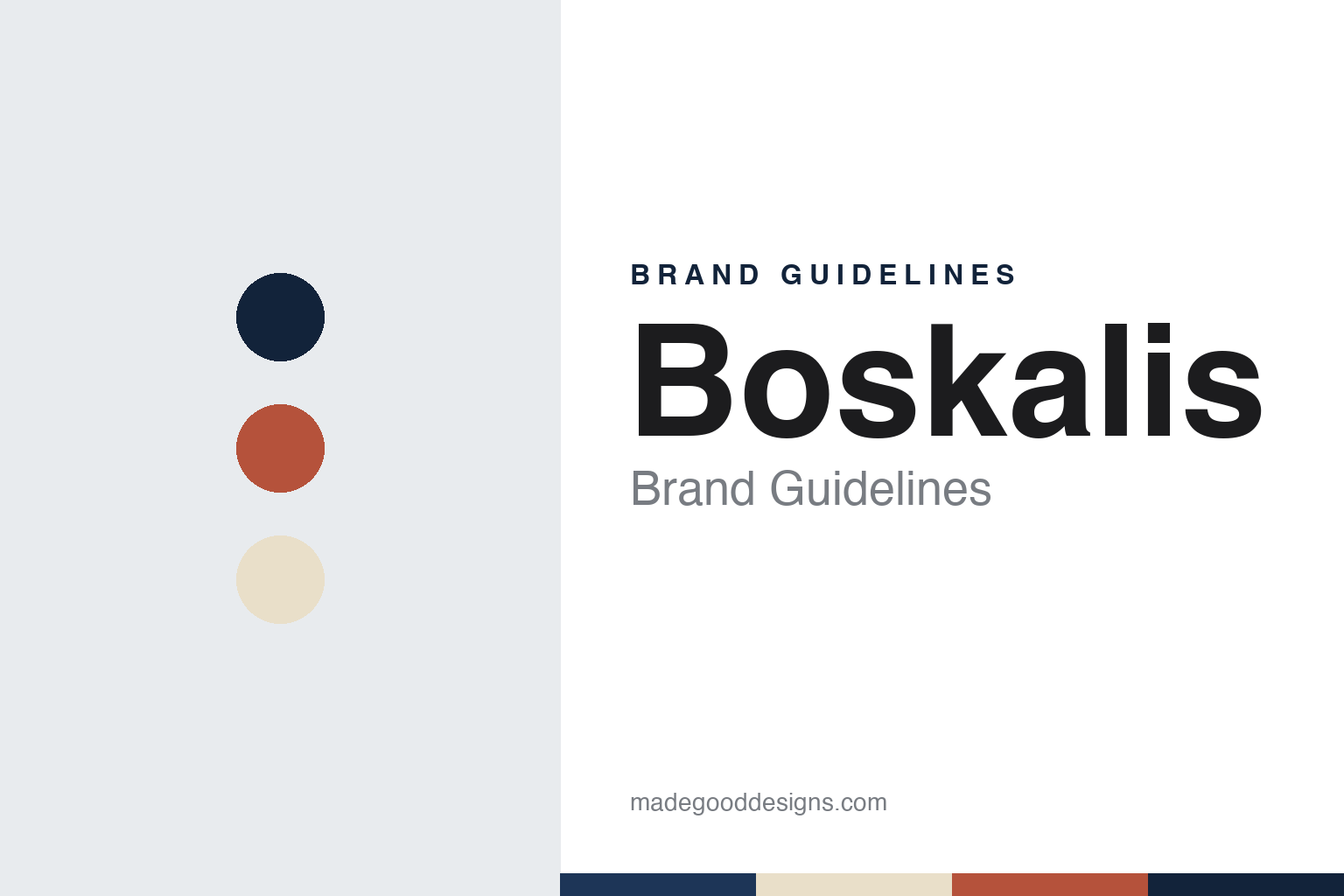
Two constants: a harbour navy, clay and sand palette and an engineering sans register. Abstract homage — not a Boskalis vessel, livery or mark; no logo or funnel mark is reproduced.
Bos and Kalis
Sliedrecht families, a small fleet and the Zuiderzee.
Boskalis began in 1910 in Sliedrecht, the river town on the Merwede that the company calls the birthplace of the Dutch dredging industry. Dutch Wikipedia says three Sliedrecht dredgers, Johannes Kraaijeveld, Eliza van Noordenne and Gerrit Jan Bos, set up the firm Kraaijeveld en Van Noordenne that year, already with a small fleet of dredging equipment; in November 2010 NRC Handelsblad traced the company to the family businesses of the Bos and Kalis families of Sliedrecht. By 1920, Dutch Wikipedia says, the firm had seven bucket dredgers, three suction dredgers, two tugs and a floating sheerlegs named Hercules.
The name followed the partners. After Van Noordenne left in 1924 the firm traded as Joh. Kraaijeveld; in 1930 it became a limited company, and it later took the name NV Baggermaatschappij Bos & Kalis, the source of the word Boskalis. After the First World War it worked on the Zuiderzee Works, the Dutch enclosure and reclamation scheme, and in 1933 it set up the Westminster Dredging Company in London. Dutch Wikipedia calls that British subsidiary a lucrative second home market; from the 1950s it won work across the Commonwealth, including Australia and Canada, and in the Middle East.
The sources used for this guide do not say how Boskalis operated during the occupation of 1940–1945. The company’s own timeline resumes in 1948, when it says it put the first diesel-electric bucket dredger into service.
The North Sea flood of 1953 led to the Delta Works, and Boskalis says it played a major role there, above all in complex coastal-defence techniques. The same year it put the trailing suction hopper dredger James 47 into service, which it describes as the first of its type in Europe. Boskalis shares were listed in Amsterdam in 1971, according to the company and Dutch Wikipedia (English Wikipedia gives 1970), and the company received the designation “Royal” in 1978.
Colour
SMIT, Dockwise and a single name.
The 1980s were difficult. Dutch Wikipedia says Boskalis came close to bankruptcy in the middle of the decade after large works in Argentina went unpaid; the company says it came through the recession by concentrating on dredging, and it bought the Dutch dredging firms Breejenbout in 1985 and Zanen Verstoep in 1988. In the 1990s it worked on the Øresund tunnel, a port at Bahía Blanca in Argentina, and the land reclamation for Hong Kong’s airport at Chek Lap Kok, along with several reclamation projects in Singapore.
The largest change came through acquisition. Boskalis made an offer for SMIT Internationale, the Rotterdam towage and salvage company, in September 2008, stepped back that December, and agreed a merger on 12 November 2009 that shareholders approved in March 2010, Dutch Wikipedia says; SMIT activities kept their own name inside the group (see the SMIT guide). Harbour towage ran through joint ventures: Keppel Smit Towage in Asia, Saam Smit Towage in the Americas and Kotug Smit Towage in north-west Europe, agreed with Kotug in December 2015. Boskalis completed the sale of its SAAM SMIT Towage stake on 30 October 2019, and English Wikipedia says it also left the Kotug and Keppel ventures as it withdrew from harbour towage. The terminal-services business Smit Lamnalco stayed; the company’s timeline lists its purchase of the remaining shares in 2024.
Offshore work grew alongside. In 2013 Boskalis bought the heavy marine transport specialist Dockwise and half of the cable installer VBMS, fully owned from 2016; it added Fairmount Marine, for long-distance ocean towage, in 2014, the dredging business of Strabag Wasserbau in Germany in 2016, the survey group Gardline in 2017 and Rever Offshore, formerly Bibby Offshore, in 2021. From April 2018, the company says, Dockwise, VBMS and Fairmount worked under the single name Boskalis.
Named jobs and ships run through the record. In March 2021 SMIT Salvage helped refloat the container ship Ever Given, which blocked the Suez Canal from 23 to 29 March, according to both Wikipedias. In December 2020 Boskalis won what Dutch Wikipedia calls the largest order in its history: about 1,700 hectares of reclamation for the New Manila International Airport. In November 2026 Dredging Today reported that the trailing suction hopper dredger Freeway had finished a series of short campaigns at the port of Barrow in the United Kingdom, work carried out through Boskalis Westminster.
Typography
Hulls, fleets and project pages.
Towage, salvage and dredging firms present themselves first through their ships. A tug, a salvage vessel or a dredger is the most visible thing such a company owns, and the hull, the superstructure and the funnel carry much of the identity: reds, oranges and yellows, deep navies and blacks, painted to be read at a distance across a working harbour. Funnel marks are an old shorthand. In Rotterdam, Dutch Wikipedia notes, Smit’s ocean tugs once wore a blue band on a black funnel and its harbour tugs a red one, until a single emblem of two yellow chain links on light blue replaced both in 1971.
Names do similar work. A vessel name on the bow identifies a ship and its owner, and naming rules can be traced in the record: Smit named its early ocean tugs after seas before switching to the prefix “Smit,” and Svitzer’s tugs carry the company name first, as with Svitzer Barrington. For a designer, the bow is a lettering problem with a fixed format, repeated across hundreds of hulls.
Behind the ships sits a printed and online register. Fleet lists and specification sheets give each vessel’s length, beam, draught and bollard pull in a consistent grid; project pages describe port works, land reclamation, wreck removal and offshore wind installations with dates, places and the vessels used; and annual and sustainability reports set out ownership, fleets and results year by year.
The guides in this group read each firm through that record: founding, ownership changes, named vessels and dated projects, taken from encyclopaedias, company pages and trade press. Each pairs the history with an unofficial palette and a Google Fonts stand-in; no logo, funnel mark or livery is reproduced.
Aa
An engineering sans for a contractor’s register. (Specimen set in Archivo, a sans STAND-IN; NOT the Boskalis logo.)
Boskalis
From Amsterdam listing to HAL ownership.
Ownership closed the public chapter. The investment company HAL Investments, already the largest shareholder in 2004 according to Dutch Wikipedia, held 45 percent when it made an offer for all Boskalis shares on 10 March 2022. By 21 September 2022 it held 98.3 percent, and the listing on Euronext Amsterdam ended on 9 November 2022. Royal Boskalis is now a privately held B.V. with its head office in Papendrecht, across the river from Sliedrecht. The company describes a fleet of about 400 vessels and projects in 90 countries, and groups its work into dredging and inland infrastructure, offshore energy, and towage and salvage.
Its history is unusually well documented for a contractor. For the centenary in 2010 the company published Verdiept Verleden, a 455-page history by Bram Bouwens and Keetie Sluyterman, researched at Utrecht University and published by Boom, which NRC Handelsblad described in an interview with the then chief executive in November 2010.
For a design guide, Boskalis shows how a family dredging firm became a group of many names and then folded most of them back under one. Compare SMIT, the salvage name it kept, and Van Oord, its Dutch counterpart in dredging. For this guide we use a harbour navy, a clay red and a fill-sand tone with a sans, an unofficial interpretation; no product or logo is reproduced.
Explore & save
Keep Boskalis’s identity on hand — save it to a board in the Made Good inspiration library.
Boskalis identity set
Pin the Boskalis harbour navy, clay and sand palette and the engineering sans register to your own board.