Accion Brand Guidelines
The 1961 volunteer project that turned to lending and then to investing.
Aa
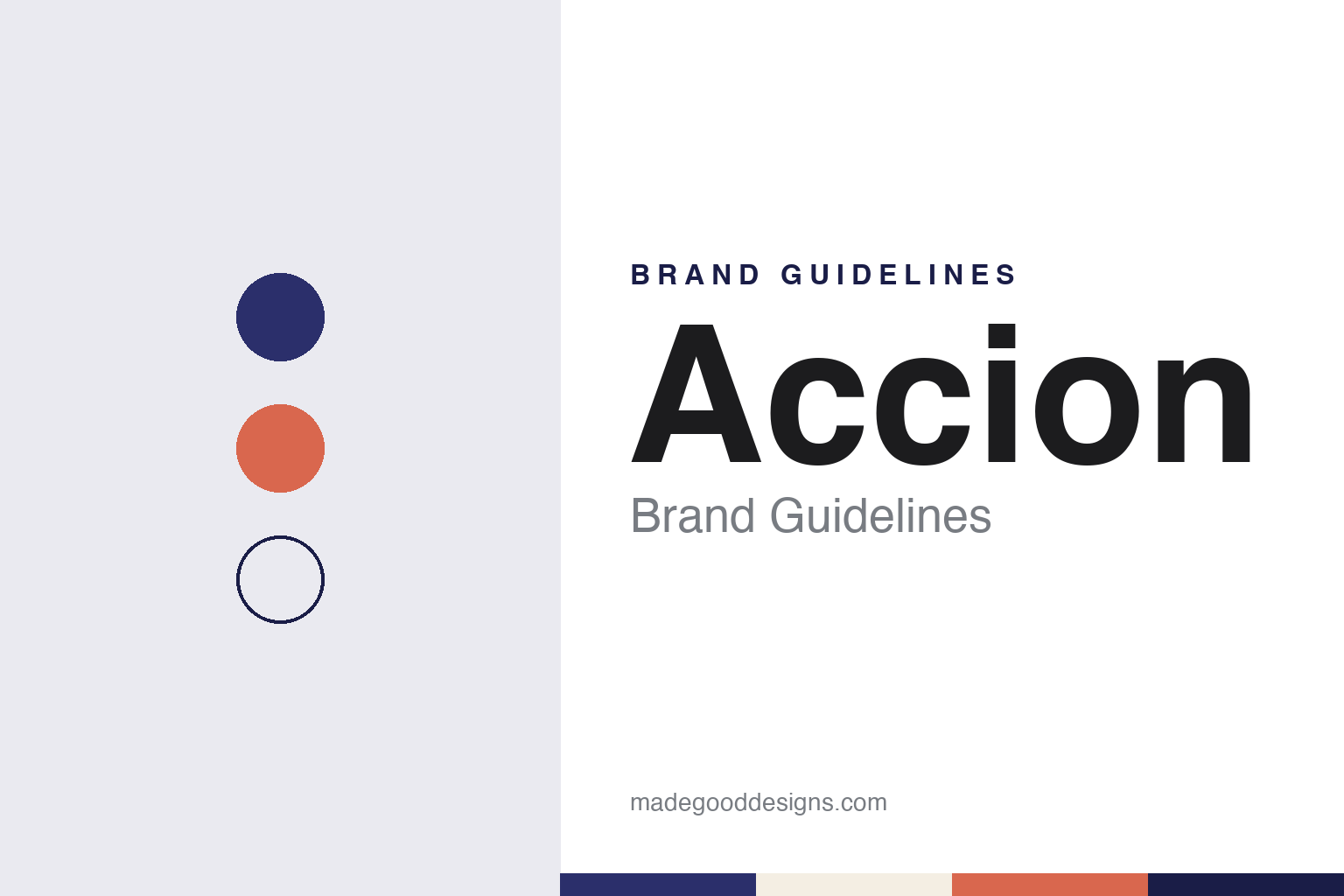
Two constants: an indigo, coral and cream palette and a soft modern serif register. Abstract homage — not an Accion product or mark; no logo or wordmark is reproduced.
Barrio projects
Thirty volunteers and a law student’s idea.
Accion began in 1961 as a volunteer project. English Wikipedia says it was founded by Joseph Blatchford, then a law student at the University of California, Berkeley, who recruited two fellow students, Jerry Brady and Gary Glenn, to run recruitment, publicity and training at home while he built contacts in Latin America. In the summer of 1961 the first group of 30 Americans went to work in urban barrios in Venezuela.
The early projects were whatever the communities chose. Wikipedia lists digging ditches, building schools, fund-raising and negotiating between rival local leaders, and says that by the mid-1960s Accion was hiring college-educated Venezuelans as organisers instead of volunteers from North America and Europe. Through the decade Blatchford and colleagues worked with local business people to set up similar community organisations in Argentina, Brazil and Peru; the Peruvian one is today Mibanco, Wikipedia says. Accion also opened an office in New York to support funders who wanted to start such programmes.
The turn to lending came in the 1970s. In 1973, according to Wikipedia, Accion staff in Recife, Brazil, began working with informal businesses, and an Accion organisation there called UNO coined the term “microenterprise” and began making small loans. Accion’s own history page describes the Recife work as the start of its microlending in Latin America, and says that in the 1980s it helped start microfinance programmes in 14 Latin American countries and set up a loan guarantee fund, the Accion Bridge Fund. Wikipedia says the guarantees helped Accion’s partners connect with local banks.
Colour
From guarantees to a bank of its own.
In 1991 Accion brought its lending model to the United States with a pilot programme in Brooklyn, New York. Its American lending now runs through Accion Opportunity Fund, a nonprofit small-business lender, according to Accion’s website.
The step that changed the field came in 1992, when Accion helped found BancoSol in Bolivia. Wikipedia calls it the first commercial bank dedicated solely to microenterprise, Accion makes a similar claim, and El Español repeated the description in June 2026, quoting Accion’s president and chief executive, Michael Schlein: until then, he said, microfinance had been run on a nonprofit basis, and BancoSol showed it could draw on capital markets. Wikipedia adds that in 1994 Accion helped BancoSol sell certificates of deposit in the United States.
Capital became Accion’s main tool. In 1995 it created an equity vehicle, the Accion Gateway Fund, Wikipedia says, and in 2003 it set up Accion Investments in Microfinance, which its history page describes as a global equity fund for the sector. In 2007 the Mexican lender Compartamos, an Accion investee, held an initial public offering, the first by a Latin American microfinance institution according to Wikipedia. The listing set off an industry debate over profit in microfinance, which Wikipedia records from both sides. Accion used the proceeds to start new lenders in Brazil, Cameroon, China, Ghana and India, and to found the Center for Financial Inclusion, a think tank in Washington, in 2008.
The work also spread beyond the Americas. Wikipedia dates Accion’s first partnerships in sub-Saharan Africa to October 2000, followed by a 2006 partnership with Ecobank that led to a savings and loans company in Ghana in 2007, an Indian programme from 2005, and Accion Microfinance China in Inner Mongolia, opened in December 2009 and later handed to a Hong Kong holding company, Grassland Finance. In April 2015 it partnered with DAWN in Myanmar, a lender first set up in 2002 as a Save the Children programme.
Typography
How microfinance lenders present themselves.
Microfinance lenders present themselves less through products than through method. Grameen Bank’s website opens on its line “A bank for the poor” and describes loans made without collateral, with all transactions except disbursement handled at village-level centres. ASA International sets out the “ASA Model” on a page of its own, from the size of a branch to the rhythm of weekly or fortnightly collections. For these institutions the method is the brand.
Their websites are built around networks and products. They publish branch, client and village counts as dated figures, offer branch locators, and list named loans for small businesses, crops, livestock, housing and education, alongside savings accounts, pension schemes and insurance. Newer pages describe digital wallets and digital financial services, sometimes launched market by market. Where a lender’s pages show small shops, farms or field officers at work, this guide describes them in words rather than reproducing them.
Documentation is a large part of the look. Lenders publish annual reports, monthly reports, governance pages and pages on social performance or impact, and listed groups add investor sections and regulatory news. Regulators are part of the picture too: in Bangladesh, the economist Mustafa K Mujeri wrote in The Daily Star in 2025, non-governmental lenders are licensed by the Microcredit Regulatory Authority, set up under an act of 2006. Claims about what microcredit achieves are the lenders’ own, or those of prize committees and researchers, and are contested in the research literature.
This guide reads each lender from its own pages and from dated outside sources: who founded it, how its lending works, and how its name is used. The palettes here — warm oranges, greens and blues — are our own unofficial interpretations, not the lenders’ published values, and no logo, photograph or document is reproduced.
Aa
A soft modern serif for a single-word name. (Specimen set in Fraunces, a serif STAND-IN; NOT the Accion logo.)
Accion
A nonprofit that invests.
Since 2012 Accion’s investing has become the centre of the brand. In April 2012 it launched Accion Venture Lab, a seed-stage programme for financial-technology start-ups serving people outside the banking system, Wikipedia says. Renamed Accion Ventures, it has backed more than 80 early-stage start-ups in over 30 countries, according to Accion, a figure El Español also gave in June 2026. Accion’s history page dates the launch of the Accion Frontier Inclusion Fund, managed by Quona Capital, to 2015, while Wikipedia dates the fund’s announcement to March 2017; Accion is its sponsor and anchor investor.
Accion’s website now groups the investing under Accion Impact Management, with strategies named Accion Ventures, Accion Emerge for growth-stage companies, and Accion Digital Transformation for established financial institutions, alongside the Quona partnership and an advisory unit, Accion Advisory. Accion says it has helped build 299 financial service providers in 77 countries. The nonprofit is headquartered in Cambridge, Massachusetts, with offices in Washington, D.C., Bogotá, Mumbai and Beijing, according to Wikipedia, and it marked its 65th anniversary with a gala in New York on 20 May 2026, El Español reported.
The Accion name has been kept through each of these shifts, from volunteer corps to lender, to bank founder and to fund sponsor. The website describes the mission as building “a fair and inclusive economy.”
For a design guide, Accion shows how one short word can stretch from barrio projects to venture funds without a change of name. Compare Compartamos, the Mexican lender Accion backed before its 2007 listing, and Mibanco, which grew from Accion’s Peruvian programme. For this guide we use a deep indigo, a coral and cream with a serif, an unofficial interpretation; no product or logo is reproduced.
Explore & save
Keep Accion’s identity on hand — save it to a board in the Made Good inspiration library.
Accion identity set
Pin the Accion indigo, coral and cream palette and the soft modern serif register to your own board.