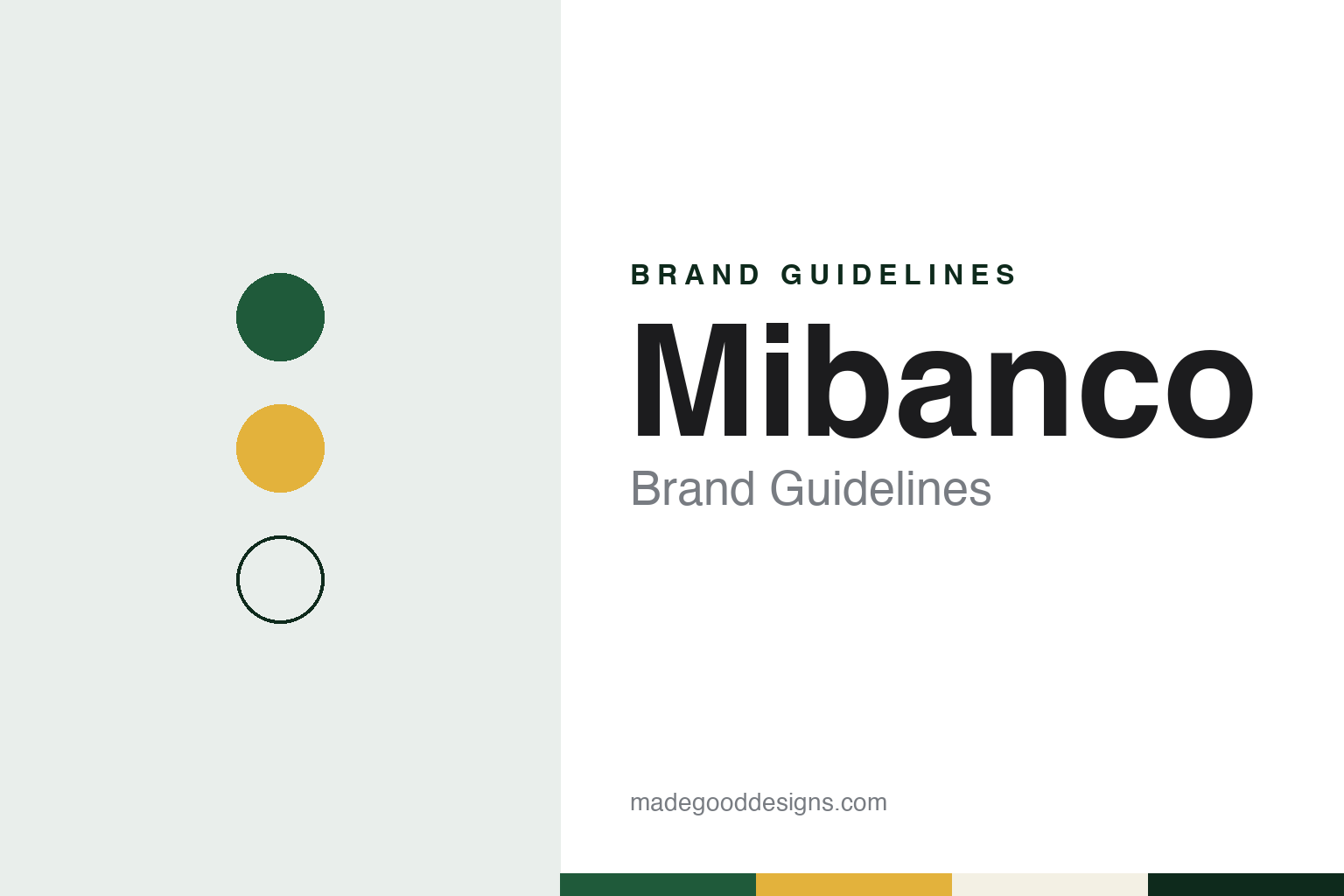
Mibanco Brand Guidelines
Lima’s microenterprise bank, from an NGO’s lending arm to Credicorp.
Aa
Two constants: an Andean green and maize palette and a geometric sans register. Abstract homage — not a Mibanco product or mark; no logo or card is reproduced.
Banco de la Microempresa
A bank built on an NGO’s lending.
Mibanco’s full name says what it is for: Mibanco, Banco de la Microempresa S.A., the microenterprise bank, based in Lima. The bank’s own timeline gives 1998 as the year it was born, and the Peruvian broadcaster América TV reported in February 2014 that it had then been in the market as Mibanco for 15 years.
Its roots are older. The same América TV report said Mibanco’s origins went back 45 years to Acción Comunitaria del Perú, or ACP, a Peruvian social organisation, and that the bank still belonged to Grupo ACP in early 2014. When the sale was announced, El Comercio wrote that both Mibanco and its eventual partner, Financiera Edyficar, had their origins in social-development initiatives and had been created more than 15 years earlier.
The bank describes its customers as people who dare to grow. Its “about us” page opens with “Creemos en quienes se atreven a crecer” — we believe in those who dare to grow — and its sign-off line is “Tu valentía tiene un banco”, your courage has a bank. It says its purpose is to transform people’s lives through their financial inclusion and progress, and that it aims to be the leading bank for Peru’s micro-entrepreneurs; those are the bank’s own aims, not measured outcomes.
Mibanco also describes itself as the number one bank in microfinance in Peru and Latin America. That ranking is the bank’s own claim, on its website in 2026.
Colour
Edyficar, Credicorp and one name.
The ownership change came in 2014. On 10 February that year El Comercio reported that Financiera Edyficar, the microfinance company of Credicorp, the Peruvian financial group, had agreed to buy 60.68 per cent of Mibanco from Grupo ACP, subject to approval by the banking regulator, the Superintendencia de Banca, Seguros y AFP (SBS). Grupo ACP’s board had agreed the sale on 6 February.
The SBS gave its authorisation in March 2014, El Comercio reported on 12 March, and in April Gestión reported that Edyficar had raised its holding further through additional share purchases, with another Credicorp company also buying a stake. Until approval, the two lenders had said they would keep operating separately.
A year later the two brands became one. On 27 February 2015 RPP reported that the SBS had approved the plan under which Mibanco would absorb almost all the assets and liabilities of Financiera Edyficar. Mibanco’s management told RPP that the combined network would have 328 service points: Mibanco’s 114 branches, Edyficar’s 175 offices and 39 shared branches of Banco de la Nación. The surviving name was Mibanco; the bank’s own timeline records 2015 as the year “Mibanco and Edyficar unite as the new Mibanco.”
Mibanco remained part of Credicorp in 2026. In May that year Gestión reported that the boards of Credicorp and of Mibanco, Banco de la Microempresa, had named a new general manager for the bank and a new head of Credicorp’s microfinance line, both from 1 October 2026.
Typography
Design and documentation.
Microfinance lenders present themselves less through products than through method. Grameen Bank’s website opens on its line “A bank for the poor” and describes loans made without collateral, with all transactions except disbursement handled at village-level centres. ASA International sets out the “ASA Model” on a page of its own, from the size of a branch to the rhythm of weekly or fortnightly collections. For these institutions the method is the brand.
Their websites are built around networks and products. They publish branch, client and village counts as dated figures, offer branch locators, and list named loans for small businesses, crops, livestock, housing and education, alongside savings accounts, pension schemes and insurance. Newer pages describe digital wallets and digital financial services, sometimes launched market by market. Where a lender’s pages show small shops, farms or field officers at work, this guide describes them in words rather than reproducing them.
Documentation is a large part of the look. Lenders publish annual reports, monthly reports, governance pages and pages on social performance or impact, and listed groups add investor sections and regulatory news. Regulators are part of the picture too: in Bangladesh, the economist Mustafa K Mujeri wrote in The Daily Star in 2025, non-governmental lenders are licensed by the Microcredit Regulatory Authority, set up under an act of 2006. Claims about what microcredit achieves are the lenders’ own, or those of prize committees and researchers, and are contested in the research literature.
This guide reads each lender from its own pages and from dated outside sources: who founded it, how its lending works, and how its name is used. The palettes here — warm oranges, greens and blues — are our own unofficial interpretations, not the lenders’ published values, and no logo, photograph or document is reproduced.
Aa
A clear geometric sans for a bank that speaks to shop owners. (Specimen set in Outfit, a sans STAND-IN; NOT the Mibanco logo.)
Mibanco
“Tu valentía tiene un banco.”
The name travelled to Colombia in 2020. In November that year the Colombian magazine Semana reported that Mibanco, Credicorp’s microfinance business, had begun operating in Colombia after the merger by absorption of Bancompartir, as the absorbing company, and the Colombian Edyficar, which were integrated under the Mibanco name. Semana said the merged lender served clients in 82 Colombian cities. It runs its own website, separate from the Peruvian bank’s, so the two should not be confused. The bank told Semana that it would keep a direct relationship with owners of micro and small businesses and aimed to reach entrepreneurs in the informal economy, who, the magazine wrote, often turn to informal daily lenders known as “gota a gota”.
In Peru, the bank’s products are named in plain, everyday Spanish. Its website lists working-capital loans to grow a business, Crédito Mujer for women, Efectivo Altoque for fast cash and loans for building or buying a home, alongside savings accounts, current accounts, remittances, a mobile app and Mibanco por WhatsApp, which it describes as like going to the bank but in WhatsApp. Its education pages run under the name Academia del progreso, and its social programmes include Mi Consultor, which brings university students to small businesses for advice, Mujeres Poderosas and the volunteering scheme Munay.
Marketing has been part of the story too. Mibanco’s timeline says it was among the two most valued brands in Peru in 2017 and won a Gran Effie and a gold Effie, the advertising-effectiveness awards, in 2018; it also lists a microfinance award from the magazine Global Banking & Finance Review in 2016. Those are the bank’s own records.
For a design guide, Mibanco shows how a merger can end with one plain, first-person name — “my bank” — for the combined business. Compare Compartamos, the Mexican group’s lender that also operates as a bank in Peru, and Bancolombia, a bank in the Colombian market Mibanco entered in 2020. For this guide we use an Andean green and a maize yellow with a sans, an unofficial interpretation; no product or logo is reproduced.
Explore & save
Keep Mibanco’s identity on hand — save it to a board in the Made Good inspiration library.
Mibanco identity set
Pin the Mibanco Andean green and maize palette and the geometric sans register to your own board.