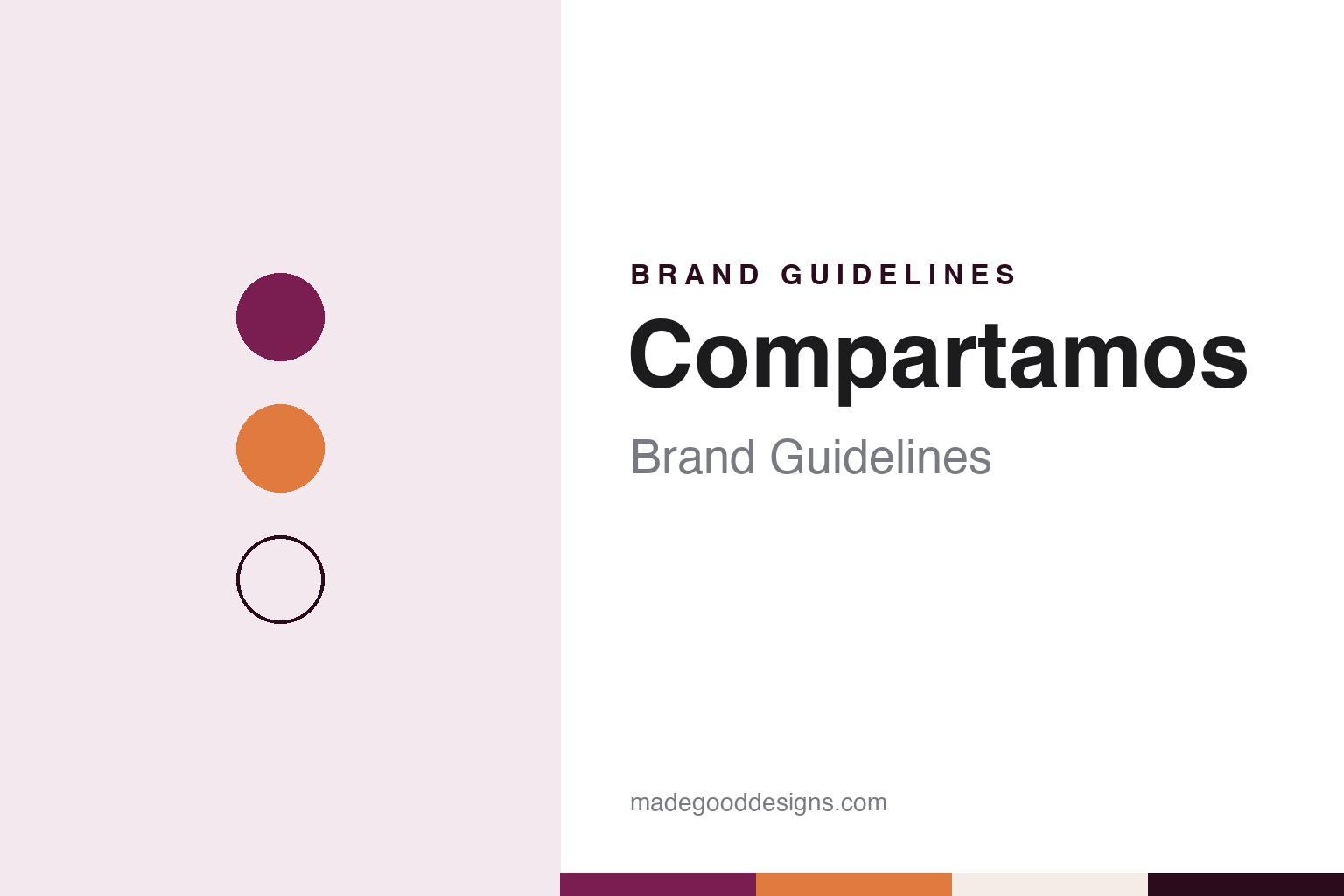
Compartamos Brand Guidelines
A Mexican NGO of 1990 that became a listed bank and then the Gentera group.
Aa
Two constants: a plum and market-orange palette and a friendly sans register. Abstract homage — not a Compartamos product or mark; no logo or card is reproduced.
From an NGO
Food parcels, then village banking.
Compartamos began as a charity, not a bank. In December 2025 Forbes México wrote that the group now called Gentera “emerged in Mexico 35 years ago as an NGO”, which puts its start in 1990. Its first work, the magazine said, was handing out food parcels and supplies, mainly in the south-east of the country.
The change came when the organisation copied a model of communal banks and small loans for productive work that had been used in Central America and Bangladesh, according to the group’s chief executive in the same Forbes México piece. That lending programme took the name Compartamos, Spanish for “let us share”, and the name stayed as the organisation turned into a regulated lender.
Group lending is still central to how the brand describes itself. In a July 2025 press release for its 35th anniversary, a senior executive of Banco Compartamos said it had 3.2 million clients in Mexico, about 70 per cent of them women, and that most of them used its loans for work. The same release said the bank had offered mobile banking for nine years and that group loans centred on women had been part of the model from the start.
The other milestone is the stock market. Forbes México dates Compartamos’s life as a public company to 2007, and the holding company has traded on the Bolsa Mexicana de Valores since then, first under the ticker COMPART and, from 2 January 2014, as GENTERA, El Financiero reported in December 2013.
Colour
Gentera, Yastás, Aterna and ConCrédito.
The holding company changed its name in 2013. In September that year El Economista reported that Grupo Compartamos would now be called Gentera, a name that would gather all the group’s businesses; the then chief executive said the name came from the group’s philosophy of putting people at the centre. Shareholders approved the change on 16 December 2013, and the new ticker took effect at the start of 2014, El Financiero reported.
At the time of the change, El Economista listed three businesses under the holding: Banco Compartamos; Yastás, which manages banking correspondents, the shops where clients can pay and collect money; and Aterna, an insurance broker. Financial companies in Guatemala and Peru were run under the bank. Forbes México added in 2025 that Gentera bought ConCrédito, a consumer-credit company, in 2018, and that Fundación Compartamos carries the group’s social programmes.
So “Compartamos” is now a brand inside a group rather than the group’s own name. In February 2026 El Economista described Gentera as a microfinance group whose main asset is Compartamos Banco, and said it served 6.5 million people at the end of 2025, across Banco Compartamos México, Compartamos Banco Perú and ConCrédito.
The group sets out its aims in its own words. Its chief executive told Forbes México in 2025 that Gentera speaks of “Valor Total”, or total value: social value in the communities it serves, human value for staff and clients, and economic value, which he described as the result of the other two. Those are the group’s descriptions of its purpose, not outcomes measured by an outside source.
The same article described the division of labour inside the group: Compartamos Banco, operating in Mexico and Peru, provides credit, savings and payment services for micro-entrepreneurs, while ConCrédito lends to consumers, Yastás runs the correspondent network and Aterna sells insurance aimed at popular segments. Forbes México put the group’s staff at about 28,000 people at the end of 2025.
Typography
Design and documentation.
Microfinance lenders present themselves less through products than through method. Grameen Bank’s website opens on its line “A bank for the poor” and describes loans made without collateral, with all transactions except disbursement handled at village-level centres. ASA International sets out the “ASA Model” on a page of its own, from the size of a branch to the rhythm of weekly or fortnightly collections. For these institutions the method is the brand.
Their websites are built around networks and products. They publish branch, client and village counts as dated figures, offer branch locators, and list named loans for small businesses, crops, livestock, housing and education, alongside savings accounts, pension schemes and insurance. Newer pages describe digital wallets and digital financial services, sometimes launched market by market. Where a lender’s pages show small shops, farms or field officers at work, this guide describes them in words rather than reproducing them.
Documentation is a large part of the look. Lenders publish annual reports, monthly reports, governance pages and pages on social performance or impact, and listed groups add investor sections and regulatory news. Regulators are part of the picture too: in Bangladesh, the economist Mustafa K Mujeri wrote in The Daily Star in 2025, non-governmental lenders are licensed by the Microcredit Regulatory Authority, set up under an act of 2006. Claims about what microcredit achieves are the lenders’ own, or those of prize committees and researchers, and are contested in the research literature.
This guide reads each lender from its own pages and from dated outside sources: who founded it, how its lending works, and how its name is used. The palettes here — warm oranges, greens and blues — are our own unofficial interpretations, not the lenders’ published values, and no logo, photograph or document is reproduced.
Aa
A friendly, rounded sans for a lender that talks in first names. (Specimen set in Figtree, a sans STAND-IN; NOT the Compartamos logo.)
Compartamos
One name in two countries.
The brand crossed into Peru through an acquisition. Gentera has been present there for about 15 years, El Economista reported in October 2026: first with a minority stake in the local lender Financiera Crear, which it later bought outright and turned into Compartamos Financiera. Forbes Perú gives 2011 as the year the Peruvian company joined the group. In January 2025 the Peruvian regulator, the SBS, authorised its conversion into a bank under the name Compartamos Banco, Forbes Perú reported, after the company’s board approved the plan in January 2024.
The Peruvian business now carries more than the bank. In the same October 2026 report, El Economista listed an insurance broker, a marketplace called CrediTienda and an electronic wallet alongside the bank, and said the Peruvian operation served more than 1.5 million clients. Its general manager told the paper that, for now, the group was concentrating on Mexico and Peru.
The brand also has a public face outside banking. Compartamos Banco runs the Premio Emprendedores, an award for its clients’ small businesses; El Economista reported in September 2026 that its 20 editions had named 400 winners, and Excélsior covered the 2026 awards in October, which featured kitchens, workshops, shops and farms in states across Mexico.
For a design guide, Compartamos shows how a lender can keep a warm, first-person name — “let us share” — while the group behind it takes a separate corporate name. Compare Mibanco, the Peruvian microfinance bank owned by Credicorp, and Kiva, the online microlending platform. For this guide we use a plum and a market orange with a sans, an unofficial interpretation; no product or logo is reproduced.
Explore & save
Keep Compartamos’s identity on hand — save it to a board in the Made Good inspiration library.
Compartamos identity set
Pin the Compartamos plum and market-orange palette and the friendly sans register to your own board.