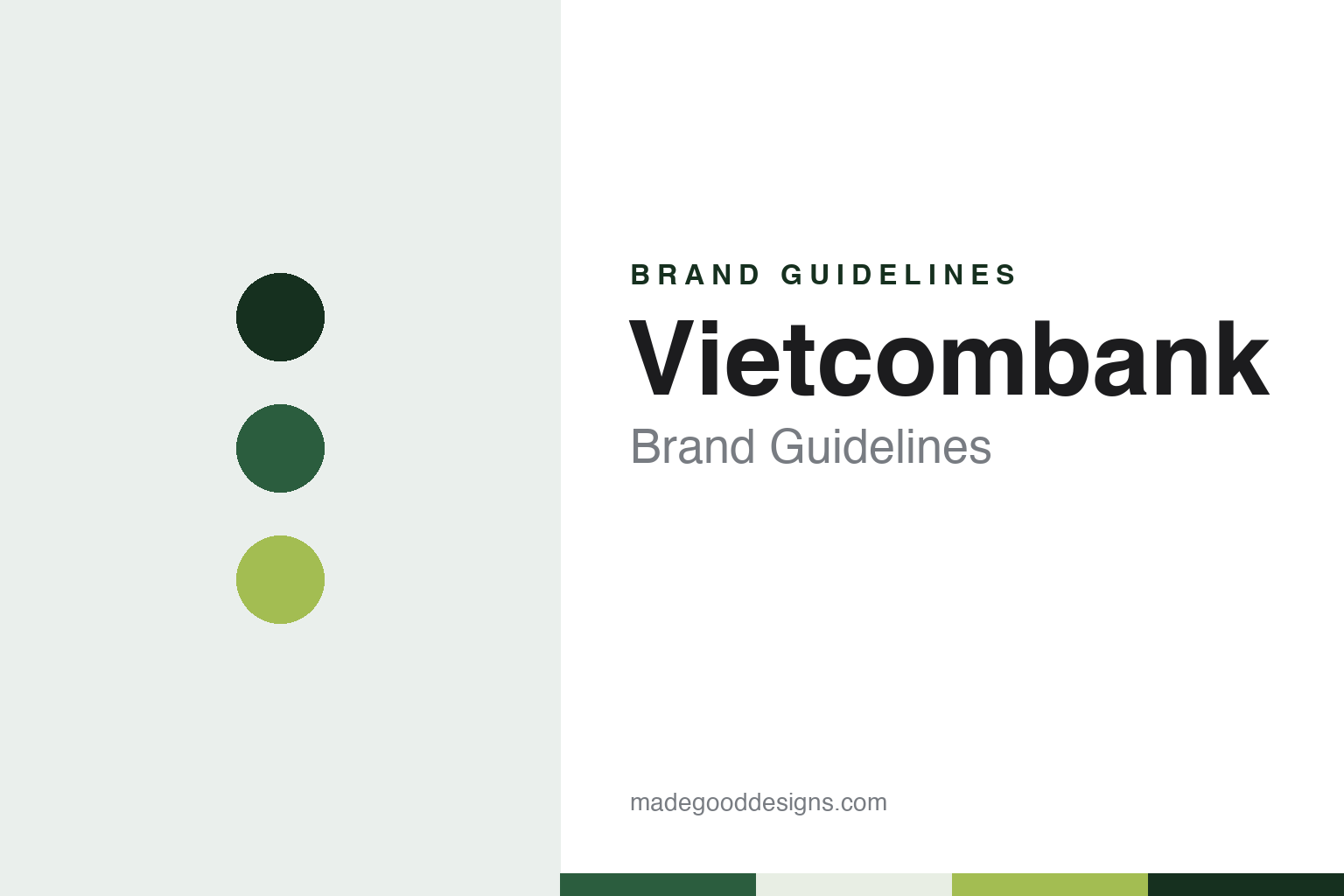
Vietcombank Brand Guidelines
Hanoi’s 1963 foreign-trade bank, equitised in 2008 and listed as VCB.
Aa
Two constants: a green and lime palette and a rounded banking sans register. Abstract homage — not a Vietcombank product or mark; no logo, card or signage is reproduced.
A foreign-trade bank
From a foreign-exchange office to a bank of its own.
Vietcombank’s formal name is the Joint Stock Commercial Bank for Foreign Trade of Vietnam, in Vietnamese Ngân hàng TMCP Ngoại thương Việt Nam, and its head office is in Hanoi. The bank traces its roots to 20 January 1955, when a central foreign-exchange management department was set up inside the National Bank of Vietnam, according to the bank’s own history page and English Wikipedia. Wikipedia adds that the department was renamed the Foreign Exchange Bureau of the State Bank of Vietnam in 1961.
The bank itself opened on 1 April 1963 as the Bank for Foreign Trade of Vietnam, under a government decree dated 30 October 1962, Vietnamese Wikipedia says. It was split off from the foreign-exchange bureau to serve as a bank dedicated to foreign trade, and for its first decades its work centred on foreign currency, trade finance and international payments, according to the bank.
In 1990 Vietcombank widened its remit from foreign trade to general commercial banking, English Wikipedia says. Vietnamese Wikipedia dates its entry into the SWIFT payment network to 1993 and its membership of the Asian Bankers Association to 1995, and says that in 1996 it was the first bank in Vietnam to issue international Mastercard and Visa credit cards. The same article names it as a founding member of the Vietnam Bank Card Association. Between 2000 and 2005, the bank says, it carried out a programme of restructuring and modernisation.
Colour
An IPO, a listing and a Japanese partner.
Vietcombank was chosen as the pilot for turning state-owned banks into joint-stock companies, a process known in Vietnam as equitisation. English Wikipedia dates the selection to 2008; the bank says it was the first state commercial bank the government picked for the pilot. After an initial public offering in 2007, it began operating as a joint-stock commercial bank on 2 June 2008, according to the bank and Vietnamese Wikipedia, and its shares were listed on the Ho Chi Minh City Stock Exchange under the code VCB on 30 June 2009.
On 30 September 2011 Vietcombank signed a strategic shareholder agreement with Japan’s Mizuho Corporate Bank, part of Mizuho Financial Group, the bank says. Tuoi Tre News reported in August 2026 that Mizuho bought a 15 percent stake that month, and that in early 2019 it took part in a private placement alongside Singapore’s sovereign fund GIC, keeping its 15 percent holding.
The state remains the controlling shareholder. In October 2026 Fintech News, citing Reuters, reported that government holdings stood at 74.80 percent of Vietcombank, and that a state capital plan approved on 27 October 2026 sets a floor of at least 65 percent for the bank by 2030. Vietnamese Wikipedia names the State Bank of Vietnam as the shareholder.
The network now runs across Vietnam and into neighbouring markets. The bank lists 126 branches and 559 transaction offices, domestic subsidiaries in leasing, securities and remittances, and a digital-bank subsidiary; abroad it names a finance company in Hong Kong, a money-transfer company in the United States and a subsidiary bank in Laos, which it says opened on 19 October 2018. It has representative offices in Ho Chi Minh City, Singapore and the United States; the US office opened on 1 November 2019 after licensing by the New York State Department of Financial Services, English Wikipedia says. In October 2024 Vietcombank became the second-largest shareholder of Eximbank, according to the same article.
The bank says that on 28 November 2018 it became the first bank to receive the State Bank’s approval to apply Basel II standards under Circular 41, and that it moved to a new core banking system on 27 January 2020.
Typography
Design and documentation.
Banks in Malaysia and Vietnam tend to present themselves through a bold wordmark or a short set of initials, often set in a single strong colour. Red, green, blue and orange recur across the sector, and many names work in two languages at once: a Malay or Vietnamese name for home customers and an English form or abbreviation for markets, filings and overseas branches. Several of the banks in this guide are known chiefly by initials that began as the names of older holding companies or merged institutions.
In Malaysia, Islamic banking usually sits beside the conventional bank as a range of its own, often run through a separate subsidiary with Shariah-compliant deposits, financing and cards. Public Bank, for example, says it began Islamic banking in 1993 and moved that business into Public Islamic Bank in 2008, while RHB offers its Islamic products through RHB Islamic Bank. RHB’s Sinar Credit Card-i, launched in November 2026, shows the “-i” suffix some Malaysian banks use for Islamic products.
Bank websites in both countries are organised around everyday tasks: deposits and savings accounts, home and vehicle loans, cards, QR payments and mobile apps. In Malaysia the national QR standard, DuitNow QR, was launched by PayNet in July 2019, according to Public Bank, whose own site lists DuitNow QR and its MyPB app under mobile banking. Photography tends to show branches, city skylines, head-office towers and customers at counters or on phones rather than abstract imagery.
Much of how these banks describe themselves appears in formal documents. Listed banks publish annual reports and, increasingly, sustainability reports, and their corporate websites group these with investor pages, milestone timelines and anniversary campaigns. This guide draws on those pages, on encyclopedia entries and on dated press reports, and marks where a fact rests on a bank’s own word.
Aa
A rounded banking sans with full Vietnamese diacritics. (Specimen set in Be Vietnam Pro, a sans STAND-IN; NOT the Vietcombank logo.)
Vietcombank
Shared trust, a strong future.
The present identity dates from 2013. The bank says it launched a new brand identity system on 31 March 2013, with the slogan “Chung niềm tin – Vững tương lai”; Vietnamese Wikipedia gives 1 April 2013, the bank’s 50th anniversary, and English Wikipedia renders the slogan as “Shared trust – Strong future.” The tones on this page are our own.
The bank’s own pages carry the brand into digital products. Its personal app is VCB Digibank and its business app VCB DigiBiz, and the website groups its retail range under accounts, cards, loans and savings. The bank describes its culture with five values — trust, standards, readiness to change, sustainability and humanity — and says that in 2025 Kantar named it among the 30 most valuable brands in Southeast Asia.
The name also stands on the Saigon skyline. Vietcombank Tower, a 35-storey building in Ho Chi Minh City designed by Pelli Clarke Pelli Architects, was built between 2011 and 2014, English Wikipedia says, and its spire takes as its reference the crown of the Hùng kings.
For a design guide, Vietcombank shows how a state-founded foreign-trade bank can carry one short name through equitisation, a stock-market listing and a move into app banking. Compare BIDV, another Hanoi bank with a state majority, and VietinBank. For this guide we use a ledger green, a young lime and rice-paper whites with a sans, an unofficial interpretation; no product or logo is reproduced.
Explore & save
Keep Vietcombank’s identity on hand — save it to a board in the Made Good inspiration library.
Vietcombank identity set
Pin the Vietcombank green and lime palette and the rounded banking sans register to your own board.