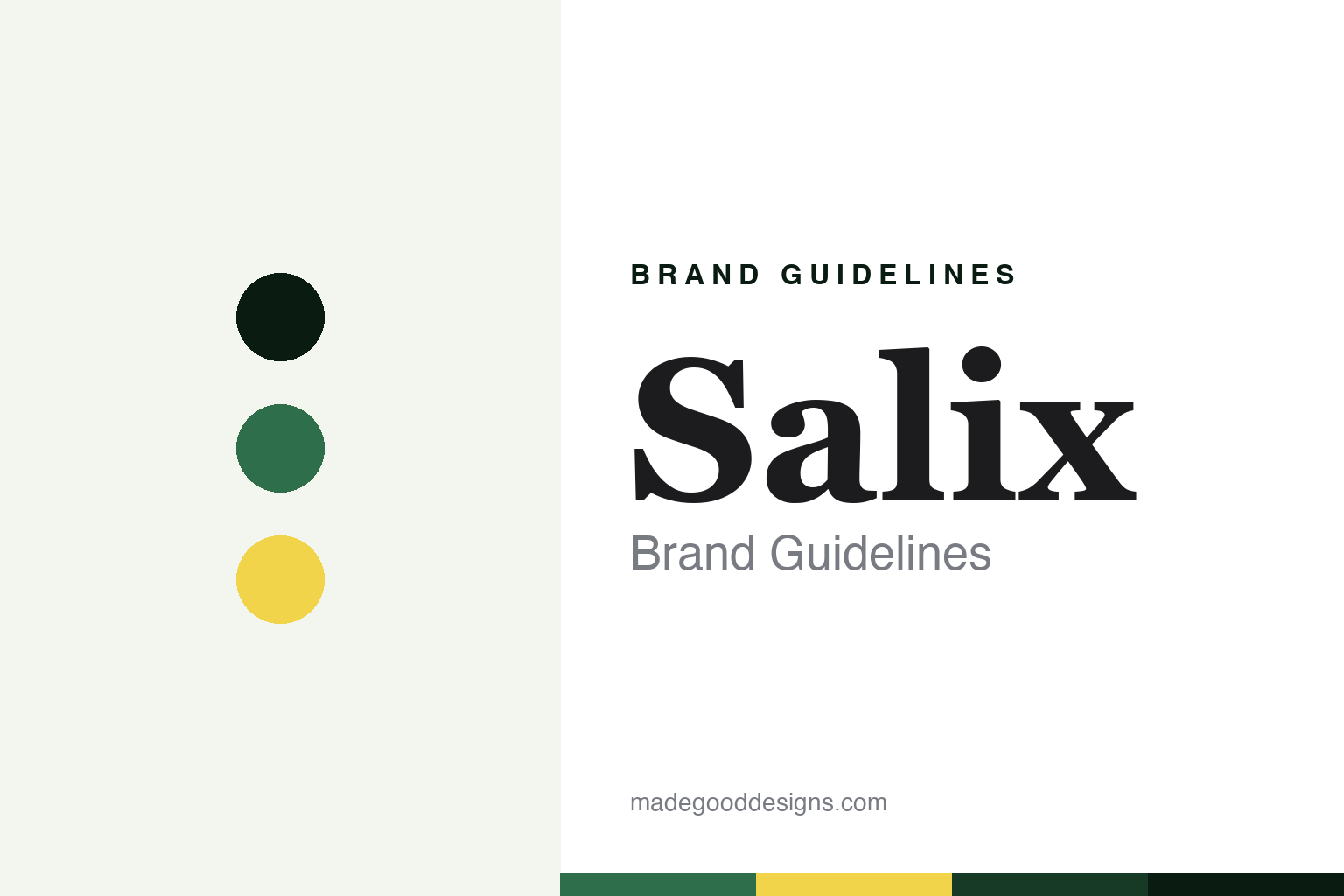
Salix Brand Guidelines
A bat company named like the tree.
Aa
Two constants: a Kent-green palette and a botanical-italic register. Abstract homage — not a Salix product or mark; no bat or logo is reproduced.
Two founders and a mentor
Salix began in 1990, from the workshop of a famous bat-maker.
Salix calls itself “A unique brand set up in 1990 by Andrew Kember and Hugh Betts,” and its about page describes the two as “both founding members of Salix,” adding: “There from the beginning, Hugh and Andrew got Salix moving.” The company — The Salix Cricket Bat Company Limited — was incorporated on 5 February 1990, briefly under an off-the-shelf name, and is registered at a farm in Langley, near Maidstone, in Kent. Both founders are still directors.
Andrew Kember learned the trade under John Newbery, the celebrated Sussex maker, and, Country Life wrote in 2017, “forged his own path after his mentor passed away.” The Newbery name survives as a separate brand; Salix is one of the workshops its maker’s training seeded. Country Life also noted a longer craft lineage: Kember’s great-grandfather was a wheelwright.
The business has passed into a second generation without leaving the family. Kelyan Kember became company secretary in 2024 and a director that September, and the register records her, with Andrew Kember, as a person with significant control. Salix describes her as “one of the only professionally trained woman cricket bat makers in the UK,” trained by both founders — its description. There is no parent company; Salix is an independent, family-owned workshop.
Colour
The genus on the label.
The name is botany. Salix is the Latin genus of the willows, and the cricket-bat tree is Salix alba var. caerulea — the variety the Forestry Commission’s 1936 bulletin urged growers to select with care, since, properly tended, it reached the size bat-makers needed “in twelve to eighteen years.” We found no page on which the company explains its name, so we state the botany, not a motive. But few brand names sit closer to the raw material: Salix bats are named after the wood they are made of.
That wood is grown under scrutiny. English bat willow is mainly an East Anglian crop, subject to the Watermark Disease (Local Authorities) Order 1974, which allows an officer to examine a willow “by cutting into the wood or otherwise” and to require a diseased tree to be cut down and its branches destroyed by fire. The bacterial disease, which stains the timber, has been recognised in Britain since 1924; the Forestry Commission notes that “No chemical cure exists.” Since 1992 the order has covered Bedfordshire, Essex, Hertfordshire, Norfolk, Suffolk and Wiltshire.
Salix makes a strong English claim for its Knife model. Wisden’s 2023 profile, which drew on the company’s own wording, said of it: “The trees are cultivated and grown in England, the clefts are cleaved and dried in England, and these handmade ‘Knives’ are made in England.” That statement is about the Knife, and we do not extend it to every model. The company’s site says more generally that it has been “handcrafting bats … from our workshops in the heart of Kent” since 1990.
Typography
“Salix is not a mass-production business.”
Salix defines itself against the factory. “Salix is not a mass-production business. There are no mass production machines churning out bats,” its site says, and Kember designed the hydraulic press the workshop uses. He told Country Life in 2017: “I’ve seen ‘handmade’ companies move manufacturing overseas and it erodes the brand.” In Wisden’s 2023 piece he put the scale in plain numbers: “If we end up doing a couple of thousand this year, including junior bats, we’ll be pretty pleased.” He described weeks of a hundred bats made by two people. The arithmetic of the willow is sobering at that scale: J.S. Wright, the Essex grower, says an average mature tree yields around 40 clefts, so a couple of thousand bats is the wood of roughly fifty trees, each of which took well over a decade to grow.
The company also claims a voice in the rules. It says Kember spoke for manufacturers at the MCC World Cricket Committee in 2014, in the debate about the balance between bat and ball, and that it took part in MCC’s consultations on the Law governing bats. Those are its accounts. The Law has since changed in a way that touches the willow directly: after a 2025 conference at Lord’s on a “cricket bat emergency” of “a shortage of willow and spiralling prices,” MCC’s new Laws, in force from 1 October 2026, allow laminated bats in open-age cricket, “as part of an attempt to slow the rising costs of bats around the world.” MCC had floated an English-willow face backed by cheaper Kashmir willow “or even other woods” — a prospect that sits awkwardly with a brand whose very name is the willow.
In Wisden’s profile, Tammy Beaumont, the England batter and World Cup winner, recalled her first Salix: a size-five bat, at the age of eleven.
Aa
A botanical italic — the way a Latin genus is printed. (Specimen set in Fraunces italic, a serif STAND-IN; NOT the Salix logo.)
Nothing is made like a Salix
The maker paints the bats himself.
Salix’s identity is unusually personal: Kember designs the bat artwork himself. In 2023 he told Wisden that the workshop had changed its palette: “We’ve tended to use pastel colours … we’ve certainly gone for brighter and bolder colours,” including “more primary colours.” Its models carry short, hard names — Knife, AMP, AJK (the founder’s initials), RAW — and a sub-brand, ACID, whose “parent brand is SALIX.”
The site closes on a line that works as a tagline: “…nothing is made like a Salix, looks like a Salix, or plays like a Salix…” The three verbs — made, looks, plays — cover the workshop, the artwork and the willow, which is to say the whole brand.
Its web address tells a quieter story. The shop now trades at cricketbatmakers.com — a domain that names the craft rather than the brand — while a Salix-named domain shows only a placeholder. The choice puts the trade before the trademark, in keeping with a company whose site spends more words on its workshop, its press and its makers than on its logo.
For this guide we use a Kent green and a primary yellow, nodding to that move to bolder colour, with a botanical italic. These are an unofficial interpretation, not Salix’s colour values, and nothing of its artwork or logo is reproduced.
Explore & save
Keep Salix’s identity on hand — save it to a board in the Made Good inspiration library.
Salix identity set
Pin the Kent-green palette and the botanical-italic register to your own board.