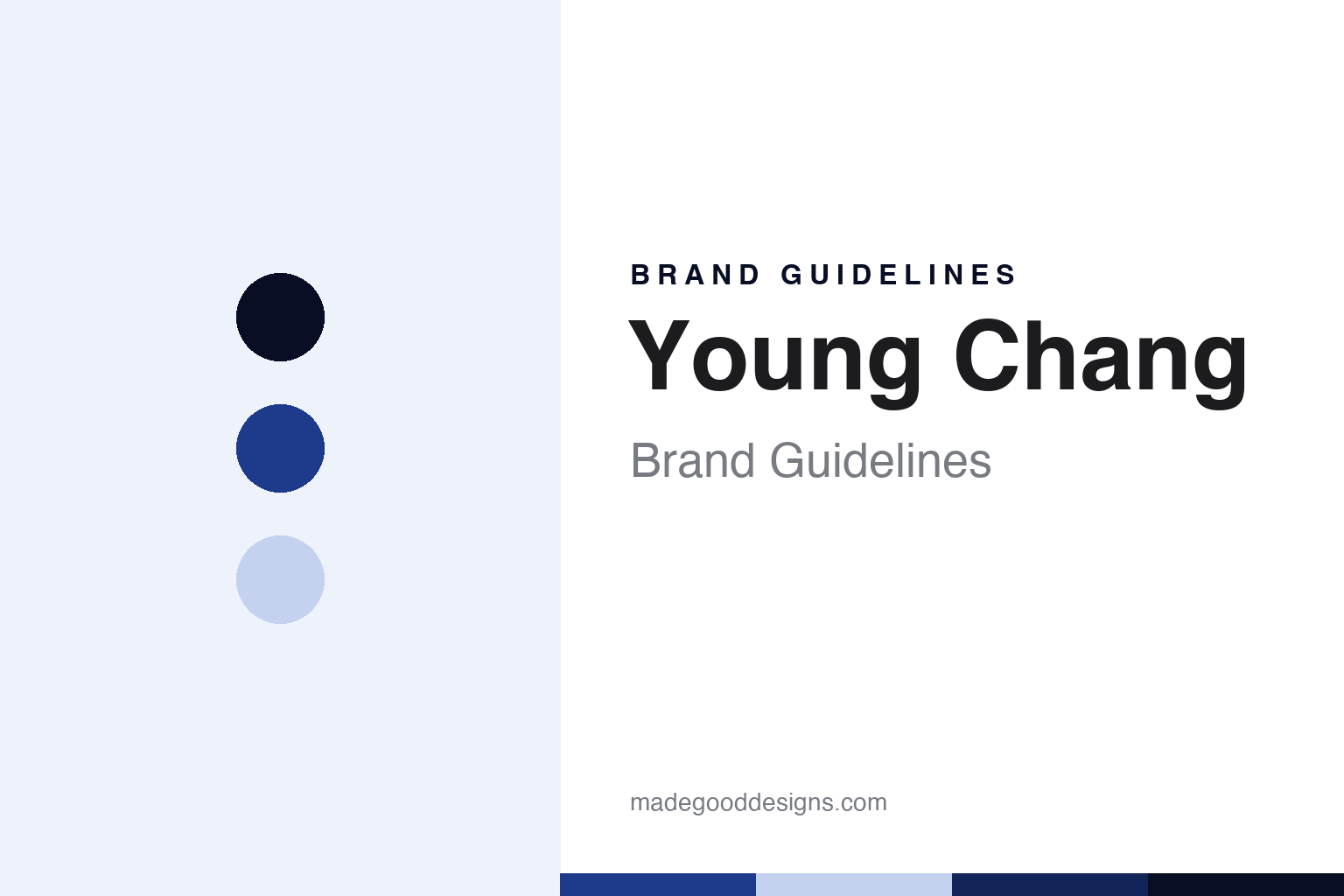
Young Chang Brand Guidelines
Two brothers’ names, and a court process.
Aa
Two constants: a Seoul-blue palette and a modern-sans register. Abstract homage — not a Young Chang product or mark; no piano or logo is reproduced.
Shinhyang Piano, Myeongdong
A Seoul shop of 1956 named for two brothers.
Young Chang began, Korean Wikipedia records, as the Shinhyang Piano Company, set up in November 1956 in Myeongdong, central Seoul; it became Young Chang Musical Instruments Manufacturing in September 1962, the name it would keep for decades. Accounts of the founding differ. Korean Wikipedia credits Kim Jae-seop and says he named the business after his elder brothers, Jae-young and Jae-chang; English accounts, including the company’s American distributor, describe three Kim brothers as founders. The name, either way, joins two brothers’ names — Young and Chang.
It grew with South Korea’s export economy. A Seoul factory was built in 1964; own-brand exports began in 1971; and, the Korean business site Bizwatch reported in 2026, in 1972 it became the first Asian maker to export its own-brand pianos to Japan, shipping 4,500. A second plant opened in Incheon in 1979, the company listed on the Korean stock market in 1984, and in 1995 it completed a factory in Tianjin, China.
Two acquisitions made it more than a piano maker. In June 1990 it bought Kurzweil Music Systems, the American electronic-instrument company, and, by English Wikipedia’s account, in 1986 it had acquired the rights to the old New York name Weber, which it used for a second piano line. Weber had been founded by Albert Weber in New York in 1852; the distributor’s site says it “is considered the first to coin the term ‘Baby Grand’” — a claim we leave as the site’s. By most English accounts, Young Chang had started out distributing Yamaha pianos in Korea; Korean sources we read do not mention it, so we give it only as those accounts’ version. Young Chang’s American distributor still positions its two brands: “Young Chang pianos have a bright tone, and Weber pianos are on the mellow side.”
Colour
The first maker of Steinway’s Essex — by Piano Buyer’s account.
Young Chang also built for others. When Steinway launched its entry-level Essex line around 2000–01, Piano Buyer says, it began “with a limited offering of models made by Young Chang.” Steinway’s own filings do not name the factory; they refer to “existing Korean production,” and in 2005 Steinway moved Essex to Pearl River in China. Young Chang appears in Steinway’s filings of the period as a competitor.
Its finances were less steady than its output. Bizwatch’s 2026 history records a debt workout in 1998, from which it emerged in 2002, and a final default in 2004. In May 2006 Hyundai Development Company bought it, outbidding its Korean rival Samick. It was renamed Young Chang Music in 2011, moved its head office to Incheon in 2015, became HDC Young Chang in 2018, and in 2026, after a group reorganisation, became IPARK Young Chang.
That year also brought a court process. On 16 April 2026 the company filed for rehabilitation at the Seoul Rehabilitation Court, which opened proceedings on 18 May 2026 and appointed an administrator; a regulatory filing of 31 August 2026 shows the deadline for its rehabilitation plan extended to 19 October 2026. Bizwatch reported that its musical-instrument revenue had fallen from ₩53.4 billion in 2019 to ₩17.5 billion in 2025, out of total revenue of ₩31.1 billion that year — of which ₩10.2 billion came from construction work, a measure of how much of the business was by then something other than musical instruments. As of this writing the company is in rehabilitation and the outcome is not known; we make no prediction.
Typography
“Designed in Korea. Reimagined for the World.”
The tagline used by its American distributor is “Designed in Korea. Reimagined for the World.” Like many second-line slogans, it names a country of design rather than a country of manufacture. The distributor’s site says that after the 2006 HDC purchase there was “a multi-million-dollar renovation of their major manufacturing facility in Tianjin, China”; we could not establish which plants make Young Chang pianos today, and describe its factories as historically in Incheon and Tianjin.
That phrasing sits on familiar legal ground. The US Federal Trade Commission’s guidance treats “Designed in USA — Made in Finland” as an honest, specific claim and “Created in USA” as deceptive, because buyers read “created” as “made.” US customs rules require imports to show “the English name of the country of origin.” In Europe, the Unfair Commercial Practices Directive treats as misleading a practice that deceives about “geographical or commercial origin,” “even if the information is factually correct.” We found no regulator action against Young Chang; the rules explain why “designed in” is chosen with care.
The distributor’s site credits its redesign to people it names — including Joseph Pramberger, whom it says Young Chang hired in 1995 as a former head of manufacturing, and the piano designer Delwin Fandrich, who reworked the instruments after 2006 with a “floating soundboard.” It lists parts from Germany: Renner actions, Röslau wire and Abel hammers. We note that the site is run by an American distributor, PianoPiano Distributors of New York, and quote it as the distributor’s words.
Aa
A clean modern sans — two names joined into one. (Specimen set in Inter Tight, a sans STAND-IN; NOT the Young Chang logo.)
Young + Chang
A family name split in two, and two names joined.
Young Chang’s name is its family story compressed: two syllables, each the second half of a brother’s name. For English-speaking buyers it reads as a single phrase; in Korea it is 영창. The company’s corporate names — Young Chang Music, HDC Young Chang, IPARK Young Chang — have changed with its owners, but the two syllables have stayed.
For a design guide, Young Chang is a case study in the difference between a brand and a business. The brand has outlasted a default, a takeover and three corporate renamings, and it spawned or carried other names — Weber, Kurzweil, the first Essex pianos. Whether the business survives its 2026 rehabilitation is a separate question, and one for the court and its creditors. The company, first listed in Seoul in 1984, carries the stock code 001890, and its head office is in Incheon. We will follow the court’s decision rather than anticipate it.
For this guide we use a deep blue and a pale sky with a clean sans. These are an unofficial interpretation, not Young Chang’s colour values, and nothing of its logo is reproduced.
Explore & save
Keep Young Chang’s identity on hand — save it to a board in the Made Good inspiration library.
Young Chang identity set
Pin the Seoul-blue palette and the modern-sans register to your own board.