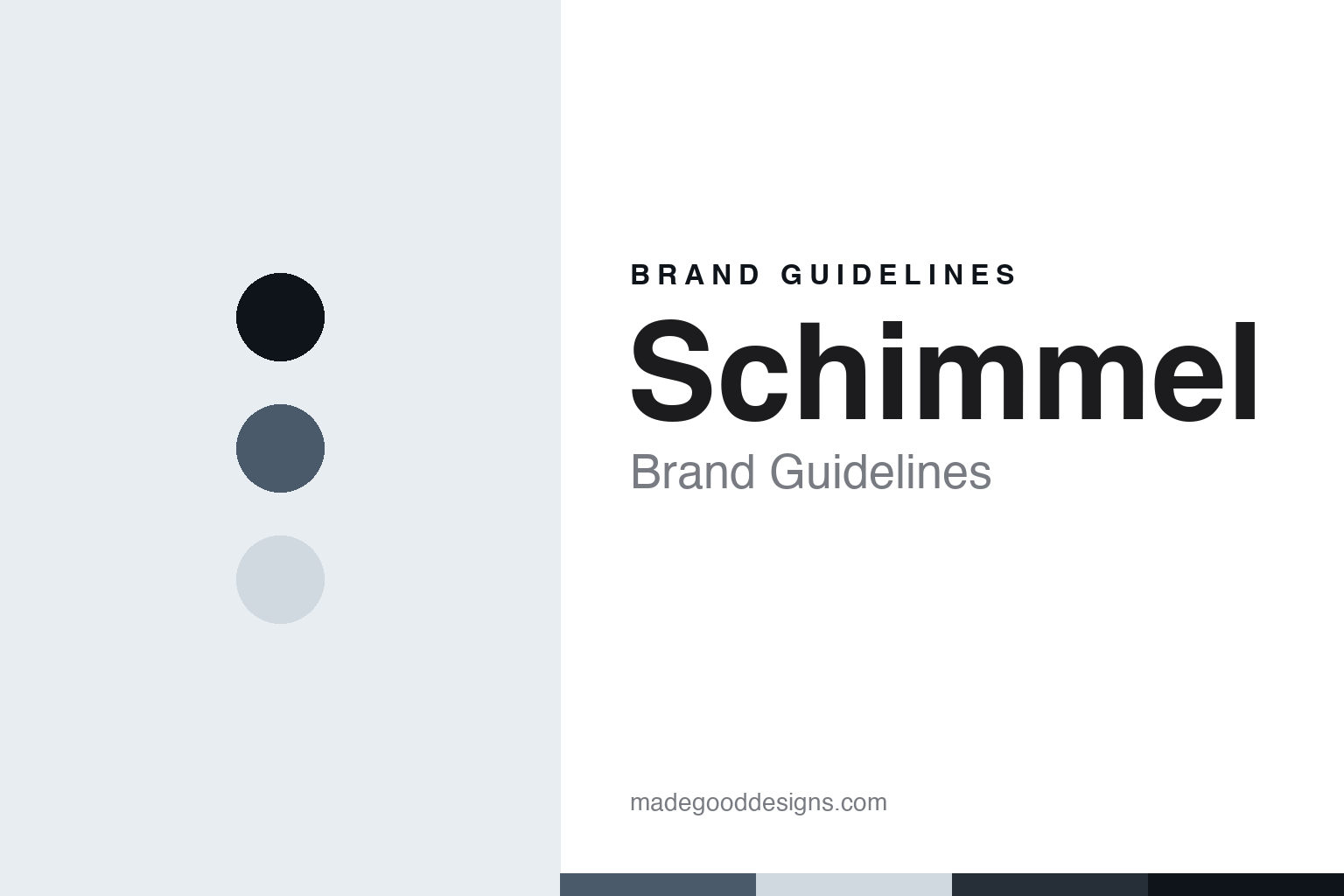
Schimmel Brand Guidelines
An alliance that was a takeover.
Aa
Two constants: a Braunschweig-slate palette and a quiet-grotesque register. Abstract homage — not a Schimmel product or mark; no piano, horse or wordmark is reproduced.
Four generations and a planned insolvency
Schimmel was a family firm for 131 years. It survived the 2008 crisis on its own, then sold.
Wilhelm Schimmel founded the company on 2 May 1885, “in einer kleinen Werkstatt nahe Leipzig,” in a small workshop near Leipzig, as its own history puts it. The firm came to Braunschweig between 1927 and 1932 — Wilhelm Arno Schimmel went on alone there in October 1932, after a cooperative of eight makers broke up — and a new factory followed in 1966. The family succession ran from Wilhelm to Wilhelm Arno in 1927, to Nikolaus W. Schimmel in 1961, and in 2003 to a son-in-law, Hannes Schimmel-Vogel.
The 2008 financial crisis hit Schimmel hard. Its own history says the crisis cost it its American market — more than 30 percent of its sales. The company went through a Planinsolvenzverfahren, an insolvency carried out under a court-approved restructuring plan, in 2009 and 2010, and came out of it in May 2010, in time for its 125th anniversary. The founder’s motto, which the company still quotes, is “Qualität setzt sich durch” — quality prevails.
One small detail on that history page repays close reading. It dates “Der ‘Schwarze Freitag’ am 24. Oktober 1927” — Black Friday, 24 October 1927. The crash usually given that name happened in 1929. It is a slip, not a deception; but it shows how rarely anyone reads a brand’s history page as closely as a buyer reads a price list.
Colour
In January 2016 a Chinese state-owned group took over 90 percent. The company’s history page calls it an alliance.
In January 2016 the Pearl River Piano Group of Guangzhou — a state-owned company listed in Shenzhen — took over 90 percent of Schimmel, according to the trade press; the family is reported to have kept about 10 percent. Pearl River is not a small buyer. In 2013, an official Chinese government source reported, it made 136,000 pianos, “a 25-percent share of the international market,” in a country that made “almost 80 percent of the world’s total.”
Schimmel’s own history page describes 2016 differently. It calls the arrangement a “finanzielle strategische Allianz” — a financial strategic alliance — with Pearl River, and does not say that Pearl River became the majority owner. The company’s imprint is more direct: the managing director of Wilhelm Schimmel Pianofortefabrik GmbH, registered in Braunschweig, is Wenbing Lan.
There was also a promise. Speaking to the trade press in 2016, a Pearl River executive, June Wang, said: “we will not build Schimmel pianos in China.” A decade on, the top-tier Konzert and Classic series are still described as built in Braunschweig, with keyboards from the German maker Kluge.
Pearl River did not only shop in Braunschweig. The same 2016 report recorded that the Bayreuth maker Steingraeber declined to sell it a stake. And Braunschweig itself now holds the round’s sharpest contrast. Schimmel and Grotrian are both Braunschweig houses; both passed to Chinese or Hong Kong owners within a year of each other, in 2015 and 2016. Grotrian’s factory closed in January 2025 after insolvency. Schimmel’s, on the evidence of its own site, is still building pianos. Same city, similar deals, different outcomes — which is a reminder that the owner’s nationality explains less than the owner’s choices.
Typography
Braunschweig, Poland, and a line made in Asia — under three versions of one name.
Like Bechstein, Schimmel tiers its name. The Konzert and Classic series are Braunschweig instruments. In 2003, before the sale, Schimmel built up its own factory in Kalisz, Poland, over nine years from a small restoration workshop, for the Wilhelm Schimmel series — labelled “Made in Europe, by Schimmel.” We could not confirm whether Kalisz is still operating in 2026, so we describe it as the company described it. It is the same move Bechstein made three years later in the Czech Republic: a second factory, in a country that was joining the European Union, under a “Made in Europe” label.
The third tier is Fridolin Schimmel, made in Asia by Pearl River to Schimmel’s designs. Sources disagree on when it began — the company’s own site says 2018; a trade magazine reported uprights at a 2017 trade show — so we give no single year. Set beside the 2016 promise, the wording becomes important. Pearl River said it would not build Schimmel pianos in China. The line it builds is called Fridolin Schimmel. Whether that keeps the promise depends entirely on what counts as a Schimmel, and that is exactly the question a tiered nameplate is designed to leave open.
Pearl River’s reach in this round goes further. The buyer’s guide PianoBuyer says that since 2020 the Artist and Classic series of the American house Mason & Hamlin have been “made in China in partnership with Pearl River,” and a 2016 industry report named it as the maker of Essex, the third line of Steinway. One state-owned company in Guangzhou now owns one heritage name and builds lines carrying, or sold alongside, two others.
German courts read “Made in Germany” as requiring the essential manufacturing steps in Germany, and the German piano association offers a separate, voluntary seal for brands made “zu 100 % in Deutschland.” Schimmel’s own labels — Braunschweig, “Made in Europe,” and a Fridolin line whose country is Pearl River’s — are, read carefully, all accurate. The care is the buyer’s job.
Aa
A calm, even grotesque — modern, unadorned, quietly confident. (Specimen set in Figtree, a sans STAND-IN; NOT the Schimmel wordmark, horse or products.)
A white horse, a winged one, and a glass piano
Schimmel is German for a white horse. The house has made the most of it.
The name helps. Schimmel is the German word for a white horse, and the house’s most famous design leans into it: the Pegasus grand, a winged horse of a piano by the designer Luigi Colani. Schimmel also showed an acrylic-glass piano as early as 1951 — a later glass instrument toured with the singer Udo Jürgens — and in 1915 made a self-playing piano, the Ducanola. It still claims patents of its own, for a mass-reduced bridge in 2020 and a pre-tensioned keybed in 2023.
That makes Schimmel arguably the most design-led house in this round, and the one with the most to gain from a confident visual identity. It is also the one whose identity most needs the plain sentence it does not print: who owns it.
For this guide we use a Braunschweig slate and a pale grey with a calm grotesque. These are an unofficial interpretation, not Schimmel’s own colour values, and nothing of its mark, horse or Pegasus design is reproduced.
Explore & save
Keep Schimmel’s identity on hand — save it to a board in the Made Good inspiration library.
Schimmel identity set
Pin the Braunschweig-slate palette and the quiet-grotesque register to your own board.