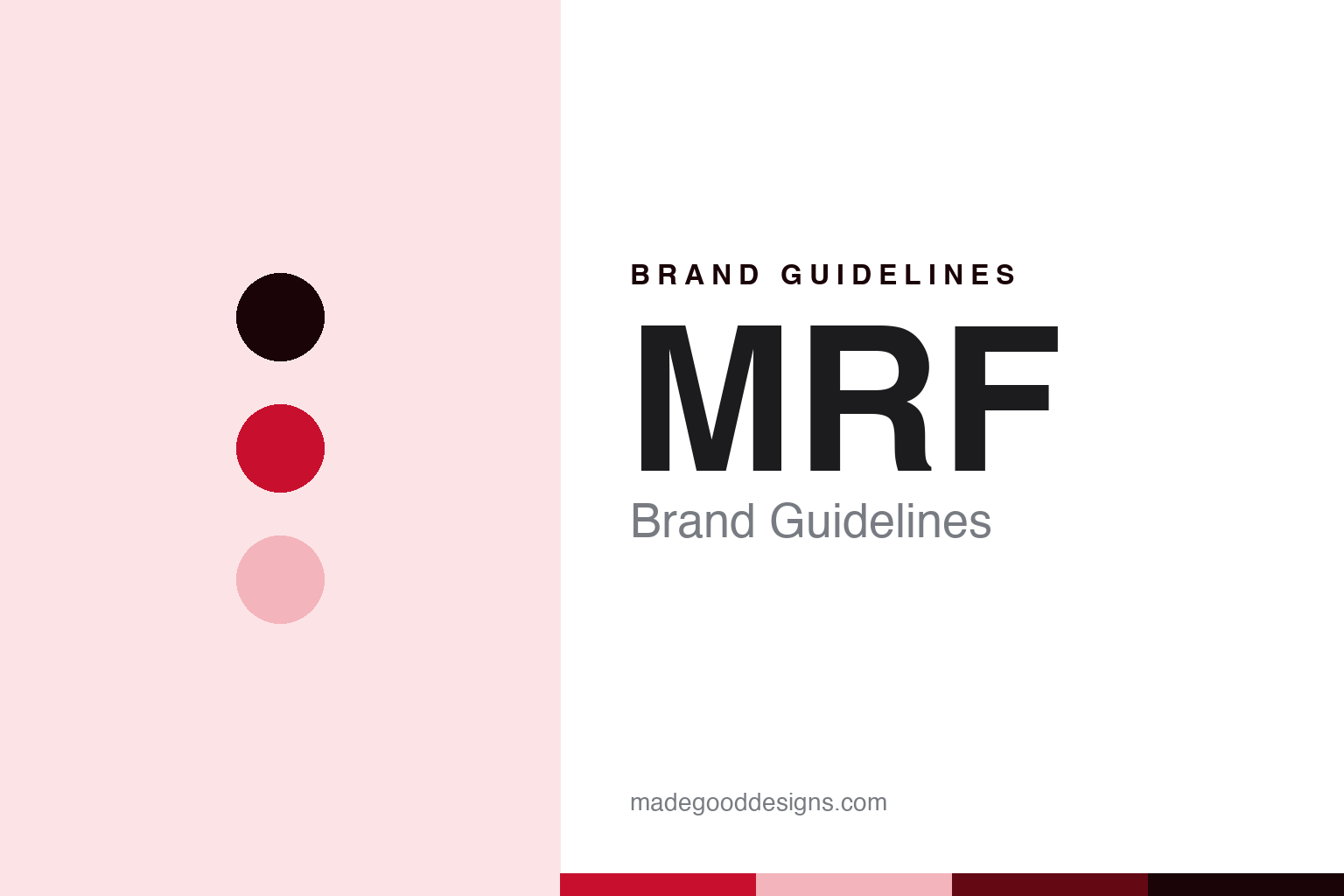
MRF Brand Guidelines
A tyre maker on the face of the bat.
Aa
Two constants: a muscle-red palette and a poster-sans register. Abstract homage — not an MRF product or mark; no bat, sticker, tyre or Muscleman is reproduced.
From toy balloons to tyres
The most famous name on an Indian cricket bat belongs to a rubber company.
MRF’s own history begins in a shed: “K. M. Mammen Mappillai started MRF’s journey as a toy balloon manufacturing unit in a shed in Tiruvottiyur in Madras in 1946.” The letters stand for Madras Rubber Factory. It moved into tread rubber in 1952, and by 1956, it says, held half the Indian market for it. In 1961 it became a public company, signed a technical collaboration with the Mansfield Tyre & Rubber Company of the United States, and made its first tyre. In 1967, it says, it became the first Indian company to export tyres to the United States.
It became famous for something else too. On 13 June 2023 MRF became the first Indian stock to trade at ₹1,00,000 a share on the Bombay Stock Exchange; it had first crossed ₹10,000 in 2012. The company with the most expensive share in India also owns one of the most recognisable stickers in Indian cricket.
Its mascot predates both. MRF says the Muscleman “was born” in 1964, when it opened an export office in Beirut. Trade obituaries in 2024 credited the advertising executive Philip Eapen, who died that July aged 86, with creating it. The flexing figure became one of India’s most recognisable advertising characters — and, decades later, the image fans associate with a cricket bat.
Colour
A logo on a bat must belong to a bat maker. So the tyre company sells bats.
Here is the puzzle every cricket fan has half-noticed. MRF makes tyres. Yet its logo has run down the face of the bats of some of the most famous batsmen of the last thirty years. How?
Part of the answer lies in the International Cricket Council’s own clothing and equipment rules, which say plainly why bat logos are allowed at all: “To allow an opportunity for players to obtain some revenue from controlled bat advertising.” They also limit who may appear. A sponsor’s “Player’s Bat Logo” is confined to one patch on the back of the bat, no larger than ten square inches, and may not be the logo of “a Manufacturer, other than the Manufacturer of the item of cricket equipment it is to be carried on.” The face of the bat — the space television sees — is reserved for the manufacturer’s own marks, within the top nine inches. The Laws add that such identifications may be no thicker than 0.02 centimetres. A 2021 investigation by Scroll.in explained how sponsors work within this: in its reading, a company that markets bats under its own name is treated as their manufacturer, so sponsors buy finished bats from established makers — it names SG, SS, BDM and BAS as the kind of makers involved — and replace the logo; a sponsor “could buy 40-50 bats in bulk for its client and then go ahead and replace the logo.” It traces the practice of separate bat-sticker deals to the late 1980s, when Kapil Dev signed with the brand Power.
We found no document naming the maker of any particular player’s MRF bat, and we do not name one. Nor do we try to settle how the ICC’s own definition of a bat manufacturer, which turns on a company’s “main aim,” applies to any individual sponsor; that is the ICC’s call, not ours. What is documented is the practice the investigation describes, and the fact that MRF sells bats under its own name. Retail “MRF Genius” bats are widely available, though who makes or licenses them is not established in anything we read.
That is the theme of this round. In our earlier cricket guides, the makers — SS, SG, Millichamp & Hall — told stories of bats that went out under other names. MRF is the other half of the transaction: the name that went out on the face.
Typography
Tendulkar, Lara, Waugh, Kohli — and a fast-bowling school.
The roll of players is the brand’s real advertising. Sachin Tendulkar famously played the whole of the 1996 World Cup with no logo on his bat — he has said he refused an offer mid-tournament because he had grown used to the bat’s look — and carried MRF from the late 1990s until around 2009. In May 2003 the Trinidad & Tobago Newsday reported, under the headline “Lara signs MRF bat contract,” that Brian Lara had joined him; Steve Waugh carried the sticker too. In June 2017 the Economic Times reported that Virat Kohli had renewed his MRF bat deal for eight years, at a value reported at around ₹100 crore; his agency’s chief executive said “We have renewed the bat sponsorship deal with MRF for eight years.” Shubman Gill was reported in 2025 to be carrying it.
The figures are reports, not disclosures, and we give them as such. Sticker deals are private contracts; the public sees only the bat.
MRF’s commitment to the game goes beyond stickers. It says its MRF Pace Foundation was “born in the year 1987,” crediting the late Ravi Mammen working with the Australian fast bowler Dennis Lillee, who directed it until 2012, when Glenn McGrath took over. It trained Indian fast bowlers including Javagal Srinath, Zaheer Khan and Irfan Pathan, and opened to players from other countries in 1992. A tyre company runs one of cricket’s best-known fast-bowling academies, and its name sits on the bats its pupils bowl at.
Aa
A heavy poster sans — the shape of a sticker read from the far boundary. (Specimen set in Anton, a sans STAND-IN; NOT the MRF logo, sticker or Muscleman.)
Three letters, one muscleman
Bat branding at its most efficient.
On the bat, MRF needs nothing but its three letters: short, heavy, legible from the stands and on a television close-up. Off the bat, it has the Muscleman. Few brands have a cricket identity so complete with so little — three capitals on a willow face.
The irony is the one this whole round turns on. The brand most associated with Indian batting does not, on any documented record, make bats. It makes tyres, and the sticker — under rules that reserve the bat’s face for its manufacturer’s marks — is the product. The bat is someone else’s craft; the name is MRF’s.
For this guide we use a muscle red and a pale red with a heavy poster sans. These are an unofficial interpretation, not MRF’s own colour values, and nothing of its logo, sticker or Muscleman is reproduced.
Explore & save
Keep MRF’s identity on hand — save it to a board in the Made Good inspiration library.
MRF identity set
Pin the muscle-red palette and the poster-sans register to your own board.