Rohde Brand Guidelines
German-engineered, Czech-built.
Aa
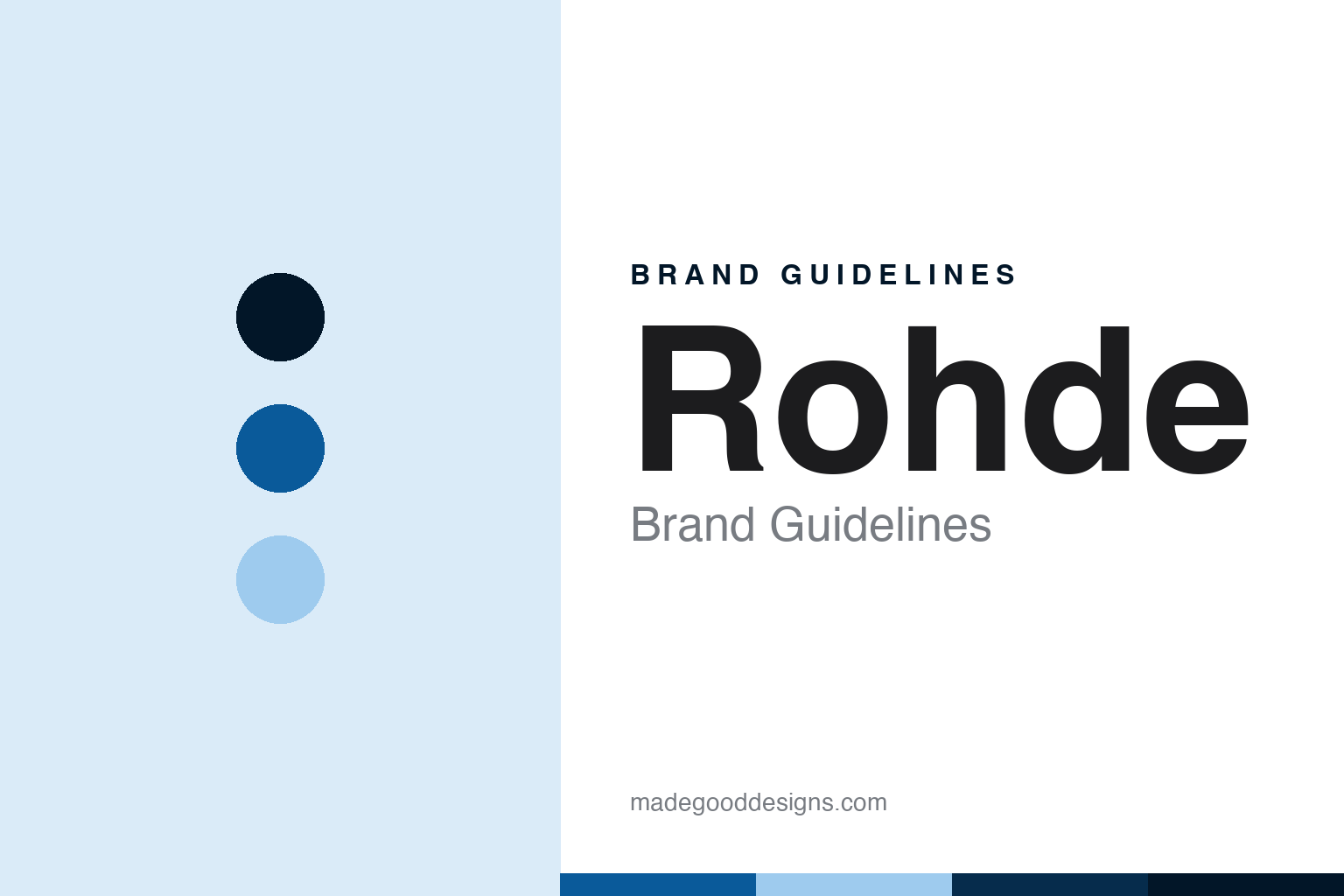
Two constants: a Prutting-blue palette and an engineering-sans register. Abstract homage — not a Rohde product or mark; no kiln or logo is reproduced.
An engineer’s workshop, handed to four sons
Rohde is the youngest company in this round and the only one whose founder handed it on within the last decade.
Rohde’s own account of its founder is brief and exact. Helmut Rohde was born in Westphalia in 1942, studied mechanical engineering in Hamburg and worked for Siemens in Munich. He opened a workshop in 1977 and founded the limited company in 1982. The legal entity is Helmut ROHDE GmbH, at Ried 9 in Prutting, a village in the Bavarian countryside south-east of Munich, registered at the Traunstein local court.
On 1 January 2016, the company says, he passed his shares to his four sons — Benjamin, Manuel, Stefan and Florian — and it “remains a family-owned business.” Its managing directors today are Benjamin Rohde, Manuel Rohde and Roland Müller. Helmut Rohde died on 9 October 2024, aged 81, as the company recorded in a notice on its own site.
That gives Rohde the shape of the older American firms in this round compressed into half the time: a founder with a technical background, a workshop, a family succession. The difference is that the family here inherited not one plant but two, in two countries — and the company has never hidden which one builds the kilns.
The succession is also more mixed than “family business” suggests. Of the four sons who received the shares, two — Benjamin and Manuel — are managing directors, and they share the role with Roland Müller, who does not carry the family name. The ownership is the family’s; the management is partly professional. Skutt made a similar split in 2025, when its family kept the company and appointed a chief executive from outside — two firms in this round arriving at the same arrangement from opposite sides of the Atlantic.
Colour
“German-engineered” is the phrase on the marketing. The catalogue says where the kilns are made, in the managing director’s own words.
Rohde’s 2025/26 product catalogue quotes Manuel Rohde directly: “We have been manufacturing at our production site in Dyjakovice in the Czech Republic since 1992. Our company headquarters is located in Prutting, Bavaria. Most or our kilns are handmade.” (The small typo is in the original.) The Czech company is ROHDE spol. s r.o., at Dyjákovice 311 in South Moravia, near the Austrian border, and a new production hall was built there in 2016.
Set that beside the brand’s own wording. Rohde describes its kilns as German-engineered, and the catalogue contains no “Made in” phrase at all. Nothing is concealed: the design is German, the headquarters is German, the factory is Czech, and the company’s own managing director says so in its own catalogue. But a buyer who reads “German-engineered” as “made in Germany” is supplying a meaning the company never claims. The phrase is accurate precisely because it is narrow.
The contrast inside Germany is instructive. Nabertherm, the country’s other well-known kiln name, says it “still produces 100% of its quality furnaces in Lilienthal,” its home town near Bremen. Two German kiln brands, two honest sentences, two different geographies. The question a buyer should ask of any engineered-in label is the one Rohde answers without being asked: engineered where, built where.
Dating the Czech production to 1992 places it within three years of the fall of the border it now sits beside — an early move, and one the company has kept for more than thirty years.
Typography
Rohde announced its arrival in the United States at the end of 2025 — and led with the safety certificate.
On 18 December 2025 Rohde announced its American launch under the headline “ROHDE Goes Stateside UL Certified. Ready to Launch.” The models built for the US market received UL certification, and they are sold through ROHDE Kilns LLC, a joint venture with Wet Dog Glass — which Rohde describes as “one of the most experienced providers of professional glass and kiln technology in the US market” — with a new logistics hub in North Carolina and the first kilns scheduled to arrive the following spring. Three Ecotop sizes — 200, 250 and 300 litres — are offered only in the US.
Leading with the certificate makes sense in this market. The US standard is UL 499, written for electric heating appliances in general; in the edition we read, kilns take up three short clauses of 171 pages, and the word “cone” never appears. Schools and public buildings are where the listing is checked, and a European maker entering that market has to pass the same appliance standard as everyone else. Canada, by contrast, has a kiln-specific standard.
The product range is broad: Ecotop and TE top-loaders, the TE-MCC+, KE-S and KE-L chamber kilns, ELS, HE hood kilns and TG gas top-loaders. Rohde says the Ecotop uses “up to 40% less electricity than the previous series” — a comparison with its own earlier kilns, not with anyone else’s. It sells a SolarReady option, a myKiln app, and says its kilns ship plastic-free. It is one of two makers in this round to make energy part of the identity — L&L, in New Jersey, tells customers its factory is solar powered — and the only one to sell the efficiency figure as a headline feature of the kiln itself.
Underneath, it fires to the same scale as everyone here. In North America the pyrometric cone is made by the Edward Orton Jr. Ceramic Foundation, a charitable trust in Ohio; in Germany the reference has long been the Seger cone, which grew out of Hermann Seger’s work in Berlin in the 1880s. Whichever cone a Rohde customer uses, it is a measure of heat-work — temperature and time together — and the UL certificate that opened the American market says nothing about it.
The choice of partner is telling, too. Rohde chose a partner it describes in terms of glass as well as kilns. That fits the American market it is entering: Skutt, Paragon and Olympic all sell glass kilns alongside their ceramic ones, so a newcomer with a glass partner is arriving where its competitors already are.
Aa
A clean engineering sans — slightly condensed, technical, precise. (Specimen set in Barlow, a sans STAND-IN; NOT the Rohde logo, wordmark or products.)
Innovation, in capitals
A blue, a capitalised surname, and a catalogue headline about inspiration.
The company writes its name in capitals — ROHDE — in the legal entity, the catalogue and the US joint venture alike. Its catalogue headline is “INNOVATION NEEDS INSPIRATION,” and its site is built around a single strong blue. It is the most corporate-looking identity in the round, and the most consistent: the same capitals appear on a Bavarian court register, a Czech company name and an American LLC.
That consistency is the point. A family name, carried unchanged across three countries’ company registers, is a brand making a promise about continuity of design while the building changes. The engineered-in label works for Rohde because the company is willing to finish the sentence.
For this guide we use a Prutting blue and a pale sky tone with a clean engineering sans. These are an unofficial interpretation, not Rohde’s own colour values, and nothing of its mark is reproduced.
Explore & save
Keep Rohde’s identity on hand — save it to a board in the Made Good inspiration library.
Rohde identity set
Pin the Prutting-blue palette and the engineering-sans register to your own board.