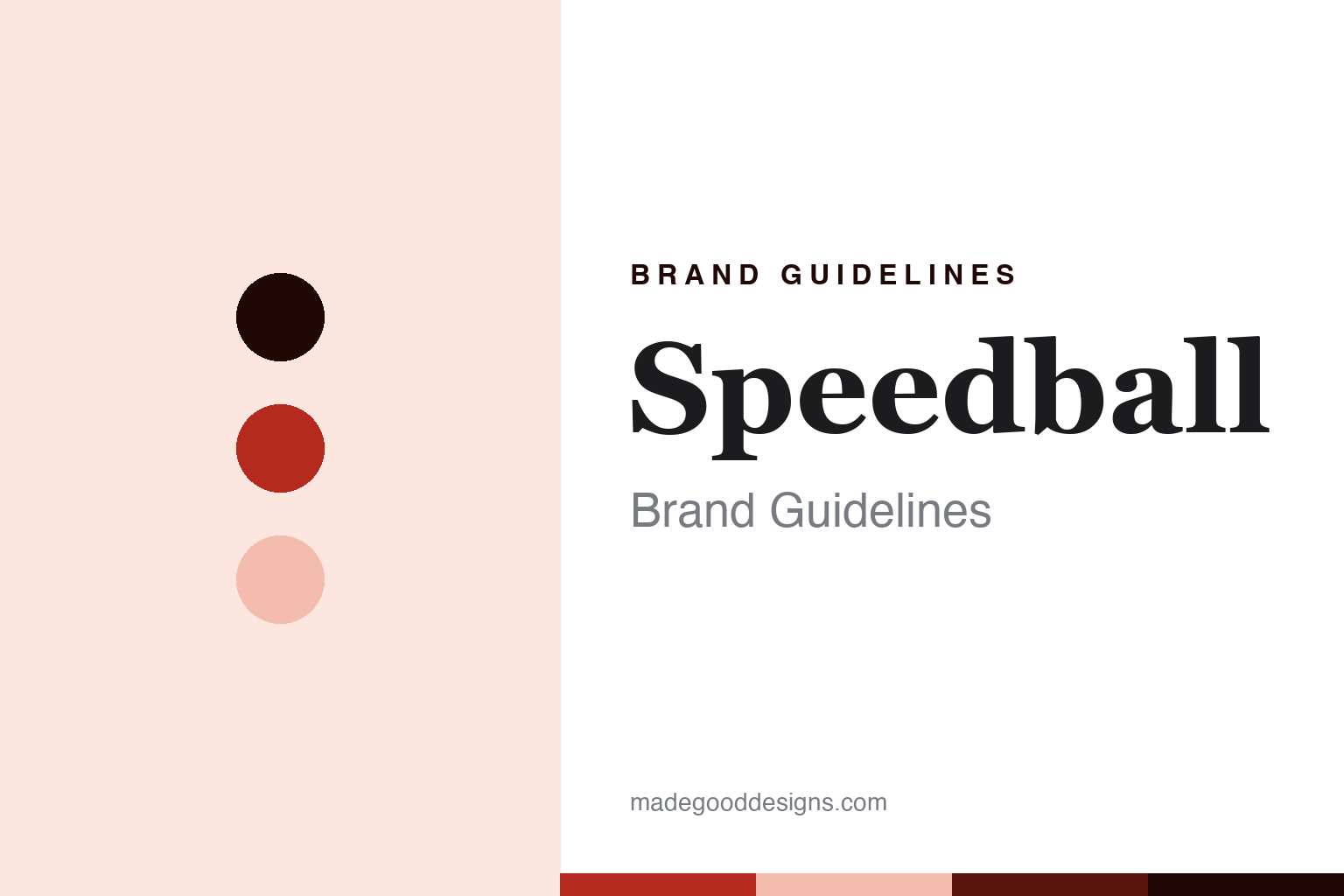
Speedball Brand Guidelines
A lettering pen that learned to throw pots.
Aa
Two constants: a nib-red palette and a lettering-serif register. Abstract homage — not a Speedball product or mark; no nib, wheel or logo is reproduced.
A pen nib that named a company
Speedball is a lettering brand first. The pottery wheels came ninety-four years later.
Speedball tells its history as a timeline, and it begins with pens. In 1899, it says, the C. Howard Hunt Pen Company started in Camden, New Jersey, able to make “almost 45,000 pens a day.” In 1903 George E. Bartol bought it, and his family kept control, the company says, “for much of the twentieth century.” Then came the product that named the brand. In 1915 Hunt and the lettering artist Ross F. George released the Speedball A-Series nib — which Speedball calls “the first broad edge lettering tool of its kind” — together with a 40-page Speedball Textbook that sold for fifty cents. B-Series and C-Series nibs followed in 1916 and 1918.
That makes Speedball a typographic brand at heart. Its nibs and its textbook were built for teaching lettering, and the nib series map onto letter shapes: the A-series makes square-ended strokes, the B-series round ones, the C-series flat, chisel-edged ones. English Wikipedia records that Ross George and William H. Gordon had filed patents for the A-series in 1913, two years before launch. In 1936, the company says, Hunt became “the first large manufacturer of linoleum block printing supplies” — its claim, and the start of a second identity in printmaking that still shows in its catalogue of lino-cutting tools and block-printing inks.
Manufacturing moved from Camden to Statesville, North Carolina, in 1957, where it remains — nearly seventy years in one town, and longer there than in New Jersey. In 1962 the parent was renamed Hunt Manufacturing Company and its offices moved to Philadelphia; Speedball was by then one brand inside a larger manufacturing group.
Colour
A management buyout in 1997. A pottery-wheel maker in 2009.
The brand became a company of its own in 1997, after eighty-two years inside Hunt. Speedball’s timeline says: “Walt Glazer successfully leads the purchase of Speedball Art Products from Hunt Manufacturing.” It then started to buy. It acquired the Houston Art company in 2008, Bienfang from Elmer’s in 2010, Global Art Materials in 2018 — moving that operation from Kansas City to Statesville — and, in July 2025, the Silicoil brush-cleaning system from The Lion Company, in a release that quoted “Speedball CEO, Walt Glazer.”
There is a small puzzle in the record. A 2021 filing by the sporting-goods company Escalade, which appointed Walter P. Glazer Jr. its chief executive from January 2022, described him as having “founded Speedball Art Products Company, a manufacturer and worldwide distributor of fine art materials (1997-2021).” The 2025 Speedball release still called him its chief executive. We give both, dated, and do not try to reconcile them.
Then came the pots. In 2009, Speedball says, it “acquires Creative Industries and becomes the proud manufacturer of the Artista and Boss Series Pottery Wheels.” The flagship Clay Boss has, in the company’s description, a “.5 HP industrial motor and 100lb centering capacity” and a 14-inch wheel head, and it “carries a 10-year warranty,” with a product page that also advertises a $50 studio rebate. One pottery retailer says the Clay Boss originated with Creative Industries in the mid-1990s and went through three major modifications before Speedball bought it — the retailer’s account, which we could not check against the company’s own. Alongside it are the Big Boss, Boss Elite, Artista, Boss Base and Boss Ribs. A brand born from a lettering nib now competes in the wheel market with Shimpo and Brent for the classroom wheel.
Typography
“Crafted in Statesville, NC, USA.”
Speedball’s origin statement is broad and confident. Its about page says “Crafted in Statesville, NC, USA – Trusted by Artists Since 1899” and describes “our U.S.-based manufacturing and distribution headquarters in Statesville, North Carolina.” That is a brand-wide statement; the Clay Boss product page we read carried the warranty and specifications but no separate origin line. Retailers describe the wheels as made in the USA; we report Speedball’s own wording and attribute the rest to them.
A pottery wheel is a cleaner machine than a slab roller or a pugmill, but the wheel’s splash pan collects slurry that dries to dust. That is why the studio-safety rules in this round reach even the most benign corner of a pottery room. Since June 2018 American employers have been held to 50 micrograms of respirable crystalline silica per cubic metre over an eight-hour day, and Britain’s regulator lists “potteries, ceramics, ceramic glaze manufacture” among the industries where workers are exposed. Speedball’s inks and paints, as art materials, fall under the US art-materials labelling law that requires the statement “Conforms to ASTM D-4236” — the toxicologist-reviewed label regime described in our AMACO guide.
Its wheels sit in a long list of brands Speedball has gathered under one roof — lettering, printmaking, Bienfang’s papers, brush care and clay. The company’s history now runs through three places — Camden, Philadelphia and Statesville — and three trades. The pottery line is the newest chapter of a company whose oldest product is a nib.
Aa
A confident lettering serif — the shapes a broad nib makes. (Specimen set in Fraunces, a serif STAND-IN; NOT the Speedball logo or products.)
Trusted by artists since 1899
A date, a guarantee and a slogan about making things together.
Speedball’s lines are plain and persistent: “Trusted by artists since 1899,” “We guarantee everything we make,” a promise of “Unscripted customer service, ready to help!” and a campaign line, “Together, We Make.” The date is the brand’s anchor, even though the Speedball name itself dates from the 1915 nib; the company counts from the pen factory, not the product.
For a design guide, Speedball is unusual twice over. Its origin is mass production — a pen factory boasting tens of thousands of nibs a day — where most brands in this round began in a garage, a van or a small workshop. And its identity was built on letterforms. The Speedball Textbook taught people how to draw letters; the brand’s own lettering is therefore part of its heritage in a way few logos are. That it now sells pottery wheels is a reminder that art-supply brands follow their customers — from the page to the press to the wheel.
For this guide we use a nib red and a pale ink tone with a confident lettering serif. These are an unofficial interpretation — we could not confirm Speedball’s own colour values — and nothing of its logo is reproduced.
Explore & save
Keep Speedball’s identity on hand — save it to a board in the Made Good inspiration library.
Speedball identity set
Pin the nib-red palette and the lettering-serif register to your own board.