FC Sondhi Brand Guidelines
The Jalandhar factory behind New Balance cricket.
Aa
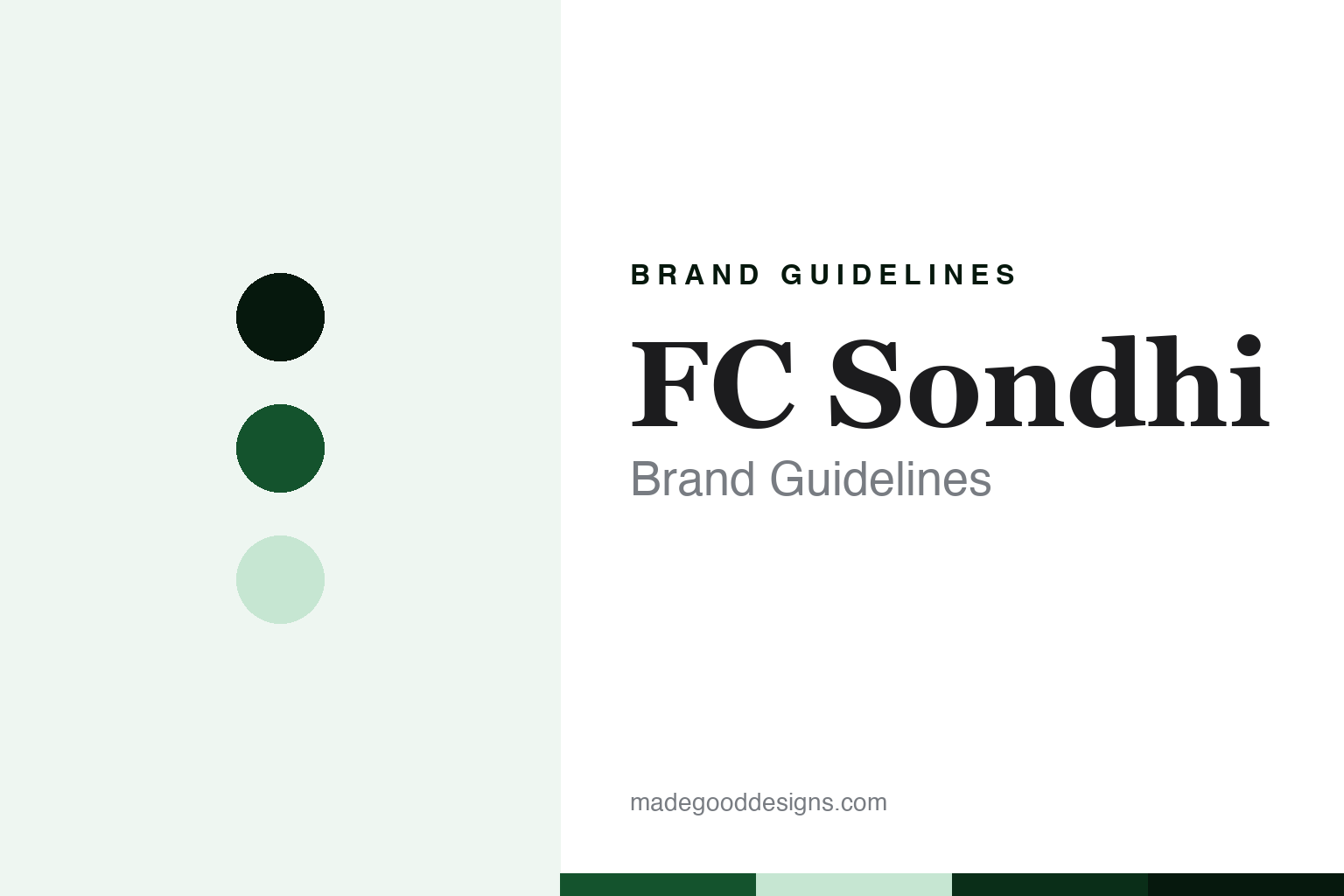
Two constants: a ground-green palette and a company-serif register. Abstract homage — not an FC Sondhi or New Balance product or mark; no bat or logo is reproduced.
Born in Sialkot, started in England
FC Sondhi is a Jalandhar company with an English beginning.
The company’s own history begins with a man, not a factory. F.C. Sondhi, it says, was “born in the year 1906 in Sialkot,” worked for a firm called Uberoi Limited, which sent him to Rangoon in 1932 and then to England, and lived in England “from 1936 onwards.” In 1944 he started F.C. Sondhi and Company Limited there, dealing in toys. Then, “after the partition of India in 1947… in 1950 he journeyed to India… and set up a branch of his company in Jalandhar City,” at No. 1 Basti Nau, under a manager, M.R. Khorana. The founder died in 1983, having seen the branch become a company in its own right.
In 1961, the history says, an Indian law required foreign companies’ branches to be “Indianised,” and the branch became F.C. Sondhi & Co. (India) Private Limited — a company India’s register shows as incorporated on 3 October 1961, and still active, at G.T. Road, Jalandhar. Its manufacturing began modestly. In 1967, the company says, P.C. Sondhi started making batting gloves and leg guards “for a well known English company… with just one skilled worker and one hand-sewing machine.” It built its own factory on Basti Sheikh Road in 1971, and the third generation, Anurag Sondhi, joined in 1998. Today the company describes more than 400 staff — Wright’s 2026 profile says more than 375 — and a 20-acre site, “Sondhi Nagar,” with its own cricket ground.
J.S. Wright, the Essex willow grower, adds details in a 2026 profile: that the firm began making bats “around 1980, initially crafting Kashmir Willow blades,” and “transitioned to English timber by 1985.” Wright also names the 1967 English client as Mitre and says Sondhi founded the Sondico brand in the UK; the company’s own page names neither, and we give both as Wright’s account.
Colour
“The sole manufacturer of New Balance cricket equipment worldwide.”
FC Sondhi’s largest role is one most buyers never see. J.S. Wright’s September 2026 profile describes it as “the sole manufacturer of New Balance cricket equipment worldwide,” with FC Sondhi’s UK company and international divisions acting as New Balance’s official cricket distributors for India, the UK, Singapore and Hong Kong. New Balance bats are carried by some of the best-known batters in the game; Wright lists Joe Root, Jamie Smith, Josh Tongue, Mark Wood, Steve Smith, Pat Cummins, Glenn Phillips and Mitchell Santner among the players associated with the equipment — internationals from England, Australia and New Zealand. If Wright’s description is right, the equipment of all of them traces back to one company in Punjab.
That makes FC Sondhi the clearest example in this round of a maker behind a famous sticker. Earlier guides in this series have described Indian and Pakistani factories building bats for global brands; here the arrangement is stated openly by the willow supplier. The company also sells its own range, PROTOS, alongside New Balance on its cricket website, and makes both “Top Grade English Willow Cricket Bats and a large variety of Kashmir Willow Cricket Bats,” it says.
Its willow loyalty is on record. FC Sondhi told Wright: “Without doubt, we find JS Wright Willow the most consistent out of all UK suppliers in both drying and grading.” Wright, for its part, dates its Indian trade to 1914, by its own history, when its partner in Allahabad used a white rhino as its logo; it says Nicholas Wright “visited every bat maker in Jalandhar, Meerut, and Allahabad” in 1982, in the years FC Sondhi was moving from Kashmir to English willow.
Typography
The helmet standard — and a maker of protection first.
FC Sondhi began in protection, not bats: gloves and leg guards in 1967. Protective equipment is now the most regulated part of cricket. Since 1 February 2017, the International Cricket Council has required that any helmet worn in international cricket comply with the British Standard BS 7928:2013, whose facial-contact test fires a men’s ball at 28 metres per second and a junior ball at 23. Helmets are not compulsory, but a player in a non-compliant one is warned twice and then suspended. In England, the ECB told professionals in 2016 that a player without compliant headgear “will not be permitted to play,” and its 2026 equipment policy defines a head protector as “the complete assembly of a helmet, faceguard and neck protector.”
The helmet rule shows how far protection has moved from the days FC Sondhi describes in 1967, when it was making for another company with a single sewing machine. Its growth since — to a 20-acre site and a global manufacturing contract — is the story of a supplier that became indispensable without becoming famous.
Jalandhar’s wider industry has the same roots. A 2019 report on the city’s sports-goods trade said it “traces its origins to Sialkot in pre-Independence India,” and counted some 1,200 small and medium units in the city, recalling “a high of 90 per cent export market share in its heyday in the 80s and 90s.” FC Sondhi is one of the firms that have outlasted that heyday: the register summary shows revenue of ₹84.2 crore for the year to March 2025.
FCS
A sturdy company serif — initials and a surname. (Specimen set in Fraunces, a serif STAND-IN; NOT the FC Sondhi logo.)
If we are doing it, let’s do it better
A vision line and a cricket ground of its own.
FC Sondhi’s vision line is unpretentious: “If we are doing it, let’s do it better.” It suits a company whose most famous products carry someone else’s name. Its own brand, PROTOS, and its initials, FCS, are the public face; the factory in Jalandhar is the substance.
For a design guide, FC Sondhi shows a different model of brand value. Its strongest asset is not a logo but a relationship — with a global sportswear company that trusts it to make everything, and with an English willow grower that publishes its praise. Its own site’s history is partly out of date, still naming an earlier managing director; the record of the firm is clearer in the company register and in its partners’ words.
For this guide we use a ground green and a pale outfield tone with a sturdy serif. These are an unofficial interpretation, not the company’s colour values, and nothing of its logos or of New Balance’s is reproduced.
Explore & save
Keep FC Sondhi’s identity on hand — save it to a board in the Made Good inspiration library.
FC Sondhi identity set
Pin the ground-green palette and the company-serif register to your own board.