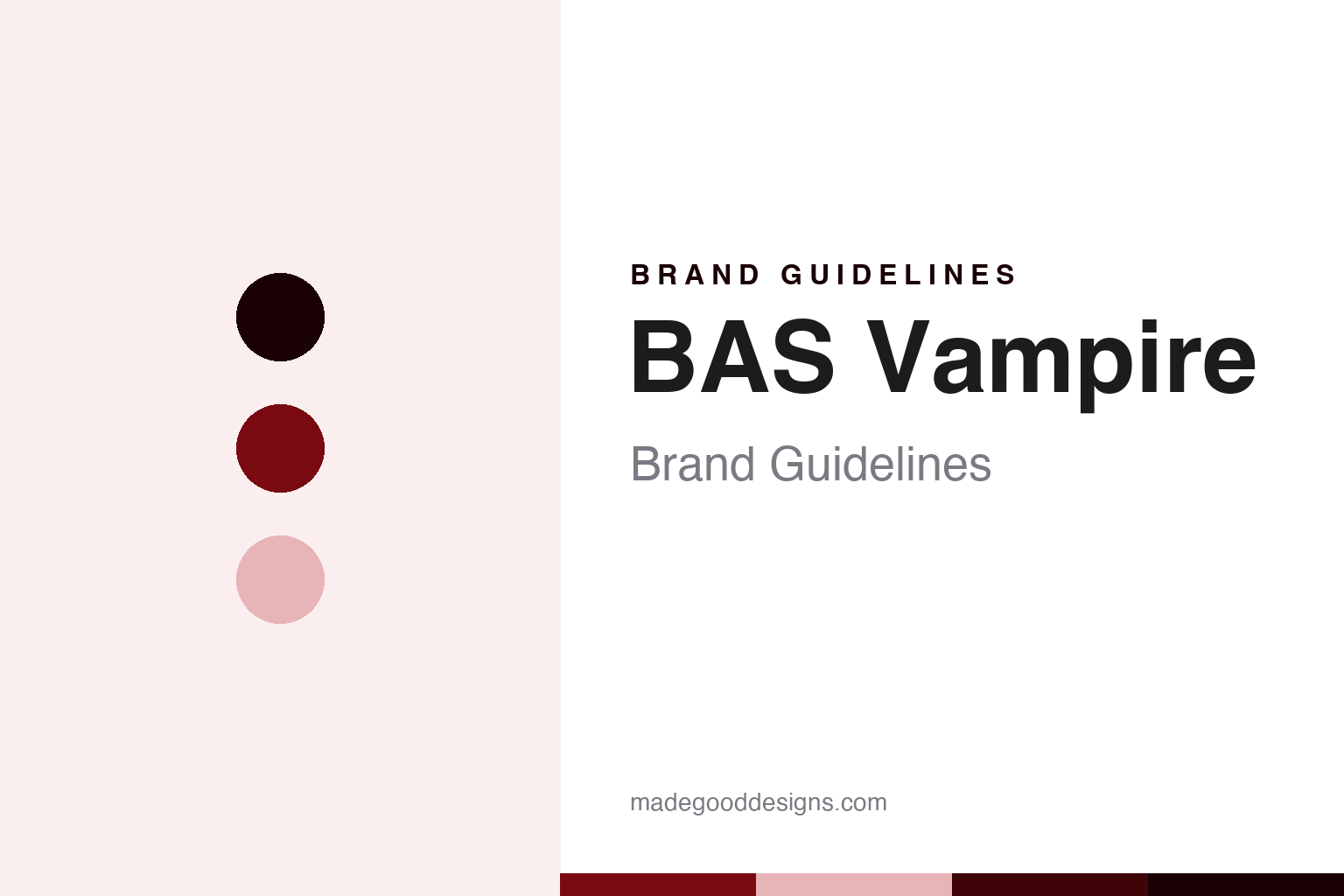
BAS Vampire Brand Guidelines
Beat All Sports, from Sialkot to Jalandhar.
Aa
Two constants: a Vampire-red palette and a heavy-grotesque register. Abstract homage — not a BAS product or mark; no bat, sticker or logo is reproduced.
Beat All Sports
A name that is also a boast, from a family that crossed a border.
BAS stands for Beat All Sports, a name that doubles as a promise. The company’s own profile dates it to 1935 and to a city now in Pakistan: “established by the dedicated duo of Late Sh. D. R. Kohli & Late Sh. M. R. Kohli, at Sialkot (Pakistan)… Beat All Sports unit at Jalandhar since 1950 is run under effective & efficient team of Kohli Brothers.” We found no independent record of the Sialkot years or the move, and give both as the company’s account. It names Ramesh and Sunil Kohli as contacts, and its address is in Jalandhar’s Industrial Area; its owner speaks of the firm’s factory in the city.
The story is a common one in Indian cricket manufacturing. Jalandhar’s sports-goods industry, a 2019 report said, “traces its origins to Sialkot in pre-Independence India”; BAS is one of the firms that tells that story about itself; a 2023 study of the Sialkot-to-Jalandhar migration names “M.R. Kohli of Beat All Sports” in its account of that move. Its trade marks — “BAS” and “Vampire,” the company says — are the brand’s most valuable property.
The business is a family firm in the legal sense too. A trade-directory listing gives a tax registration whose structure indicates a partnership firm rather than a company, and names “Mr. R. C. Kohli” as managing partner. The same family is behind a newer helmet brand: Shrey, whose site credits “Mr. R. C. Kohli, Managing Director of BAS,” with its 2013 launch.
Colour
Dhoni, by the owner’s account.
BAS’s most famous story is told by its owner, Somi Kohli. In a 2020 interview reported by Sportskeeda, citing the Indian Express, he said: “I sent the kits to Mahendra Singh Dhoni in February 1998, and it has been a 22-year-long association.” A dealer from Ranchi, Paramjeet Singh, had spent six months persuading him to back the young player. “In 2004, I first met him in Chandigarh and months later he came to Jalandhar to visit our factory. Dhoni stayed at my home.” The report also said that bats Dhoni used with the stickers of a sportswear sponsor were “manufactured by Beat All Sports.”
Those are Kohli’s accounts, and we report them as such. A 2024 report in The Quint, on the same relationship, said Dhoni used both BAS and SS bats at the 2019 World Cup, and Kohli has said Dhoni took no fee to carry BAS stickers there — an episode that The Quint reported in 2024 as a story about a fee turned down. If the account is right, it is about as strong an endorsement as a small maker can receive: one that was not paid for. What Kohli’s account describes is a pattern familiar from earlier guides in this series: a maker that supports a player early, builds bats for him under other names when sponsors pay, and keeps the relationship when the sponsorship ends.
BAS’s range includes English-willow Vampire models such as the Commander, King Hitter and Millennium, as well as cheaper lines; retailers sell them widely. We could not find an official explanation of the Vampire name, or an official tagline, and do not supply either.
Typography
The helmet standard, and a family that makes both.
The Kohli family’s move into helmets with Shrey put it on the most regulated side of cricket equipment. Since 1 February 2017, the International Cricket Council has required that any helmet worn in international cricket comply with the British Standard BS 7928:2013; helmets are not compulsory, but a player in a non-compliant one receives an official warning for each of the first two matches and a one-match suspension for a third breach. The standard’s facial-contact test fires a men’s ball at 28 metres per second and a junior ball at 23, speeds it calls “theoretically equivalent to realistic cricket ball speeds faced by cricketers.” In England, the ECB told professionals in January 2016 that “Any player who does not wear compliant protective headgear will not be permitted to play.”
A bat has no such certificate. Its rules are the Laws of Cricket on wood and size, and the rest is reputation — a maker’s name, the willow grade and the players who use it. BAS’s reputation was built in the second way, and the story it tells about Dhoni is part of that reputation. For a family making both bats and helmets, the two products sit under two different kinds of trust: one on a name, the other on a test. The standard itself is candid that the test has limits: “wearing a helmet, faceguard and/or neck protector cannot always prevent death or long-term disability.” The British maker Masuri’s guide in this round sets out how that sentence played out in 2014.
Jalandhar’s trade has weathered hard times. The 2019 report recalled “a high of 90 per cent export market share in its heyday in the 80s and 90s” and counted some 1,200 small and medium sports-goods units in the city. BAS’s own profile says it has received export awards from India’s Sports Goods Export Promotion Council. English willow has reached the city’s bat makers through a long-established trade: J.S. Wright, the Essex grower, says its first small orders from Jalandhar followed a 1979 breakthrough in Meerut, and that in 1982 Nicholas Wright “visited every bat maker in Jalandhar, Meerut, and Allahabad.”
BAS
A heavy grotesque — three capitals with a boast inside them. (Specimen set in Archivo Black, a sans STAND-IN; NOT the BAS or Vampire logo.)
BAS and Vampire
An acronym that boasts, and a model name that bites.
BAS’s brand works on two levels. The acronym is modest-looking — three capitals on a sticker — but spells out an aggressive claim, “Beat All Sports.” The Vampire name, the brand’s best-known line, is more theatrical — a model name with a bite. Its Instagram handle, “bas_thegamechanger,” suggests the tone, though we did not find it used as an official slogan.
For a design guide, BAS shows how a family brand can carry two identities at once: a sober company name for the trade and a vivid product name for the player. The company is the Kohlis’ and Jalandhar’s; the Vampire is the batter’s.
For this guide we use a deep red and a pale blush with a heavy grotesque. These are an unofficial interpretation, not BAS’s colour values, and nothing of its logos is reproduced.
Explore & save
Keep BAS Vampire’s identity on hand — save it to a board in the Made Good inspiration library.
BAS identity set
Pin the Vampire-red palette and the heavy-grotesque register to your own board.