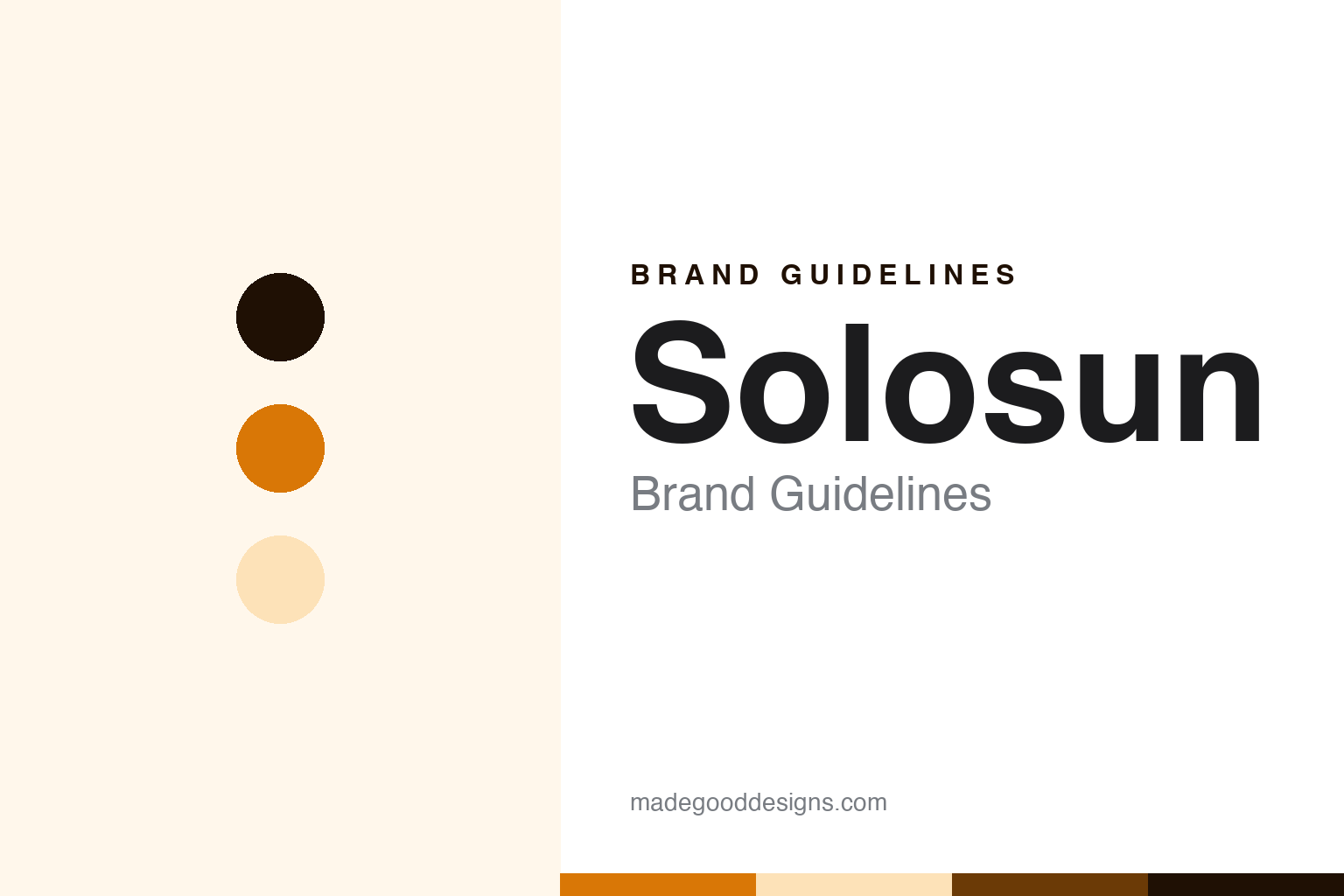
Solosun Brand Guidelines
A cricketer’s workshop that sells its own bats.
Aa
Two constants: a sun-amber palette and a heavy-grotesque register. Abstract homage — not a Solosun product or mark; no bat or logo is reproduced.
From a rented workshop
Solosun’s story is told mainly by its willow supplier.
Most of what is published about Solosun International comes from one source: the English willow grower J.S. Wright & Sons, which profiled the company in July 2026 in a series on its overseas customers. We rely on it heavily and say so. Wright opens by calling the partnership “testament to what happens when cricketing knowledge and craftsmanship meet drive and commitment,” and writes that Solosun is “Driven by founder Devashish and daughter Navya,” and that it “has grown from a humble rented workshop into a model of self-reliance.” Devashish, Wright says, had represented Haryana and Delhi state and university teams before going into business.
The business began with protection, not bats. “In 2006, Devashish turned that passion into a business, starting in a small, rented factory in Gurgaon manufacturing leg guards and batting gloves,” Wright says; later “they expanded into cricket bat manufacture and established the company’s main hub in Meerut,” the north Indian city known for its sports-goods trade. Devashish now runs the firm with his daughter, “overseeing 40 skilled workers across Gurgaon, Delhi, and Meerut.” Indian trade directories corroborate the outline: they list Solosun as a manufacturer established in 2006, under a proprietor named Devashish, with an address in Meerut’s industrial area; they put its staff at 21 to 50 and its annual turnover at between ₹0.5 and 2.5 crore — the company’s own figures, supplied to the directory, and broadly consistent with Wright’s forty workers. Meerut is also home to SG, one of India’s best-known bat makers, so Solosun’s hub sits in established bat-making country.
Its relationship with Wright, the grower says, began in 2010, after a period of manufacturing for Reebok India — Wright does not say what — and a meeting in Amritsar with a trader, Suresh Gupta, who “opened the door to a direct partnership.” We give those details as Wright’s. The post’s own heading speaks of “a decade of trust,” although the relationship it describes began in 2010, sixteen years before the post; we use Wright’s start date.
Colour
No paid endorsements: the shop is the brand.
Solosun’s most distinctive choice is what it does not do. Wright says the company avoids paid international endorsements altogether, and instead opened “dedicated retail stores across the Delhi region, selling Solosun products (plus in-store repair services) directly to local cricketers.” Wright calls this a “self-sale” model. Its social-media accounts point to shops in Gurgaon and in Chhawla, on Delhi’s south-western edge.
It is a different strategy from the one described in earlier guides in this series, where a famous player’s sticker does much of the selling. Solosun’s bet is the opposite: that a cricketer who can walk into a shop, handle a bat and have it repaired will become a customer without a celebrity’s help.
Devashish’s own words in the Wright post are about his supplier: “We feel JS Wright is one of the most honest companies we have ever worked with… They treat every customer with equal respect. Their willow seasoning process is outstanding, and their grading is remarkably consistent. Their name will always be remembered in cricket history.” Wright closes its profile with a pun on its own name: “doing business the right way. And the Wright way.” The directories also list Kashmir-willow bats among the company’s products, so we describe Solosun as a maker of both grades rather than an English-willow specialist. That combination has new significance: from 1 October 2026, the Marylebone Cricket Club’s Laws allow laminated bats in open-age cricket “as part of an attempt to slow the rising costs of bats around the world”; MCC had floated an English-willow face backed by cheaper Kashmir willow. A maker that already works in both woods is well placed for that change.
Typography
Pads and gloves first — and the helmet rule.
Solosun started in protective equipment, and protection is the part of cricket that the rule-makers regulate most closely. Since 1 February 2017, the International Cricket Council has required that any helmet worn in international cricket comply with the British Standard BS 7928:2013. Its facial-contact test fires a men’s ball at 28 metres per second and a junior ball at 23, speeds it calls “theoretically equivalent to realistic cricket ball speeds faced by cricketers.” Helmets are not compulsory, but a player in a non-compliant one is warned twice and then suspended. In England, the ECB told professionals in 2016 that a player without compliant headgear “will not be permitted to play.”
Leg guards and gloves, Solosun’s first products, are made to players’ comfort and their makers’ judgement; the bat, its later product, to the Laws of Cricket on wood and size. Solosun’s range spans the lightly regulated and the more closely defined; the helmet, with its mandatory international standard, is the one item in a kit bag where a buyer can check a test number before buying.
Meerut, Solosun’s manufacturing hub, has its own place in Wright’s history: the grower says its first breakthrough in India came in 1979 with an order for 200 units from a Meerut maker, Sareen Sports, and that in 1982 Nicholas Wright “visited every bat maker in Jalandhar, Meerut, and Allahabad.”
Aa
A heavy grotesque — a bright, simple name. (Specimen set in Archivo Black, a sans STAND-IN; NOT the Solosun logo.)
Self-sale
A name with sun in it, and a shop instead of a sticker.
We could not verify Solosun’s logo, colours or a tagline, and found no website for the brand, so we do not describe any of them. What we can describe is its brand strategy, from its supplier’s account: a family name at the head of the business, a workshop in an established bat-making city, shops instead of sponsorships, and repairs as part of the offer.
For a design guide, Solosun is a reminder that a brand can be built at street level. The identity that matters is the shop front and the person behind the counter, and the strongest public statement about the brand comes not from the brand itself but from its supplier, in a post that names the founder, his daughter and the town where the bats are made.
For this guide we use a sun amber and a pale sun, after the name, with a heavy grotesque. These are an unofficial interpretation, not Solosun’s colour values, and nothing of its marks is reproduced.
Explore & save
Keep Solosun’s identity on hand — save it to a board in the Made Good inspiration library.
Solosun identity set
Pin the sun-amber palette and the heavy-grotesque register to your own board.