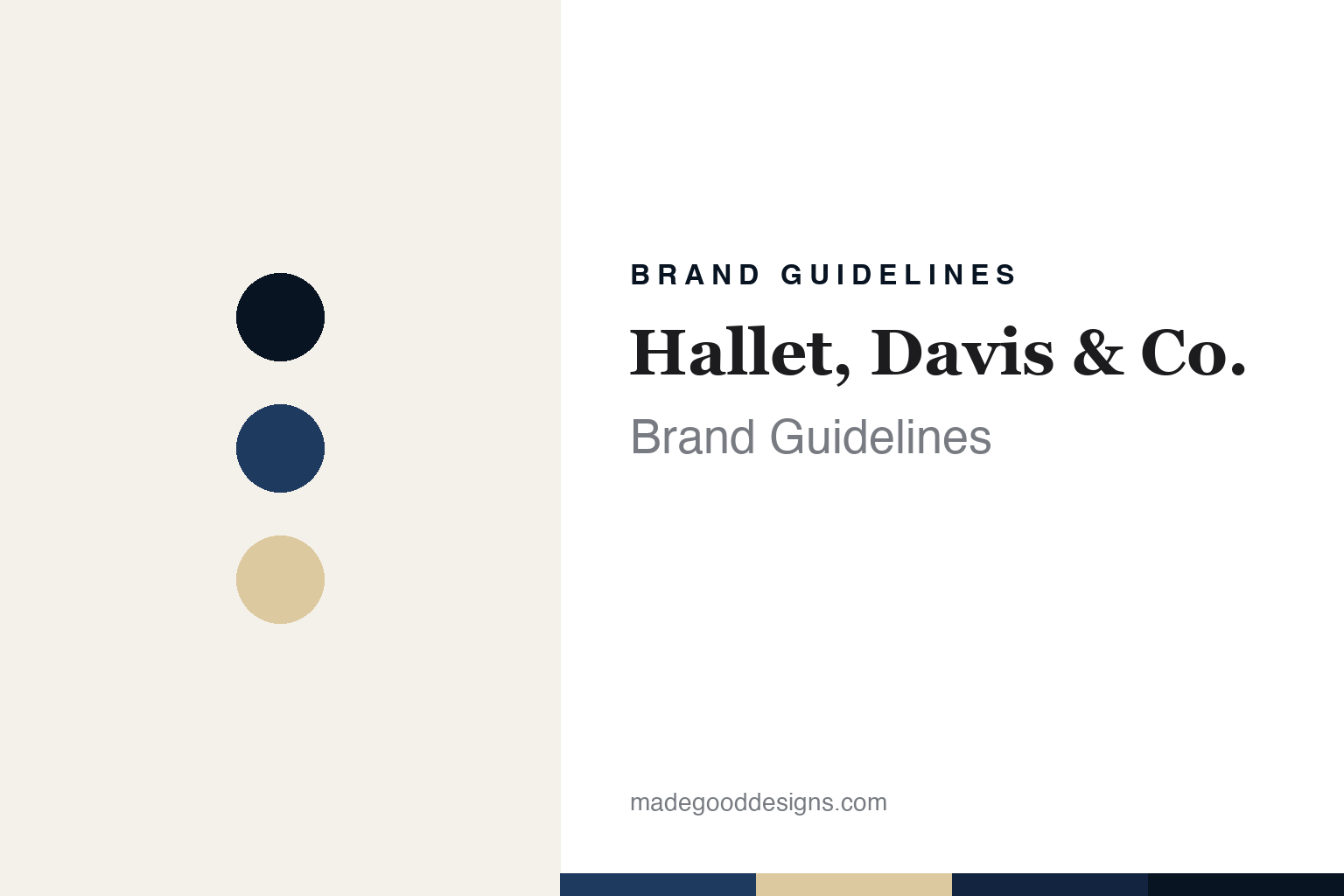
Hallet, Davis & Co. Brand Guidelines
A Boston name, made overseas.
Aa
Two constants: a Back-Bay-blue palette and a gilt-serif register. Abstract homage — not a Hallet, Davis product or mark; no piano or logo is reproduced.
Brown & Hallet, then Hallet & Davis
A Boston partnership whose names outlived it.
The name began as a partnership. Dealer histories record that the firm started in Boston in 1835 as Brown & Hallet, on Washington Street; when Brown retired in 1843, George H. Davis joined, and the firm became Hallet & Davis. Davis himself retired around 1847, and the business went on under other partners — Hallet, Cumston & Allen among them. The company today says it “can trace its origins to the year 1835”; Piano Buyer, more cautiously, says it “dates back to at least 1843 in Boston.” We give both: origins in 1835, the Hallet & Davis name from 1843.
The firm grew in the Boston trade, was incorporated as Hallet, Davis & Co. later in the century, and in the twentieth century passed, through the consolidations of the American piano industry, into the Aeolian-American group. Dealer histories record an incorporation as Hallet, Davis & Co. in 1879 and control by the Conway family from 1905, who launched a Conway brand alongside it. Piano Buyer says its pianos were then made at Aeolian’s plant in Memphis, Tennessee, until Aeolian went out of business in 1985 — the same collapse that sent the Baltimore name Knabe to its creditors and on through a chain of new owners. We found no reliable date for the end of manufacturing in Boston, and give none.
The company also tells two famous stories about itself: that Franz Liszt played one of its pianos at the Paris exposition of 1867, and that in 1911 Pope Pius X chose one for the Vatican and awarded the company a gold medal. Neither has independent confirmation that we could find, and we give both as the company’s claims.
Colour
After Aeolian: a distributor and two Chinese factories.
After Aeolian’s collapse the name was taken up by an American importer. Piano Buyer says: “North American Music subsequently began producing Hallet, Davis & Co. pianos, first in Korea, and now in China.” Today the brand is sold from Stony Point, New York — where North American Music is also the American distributor of the Italian maker Schulze Pollmann — and Piano Buyer names two makers: “The Heritage Collection is made by the Beijing Hsinghai Piano Group,” and the Signature Collection by Pearl River. The Hsinghai group is the same Beijing maker that partnered with Canadian investors to revive Heintzman in 1989.
The brand’s own site does not name a country, but it does give a reason, which is rarer: “Hallet, Davis & Co. found it impossible to build pianos in the United States because of the high labor costs… partnered with overseas manufacturers.” That is about as direct as a revived American piano name gets. It does not pretend to be built in Boston; it explains why it is not.
Korea came first, Piano Buyer says, and China later; the Stony Point address appears on the brand’s own website, and is the only place the site names. Its current models carry “HS” prefixes — grands from the HS148 to the HS188, uprights from the HS109D to the HS131Y. We do not decode the letters; the brand does not explain them. Piano Buyer’s 2022 survey of the American market put the wider practice in one sentence: “Many American distributors and dealers contract with Beijing, Pearl River, and other makers, selling pianos in the U.S. under a multitude of names.” Hallet, Davis & Co. is one of them.
Typography
When a name outlives its makers.
Hallet, Davis & Co. is a name that has outlived every person and factory associated with it, and its history shows how the law treats such names. In the United States, a trade mark is “abandoned” when “its use has been discontinued with intent not to resume such use,” and “Nonuse for 3 consecutive years shall be prima facie evidence of abandonment.” A name kept in continuous use, as this one was by successive owners, does not lapse; a name that falls silent can be claimed by someone else. European and British law set a five-year clock.
The trade’s cheapest version of the practice has a name. In a 2019 decision on the Schiedmayer name, the US Trademark Trial and Appeal Board described pianos bought as “unbranded, ‘no-name’ pianos from China” and given the marks of unrelated makers — “known in the industry as ‘stencil pianos’” — and quoted a buyer’s guide: “Frequently these names come from old, defunct American companies that still command some recognition in the marketplace.” The board cancelled that registration because the use would “falsely suggest a connection” with the real maker.
Hallet, Davis & Co. sits between those poles. It is an old American name now made by large Chinese factories, but it has been in continuous commercial use and its seller says openly why it builds overseas. British law offers a useful test for any such brand: whether its use makes it “liable to mislead the public, particularly as to the nature, quality or geographical origin” of the goods.
Aa
A high-contrast serif — the gilt of a Boston fallboard. (Specimen set in Cormorant Garamond, a serif STAND-IN; NOT the Hallet, Davis logo.)
Tone, touch, reliability
A tagline in three parts, and two founders’ surnames.
The brand’s line is a list of what a buyer wants: “Beautiful and Satisfying Tone – Proper Touch and Response – Reliable and Consistent Performance.” Its site also promises “Remarkable pianos designed to meet the demands of even the most advanced pianists the world over,” and speaks of “German engineering designs” — its claim. The name itself is two surnames and an ampersand, the formula of a nineteenth-century partnership; neither Mr. Hallet nor Mr. Davis has had anything to do with it for more than a century and a half.
For a design guide, Hallet, Davis & Co. is a case of a name that has become pure brand. It carries Boston, 1835 and a partnership’s formality; the instruments come from two Chinese factories. The distributor’s frank explanation about labour costs is the brand’s most honest sentence, and its most useful one: it tells buyers what kind of brand this is before they ask.
For this guide we use a Back Bay blue and a brass with a high-contrast serif. These are an unofficial interpretation, not the company’s colour values, and nothing of its logo is reproduced.
Explore & save
Keep Hallet, Davis & Co.’s identity on hand — save it to a board in the Made Good inspiration library.
Hallet, Davis identity set
Pin the Back-Bay-blue palette and the gilt-serif register to your own board.