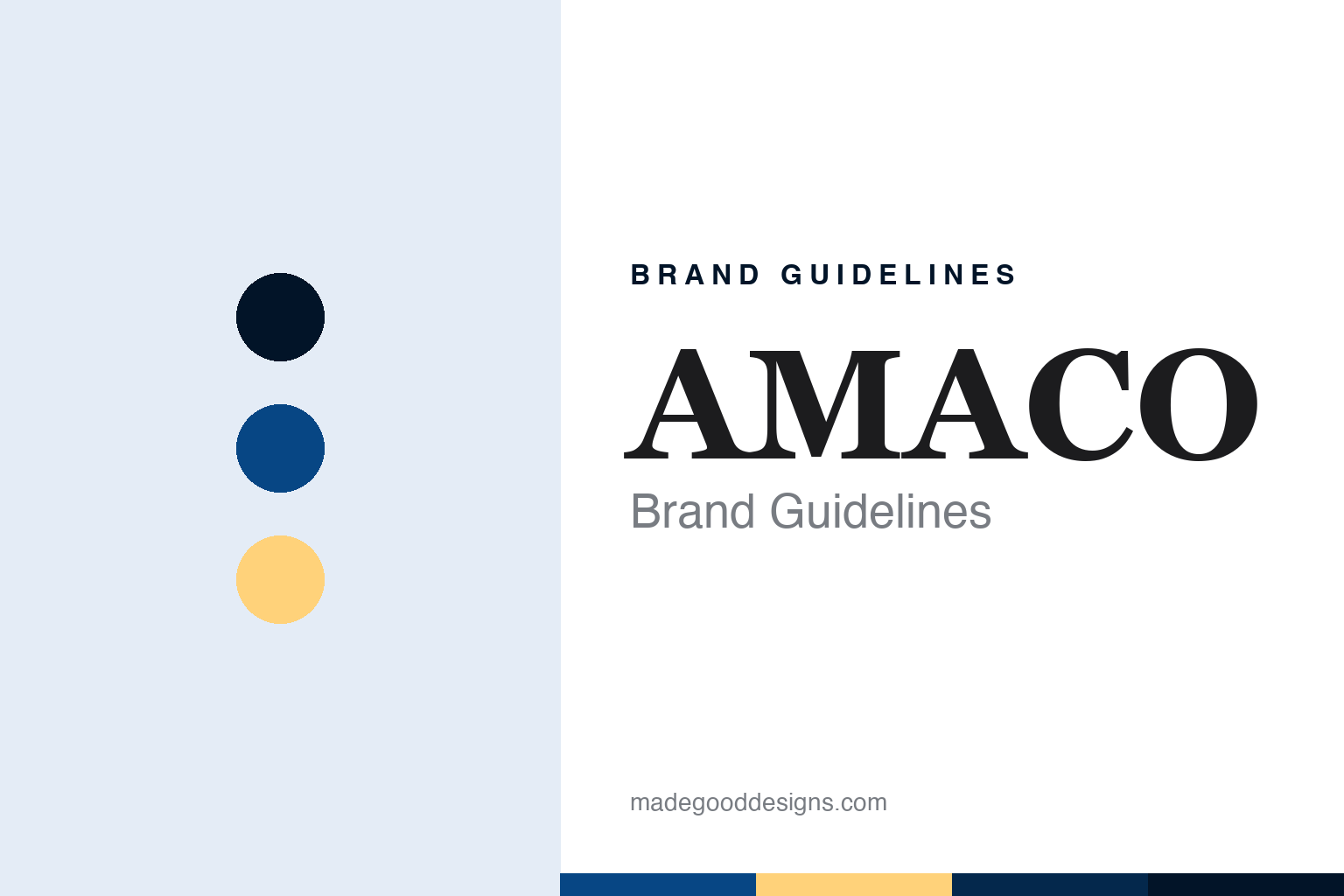
AMACO Brand Guidelines
A glaze label under law.
Aa
Two constants: a badge-navy palette and a schoolroom-serif register. Abstract homage — not an AMACO product or mark; no glaze, label, seal or badge is reproduced.
A schoolroom company
AMACO grew up selling clay to teachers — and its history reads like a school year.
AMACO — the American Art Clay Company — says it “was founded in 1919 by Ted O. Philpott” in Indianapolis and is now “a fourth-generation 100-year family-owned and operated company.” A 2015 obituary of the founder’s daughter, Valri Philpott Sandoe, described her as “the principal owner and officer of her late father’s company.” It is one of the few businesses in this series still owned by the family that started it more than a century ago.
Its own timeline is unusually charming. It records first lesson plans in 1921; an art deco production pottery in 1930; teacher workshops at Indianapolis’s Herron art school in 1950; and, in the 1960s, “Operating an exotic zoo for school tours.” It made the metallic finish Rub ’n Buff from 1964, bought Brent potter’s wheels in 1978, and acquired Reward Glazes and launched Velvet underglazes in 1979. In 1987 it filed patents, naming David L. Sieverding as inventor, for a polycaprolactone modelling compound and for decorative foils; in 1989 it acquired the Friendly Plastic brand; and in 2004 it moved headquarters “after 75 years near the Indianapolis Motor Speedway.” It also claims a run of firsts — commercially made clays, lead-free glazes, electric kilns and potter’s wheels — which are AMACO’s own and which we report as such.
That is the context for everything else here. AMACO’s products have long gone into schools. Its products go into classrooms, and its labels are read by teachers deciding what a twelve-year-old may handle.
Colour
AMACO helped build the art-materials safety system. It says so itself.
Two lines in AMACO’s timeline matter more than the rest. In 1936 it was, it says, a “founding member of ACMI” — the Art & Creative Materials Institute, the industry body behind the safety seals found on many American art supplies. In 1976 it lists “Establishing the first glaze labeling safety practices with ACMI.” Elsewhere it says its products have been certified by ACMI “since 1940.” Both dates are its own; they need not conflict, since joining and certifying are different things.
The seals mean specific things. ACMI says its AP (Approved Product) seal is given to products “certified in a toxicological evaluation by a board certified toxicologist… to contain no materials in sufficient quantities to be toxic or injurious to humans, including children.” Its CL (Cautionary Labeling) seal marks products “properly labeled… for any known health risks,” and ACMI says: “Never give children in sixth grade or younger a product with the CL Seal.” AMACO explains one of its own CL glazes plainly: it “contains soluble copper, which, if ingested in sufficient quantities, can irritate the stomach lining.” It says its glazes are tested for lead and cadmium to ASTM methods.
Behind the seals sits federal law. Since 18 November 1990, under the Labeling of Hazardous Art Materials Act, every art material sold in the United States must carry a statement such as “Conforms to ASTM D-4236” — evidence that a toxicologist has reviewed the product for chronic hazards and the label says what it must. It is not, as ACMI’s own explanation makes clear, a certificate that the product is non-toxic. And a glaze that passes as an art material in the jar faces a different regime once fired onto a mug: the FDA caps leachable lead from cups and mugs at 0.5 micrograms per millilitre, and from flat plates at 3.0.
Typography
In 2026 AMACO began shipping glazes with redacted labels. It said nothing in them had changed.
The most unusual document in this round is AMACO’s 2026 product-update page. In June 2026 it told customers that temporary label markings were being applied “to ensure compliance with California labeling law… We are making this change to minimize frivolous lawsuits.” California’s law, it explained, lets plaintiffs “recover penalties and attorneys’ fees, even if the product is safe.” By July, products with “redacted information” on their labels were shipping; by August and September, temporary stock labels with “no glaze tile image.” And the line every customer needed: “Nothing has changed in the formulation.”
California’s Proposition 65 is the law in question, and AMACO has met it before. The state attorney general’s records show two earlier private enforcement notices against the company, both concerning phthalates — plasticisers — rather than glazes: one in 2007 over a phthalate in modelling clay, settled with reformulation and $19,500 in fees and a payment in lieu of penalty; and one in 2015 over a phthalate in vinyl tool grips, settled in 2016 with reformulation and $20,500. We report those as the records show them, and we do not suggest that the 2026 label changes reflect any finding about AMACO’s glazes. The company says they do not.
For a brand, the episode is a rare thing: a long-trusted classroom name explaining publicly why its own labels now show less. The redactions are a defence; the explanation is the brand.
Other makers handle the same law differently. The California clay maker Laguna Clay simply prints a standing warning on its website that some of its products “can expose you to chemicals including crystalline silica, which are known to the State of California to cause cancer, and Lithium Carbonate, which is known to the State of California to cause birth defects or other reproductive harm.” One company warns about everything; another removes what might invite a claim. Both are responses to the same statute.
Aa
A friendly schoolroom serif — clear, a little old-fashioned, at home on a jar label. (Specimen set in Fraunces, a serif STAND-IN; NOT the AMACO badge, seals or products.)
A navy badge with a date in it
AMACO’s mark carries its founding year and its wheel brand together.
The current logo is a rounded navy badge: “AMACO” in white capitals with “EST. 1919” beneath, and beside it the lowercase “brent” in a warm yellow-gold. The two names sit as one lock-up — clay and glaze on one side, wheels on the other — which is how the company has worked since 1978.
AMACO’s mark is a reminder that in the studio-materials trade, the label is part of the product. Its founding date, its seals and its warnings all sit on the same jar, read by the same teacher. A clear badge earns trust; a clear explanation, as in 2026, keeps it.
For this guide we use a badge navy and a Brent gold with a friendly schoolroom serif. The navy is close to the badge’s own colour, but these values are our interpretation, not AMACO’s specification, and nothing of its badge, seals or labels is reproduced.
Explore & save
Keep AMACO’s identity on hand — save it to a board in the Made Good inspiration library.
AMACO identity set
Pin the badge-navy palette and the schoolroom-serif register to your own board.