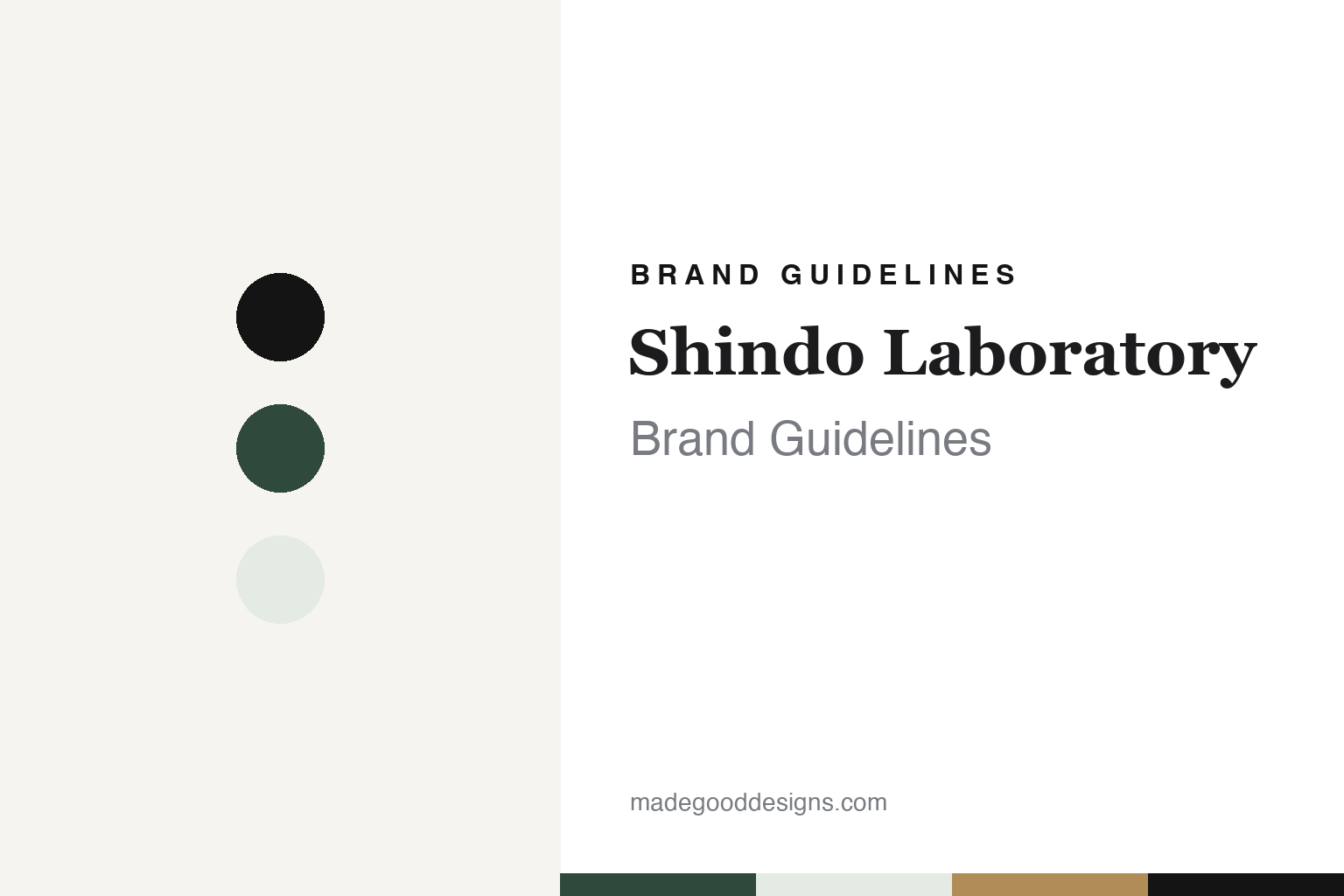
Shindo Laboratory Brand Guidelines
Ken Shindo’s green-cased valve amplifiers from Tokyo.
Aa
Two constants: a Shindo green, brass and black palette and an Engraved serif register. Abstract homage — not a Shindo Laboratory product or mark; no amplifier, swan, logo or nameplate is reproduced.
Tokyo, 1977
A Matsushita engineer and a cupboard of old parts.
Shindo Laboratory began in Tokyo in 1977. Its founder, Ken Shindo, had been a design engineer at Matsushita, the electronics group behind Panasonic and Technics, Stereophile reported in a 2014 news item by Art Dudley. He had inherited an interest in recorded music and playback equipment from his father, the magazine said, and spent years of spare hours learning how different vacuum tubes and vintage parts sounded before he struck out on his own. The company’s American importer, Tone Imports, gives the same year: “Shindo Laboratory was established in 1977.”
Among the first commercial products, according to Stereophile, were the model 1474 preamplifier and the 124B, a push-pull amplifier built around the 350B tube. Both used new-old-stock parts — components made decades earlier and never put into service — which the magazine called “a Shindo calling-card to this day.” The company’s own site says it first produced a single-ended amplifier with the Western Electric 300B tube in 1979, and it still lists a W.E. 300B Single Limited, an 8-watt class-A amplifier that it says is fitted with a 300B made in 1988.
The firm has stayed small and central. Its website gives an address in Hongo, in Tokyo’s Bunkyo ward, about ten minutes’ walk from Ochanomizu station, with business hours of noon to six on weekdays. Its products are signed with a swan: the 6moons review of the Monbrison preamplifier describes an “engraved signature Shindo Laboratory Swan” on the front. The same review, written when the brand was “only recently imported into the United States by Jonathan Halpern,” noted that it already enjoyed “an exalted status among the European and Southeast Asian cognoscenti.”
Colour
The tube first, the circuit second.
What set Shindo apart was the order in which it worked. Ken Shindo, Stereophile wrote, designed his circuits to play up the characteristics of the tubes he chose, “a not-insignificant point, considering that most other manufacturers do things the other way around.” The result was a catalogue of many amplifiers with similar power ratings, each meant to bring out a different side of a performance. There was almost always an EL34 amplifier in the line, the magazine noted, alongside designs built on less common tubes such as the 6B4G, the PX25, the E2d and the VT52. The current English pages list, among others, the Cortese, an 8-watt class-A amplifier using the F2a, and the Montille, a 20-watt class-A design with four CV391 tubes.
The 6moons review of the Monbrison described point-to-point wiring with no printed circuit boards, a dual-mono layout, and tubes, resistors and capacitors all chosen by ear, many of them American or European new-old stock. Over time the range grew beyond amplifiers. By 2014, Stereophile said, it took in vintage-inspired loudspeakers, many with field-coil drivers; step-up and impedance-matching transformers; an AC isolation transformer; and a widely imitated record player built around the Garrard 301 motor. The company’s site lists the Latour, a 70-kilogram floor-standing speaker with field-coil drivers rated at 100 dB per watt.
The isolation transformer is the Mr. T. Reviewing it in 2018, Dudley, who used a Shindo preamplifier and amplifier in his own system, found a large transformer by Haruna Denki inside a small steel box, and noted that his sample had arrived from “Shindo’s Tokyo workshop.” The model names, meanwhile, are mostly borrowed from French wine estates and appellations: Lafite, Latour, Petrus, Monbrison, Giscours, Montille, Vosne-Romanée.
Typography
Valves and colour.
Japan’s audio industry is best known for its large electronics groups, but much of its valve-amplifier and cable trade belongs to small specialist companies. The seven in this guide are all based in or around Tokyo, according to the addresses on their own websites.
Three are valve-amplifier makers. Shindo Laboratory lists its address in Hongo, in Tokyo’s Bunkyo ward. Audio Note, the Japanese company behind the Kondo name, says it was founded in 1976 and has worked with silver since then; it is based in Kawasaki, Kanagawa. Triode, set up in 1994 as Triode Supply Japan, is based in Koshigaya, Saitama; it says it designs its products itself and has them built by partner factories in China, and that its TRV-CD6SE CD player of 2020 was its first product made in Japan.
Two more make a wider mix of equipment. Fidelix, in Kiyose, western Tokyo, gives its founding year as 1976. Kripton, whose range runs from loudspeakers to cables and power accessories, lists its address in Yotsuya, Shinjuku.
The last two are cable and connector specialists. Furutech says it was established in April 1988 and designs and manufactures cables, connectors and power products from Togoshi, Shinagawa. Oyaide Electric began as an Akihabara wire seller in 1952, still runs a shop beneath the JR Sobu line, and has its head office in Yushima, Bunkyo.
This guide sets out what can be checked about each brand — who founded it, who owns it, and what it says about where its products are made — and marks clearly what rests only on the company’s own word.
Aa
An engraved serif — a register for a swan-signed, wine-named catalogue. (Specimen set in Libre Caslon Text, a serif STAND-IN; NOT the Shindo Laboratory logo.)
Shindo Laboratory
One green, repeated for decades.
The most recognisable thing about a Shindo component is its colour. By the 1980s, Stereophile said, metallic-green casework, inspired in part by the colour of certain vintage Altec products, had become one of the company’s informal trademarks. 6moons called the finish “Altec green,” and Dudley in 2018 described the Mr. T as finished, inside and out, “in Shindo’s trademark shade of green.” No official colour value is published, and we found no documented typeface or logo system in the sources we checked.
Ken Shindo died in late January 2014, aged 74, Stereophile reported in a news item dated 7 February 2014. The magazine said his wife, Harumi, and their youngest son, Takashi — described as the builder of various Shindo amplifiers and preamplifiers then in circulation — had helped him over the years, and quoted Jonathan Halpern of Tone Imports as saying that Shindo Laboratory would remain in business, operated by the family and its employees. We found no record of a sale or change of ownership in the sources we checked. The company’s website carries an update notice dated 2024, lists distributors from Germany and the United States to Thailand, Serbia and Israel, and says it will not repair products bought through Yahoo! Auctions. Its English page adds that Shindo Laboratory was “never affiliated with Tone Arts Laboratory,” a useful note for anyone searching the name. Europe has its own obstacle: the EU’s RoHS rules, Stereophile wrote in 2014, effectively prohibit the sale there of electronics containing vintage capacitors.
For a design guide, Shindo Laboratory shows how a single colour can become a signature without any published specification: one green, repeated across decades of hand-built boxes, does the work a logo manual does elsewhere. Compare the fellow Japanese valve-amplifier makers Leben and Air Tight. For this guide we use Shindo green, brass and black with a serif, an unofficial interpretation; no product or logo is reproduced.
Explore & save
Keep Shindo Laboratory’s identity on hand — save it to a board in the Made Good inspiration library.
Shindo Laboratory identity set
Pin the Shindo green, brass and black palette and the Engraved serif register to your own board.