Salk Sound Brand Guidelines
The Michigan speaker maker that built every pair to order.
Aa
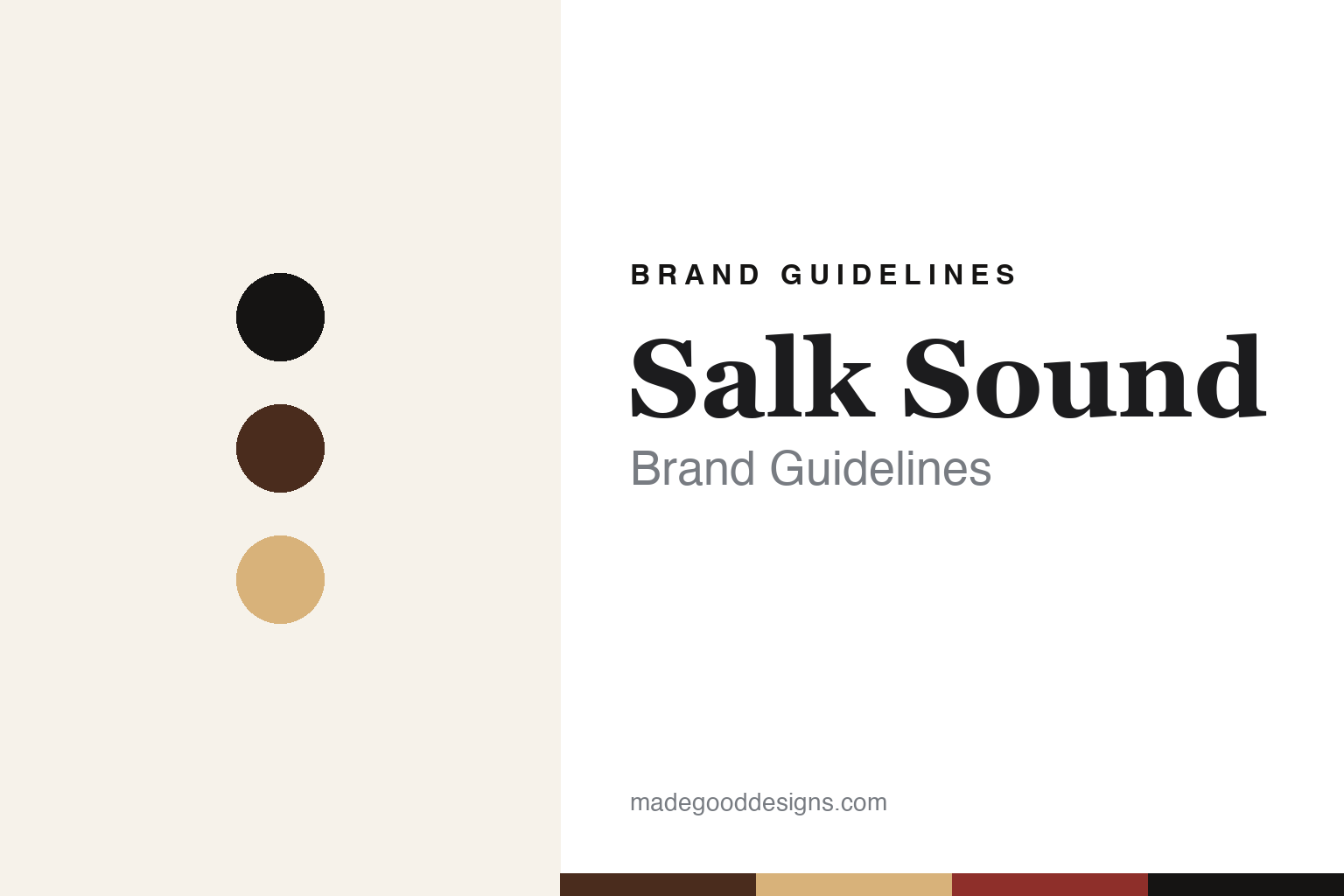
Two constants: a Salk walnut, maple and cherry palette and a Craftsman serif register. Abstract homage — not a Salk product or mark; no speaker, logo or nameplate is reproduced.
Truth in Sound
A backyard workshop that became a business.
Salk Sound was the loudspeaker business of Jim Salk, in the suburbs north of Detroit. Secrets of Home Theater and High Fidelity named him as its founder in a 2015 review, and he tells the story himself on the company’s website. More than forty years ago, he writes, he set out to build a recording studio, found that the architects he asked knew little about acoustics, and taught himself instead — acoustics, studio construction, electronics and recording.
The speakers came later. “Around the time the new millennium began,” he says, he wanted a pair of high-end speakers but not the prices, so he built his own. Someone posted a picture of a pair he had veneered in Mappa burl, and strangers began asking him to build pairs for them. For about two years he did so as a hobby, working in his back yard, shovelling snow in winter to reach his saw. Friends in the industry told him not to turn it into a business; he rented manufacturing space anyway.
The earliest archived copy of its website, from October 2003, already shows the name: “Custom-crafted, high-performance audio,” a first line called Veracity, defined dictionary-style as “adherence to the truth,” and the slogan “truth in sound.” The footer then described Salk Sound as “a division of Salk Communications, Inc.” Its own pages place its workshop in Oakland County, Michigan — its FAQ places its production facilities in Pontiac, in the Detroit metro area, and its later contact details are in Lake Orion. Trade press often called it Salk Signature Sound.
Colour
Direct, to order, with Dennis Murphy crossovers.
Salk’s model was simple: no dealers. “We sell direct,” its FAQ says, putting the money a retail chain would take into cabinets, drivers and crossover parts. Every pair was “built to order for each individual customer and hand-crafted in our Michigan production facility,” the company says, with drivers bought from Norway, Denmark, Germany, Japan and the United States, “many of them custom made just for us.” Customers paid the freight, so the cabinets could be heavy. Secrets confirmed in 2015 that “all Salk speakers are custom made to order.”
The crossovers came from Dennis Murphy, an economist by profession and a viola player in the Washington Metropolitan Philharmonic, who “has been designing crossovers for private clients and Salk Sound for over twenty years,” according to Philharmonic Audio, the speaker company he launched in 2012. Salk’s pages credit “an incomparable Dennis Murphy crossover design” and transmission-line cabinets “based on the pioneering work of Martin King.” At the 2014 Capital Audiofest, Positive Feedback reported, Salk shared a room with Philharmonic; the two firms had done work for each other.
The best-known models were the SongTower, a transmission-line floorstander with Hiquphon silk-dome tweeters and a pair of Seas woofers, and the Veracity HT2-TL, with a RAAL ribbon tweeter and Seas Excel woofers. The three-way Song3, launched at AXPONA in 2016, used a RAAL ribbon. Secrets reviewed the Exotica 3 in September 2015 — SEAS Exotic drivers above twin servo-controlled Rythmik woofers, at $12,995 a pair — and named it its “Best Looking Speakers for 2015.” The flagship SS 9.5 of 2019 weighed 112 pounds and cost $9,995 a pair, Part-Time Audiophile reported; the company also sold Salk/Rythmik subwoofers and a StreamPlayer music server. Salk says The Absolute Sound gave the SongTower its Editor’s Choice award seven years running, by 2017; we did not check each year.
Typography
Design and documentation.
The seven loudspeaker makers in this guide are small American companies, most of them built around a single designer. The oldest is Legacy Audio, which Bill Dudleston started in 1983 in Springfield, Illinois, where it remains. It sells through authorized dealers and online, and in 2025 it introduced Jay McArdle as its new owner and chief executive.
Two are in Utah. Tekton Design, run by Eric Alexander, gives its address as Orem and calls its business model “strictly direct-to-consumer.” Spatial Audio Lab, founded by Clayton Shaw, also sells direct, saying dealers “often want a double digit mark-up rate”; the company says Shaw sold its assets to Sam and David Whitt in 2023.
In the Midwest, Salk Sound, Jim Salk’s company, built speakers to order in Pontiac, Michigan, by its own account, and sold them direct. On 15 September 2023 it said it had stopped taking orders and sold its woodworking equipment.
On the coasts, Stereophile places Jeff Joseph’s Joseph Audio on Long Island, New York, and the company’s website sends buyers to dealers. Daedalus Audio, which Lou Hinkley founded in 1992, works from Ferndale, Washington; it says its speakers are sold only direct in the US, with dealers in Australia and Singapore.
The South has Volti Audio. Greg Roberts, who started out rebuilding Klipschorns in Maine, now builds horn loudspeakers in Baxter, Tennessee, selling almost entirely direct.
This guide sets out what can be checked about each brand — who founded it, who owns it, and what it says about where its products are made — and marks clearly what rests only on the company’s own word.
Aa
A craftsman serif — “truth in sound.” (Specimen set in Fraunces, a serif STAND-IN; NOT the Salk logo.)
Salk Sound
Figured wood, dyed to order.
The company’s look was its wood. Standard finishes were curly maple, curly cherry, curly walnut, oak, straight mahogany and satin black, and the veneers could be dyed — its own examples are “deep rose-red curly cherry or electric blue curly maple.” A gallery of finished pairs sat at the centre of its website, and show reports regularly noted the cabinets: Positive Feedback called Salk “a manufacturer of some very fine-looking loudspeakers” in 2014, and in 2021 Part-Time Audiophile photographed an SS 9.5 in red paint.
The business has now closed its workshop. A notice on its website says that as of September 15, 2023, Salk Sound is no longer accepting orders for new speakers, that it has sold its woodworking equipment and no longer has a shop, and so cannot build new speakers or repair old ones. Signed “Jim,” it thanks customers for “over 20 years” and says the site will stay up “for archival purposes,” with “a few ideas” for what Salk Sound might become. It gives no other reason, and we add none. Its last announced design, in November 2021, was the BePure 2, a two-way; Part-Time Audiophile reported the same month a new Salk speaker with Purifi drivers at Capital Audiofest.
We found no published brand guidelines or official colours; the website’s wordmark is plain, and the palette here is ours.
For a design guide, Salk shows how a small direct-sale maker can make the cabinet itself the brand. Compare Vandersteen, another American speaker maker built around one designer, and Thiel, another American speaker maker long identified with its founder. For this guide we use walnut, maple and a rose-red cherry with a serif, an unofficial interpretation; no product or logo is reproduced.
Explore & save
Keep Salk Sound’s identity on hand — save it to a board in the Made Good inspiration library.
Salk Sound identity set
Pin the Salk walnut, maple and cherry palette and the Craftsman serif register to your own board.