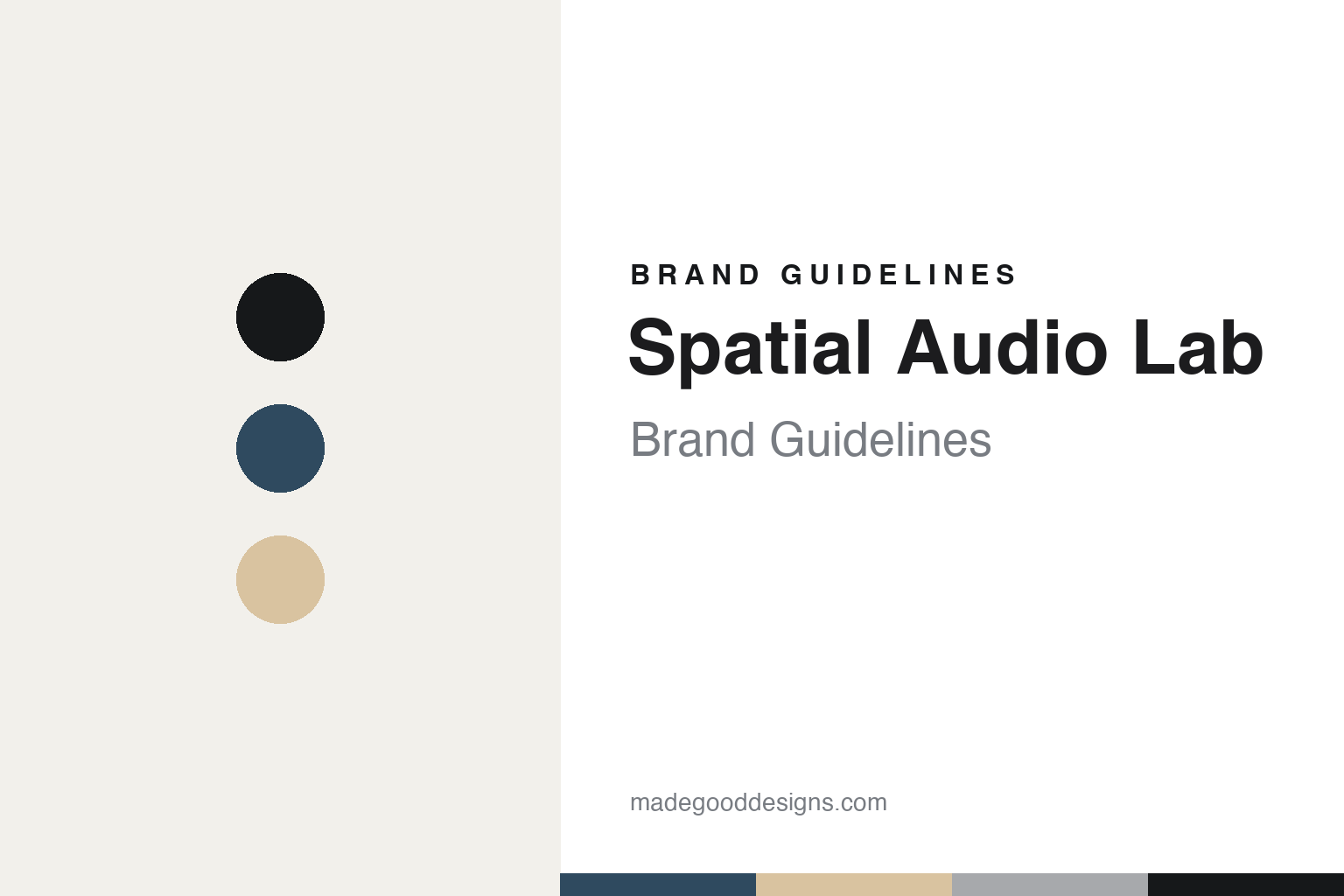
Spatial Audio Lab Brand Guidelines
Clayton Shaw’s open-baffle speakers from Utah.
Aa
Two constants: a Spatial blue, birch and aluminium palette and an Open grotesque register. Abstract homage — not a Spatial Audio Lab product or mark; no speaker, logo or nameplate is reproduced.
A Park City company
Clayton Shaw, after Emerald Physics.
Spatial Audio Lab is a loudspeaker maker, not the immersive-sound format that shares its name: “spatial audio” is also the generic term for 3D sound in headphones and cinemas, and the two are unrelated. The company was founded by Clayton Shaw, an engineer whose earlier audiophile brands, by its own account, included Evett & Shaw and Emerald Physics. Part-Time Audiophile called Spatial “the brain child of Clayton Shaw (also the founder of Emerald Physics)” in 2016.
Its first website, at spatialaudio.us, is archived from May 2014, under the copyright of Spatial Computer LLC. Its About page introduced a “Park City company”: “Located in Park City Utah, SPATIAL was formed to develop effective solutions to some of high-end audio’s most pressing issues,” beginning with room acoustics. Before speakers it offered Spatial HD room-control software, a “Black Hole Acoustic Pressure Absorber” and online analysis of customers’ listening rooms. The page credited Shaw with more than 35 years in audiophile and professional audio, including a post as director of R&D and engineering at a large, unnamed pro-sound speaker maker. We found no founding year, so we give 2014 as the date it was first documented, not as its start.
By 2015 the site announced the Hologram loudspeakers — the M1, which it said made its world debut at the California Audio Show, and the M2 — and a beryllium coaxial driver, the X32. It also reported that the M2 had won a best-sound award from The Absolute Sound at AXPONA, which we have not confirmed. By 2021 its address had moved to Salt Lake City.
Colour
No box, and no toys for rich guys.
Every Spatial speaker is an open baffle: drivers mounted on a flat panel with no box behind them, so that sound radiates forwards and backwards in a figure-of-eight. The company argues that this dipole pattern excites the room less in the bass and removes “box coloration”; its earliest tagline was “Spatial has eliminated the box.” Its speakers are flat, narrow panels with exposed woofers — the design is the technology, made visible.
Price was part of the pitch. At the Newport show in 2015, Part-Time Audiophile reported, the new M3 Hologram cost $1,495 a pair against $4,000 for the earlier M1, thanks to “better build processes and larger order quantities,” and Spatial sold only direct and only in the United States. “I’m getting so tired of everything being too expensive,” Shaw said; “I don’t want to just sell toys to rich people.” By AXPONA 2016 the M3 was just under $2,000, with a $600 Turbo S upgrade, and the magazine praised its coaxial drivers and “minimalist design chic.”
Later models grew larger. Part-Time Audiophile reviewed the M3 Sapphire in October 2020 — a modified Peerless sapphire-dome tweeter over custom Eminence woofers, just under $5,000 a pair — and gave it an Editor’s Choice award. The X-series added an air-motion-transformer tweeter; the company dates its X4 Premium to 2019. Its range in 2021, as archived, was four models: the M5 and M3 Sapphire and the X5 and X3; the new owners later shelved the M-series in favour of a cheaper design and brought back the X4. Today it sells the S-series, its least expensive line, the X4, and the semi-open Q-series, with 15-inch dipole woofers, which it says was unveiled at Southwest Audio Fest in 2024.
Typography
Design and documentation.
The seven loudspeaker makers in this guide are small American companies, most of them built around a single designer. The oldest is Legacy Audio, which Bill Dudleston started in 1983 in Springfield, Illinois, where it remains. It sells through authorized dealers and online, and in 2025 it introduced Jay McArdle as its new owner and chief executive.
Two are in Utah. Tekton Design, run by Eric Alexander, gives its address as Orem and calls its business model “strictly direct-to-consumer.” Spatial Audio Lab, founded by Clayton Shaw, also sells direct, saying dealers “often want a double digit mark-up rate”; the company says Shaw sold its assets to Sam and David Whitt in 2023.
In the Midwest, Salk Sound, Jim Salk’s company, built speakers to order in Pontiac, Michigan, by its own account, and sold them direct. On 15 September 2023 it said it had stopped taking orders and sold its woodworking equipment.
On the coasts, Stereophile places Jeff Joseph’s Joseph Audio on Long Island, New York, and the company’s website sends buyers to dealers. Daedalus Audio, which Lou Hinkley founded in 1992, works from Ferndale, Washington; it says its speakers are sold only direct in the US, with dealers in Australia and Singapore.
The South has Volti Audio. Greg Roberts, who started out rebuilding Klipschorns in Maine, now builds horn loudspeakers in Baxter, Tennessee, selling almost entirely direct.
This guide sets out what can be checked about each brand — who founded it, who owns it, and what it says about where its products are made — and marks clearly what rests only on the company’s own word.
Aa
An open grotesque — “Spatial has eliminated the box.” (Specimen set in Archivo, a sans STAND-IN; NOT the Spatial Audio Lab logo.)
Spatial Audio Lab
New owners, the same open baffle.
The founder no longer owns the company. In March 2023, Spatial’s website says, Shaw decided to sell, and Sam Whitt, a former employee, and his father, David Whitt, agreed to acquire the company’s assets; Shaw stayed on as head of sales and an adviser. David Whitt signed newsletters that year as general manager. The new owners cleared a backlog of X4 orders — “some people waited over a year,” they wrote — priced the X4 Ultra at $9,800 a pair, and added amplifiers: the Revelation 300B monoblocks and preamplifier designed by Don Sachs and Lynn Olson, which 6moons listed at $20,000 a pair and $5,000.
Shaw has since shown speakers under his own name. At Pacific Audio Fest in 2024 Part-Time Audiophile reported a Clayton Shaw Acoustic Lab room with the Caladan, at $3,450 a pair, and wrote that Spatial Audio “had changed its name”; Spatial Audio Lab is still trading under the Whitts, so we treat the two as separate businesses. Shaw’s site traces the Caladan back through “the Spatial M Series” to the Emerald Physics CS2 of 2008.
Spatial describes its speakers as “American-made” and its team as building the crossovers, running the CNC machine and hand-finishing the baffles, with painting and powder coating by another family firm; we give that as its account. Its top models stand on solid aluminium bases, and it recommends Ultralam baffles over painted MDF. It offers a five-year limited warranty on speakers. We found no published brand guidelines.
For a design guide, Spatial Audio Lab shows a brand whose engineering idea is also its shape. Compare Magnepan and MartinLogan, two other American makers of dipole panel speakers. For this guide we use a slate blue, birch and aluminium with a sans, an unofficial interpretation; no product or logo is reproduced.
Explore & save
Keep Spatial Audio Lab’s identity on hand — save it to a board in the Made Good inspiration library.
Spatial Audio Lab identity set
Pin the Spatial blue, birch and aluminium palette and the Open grotesque register to your own board.