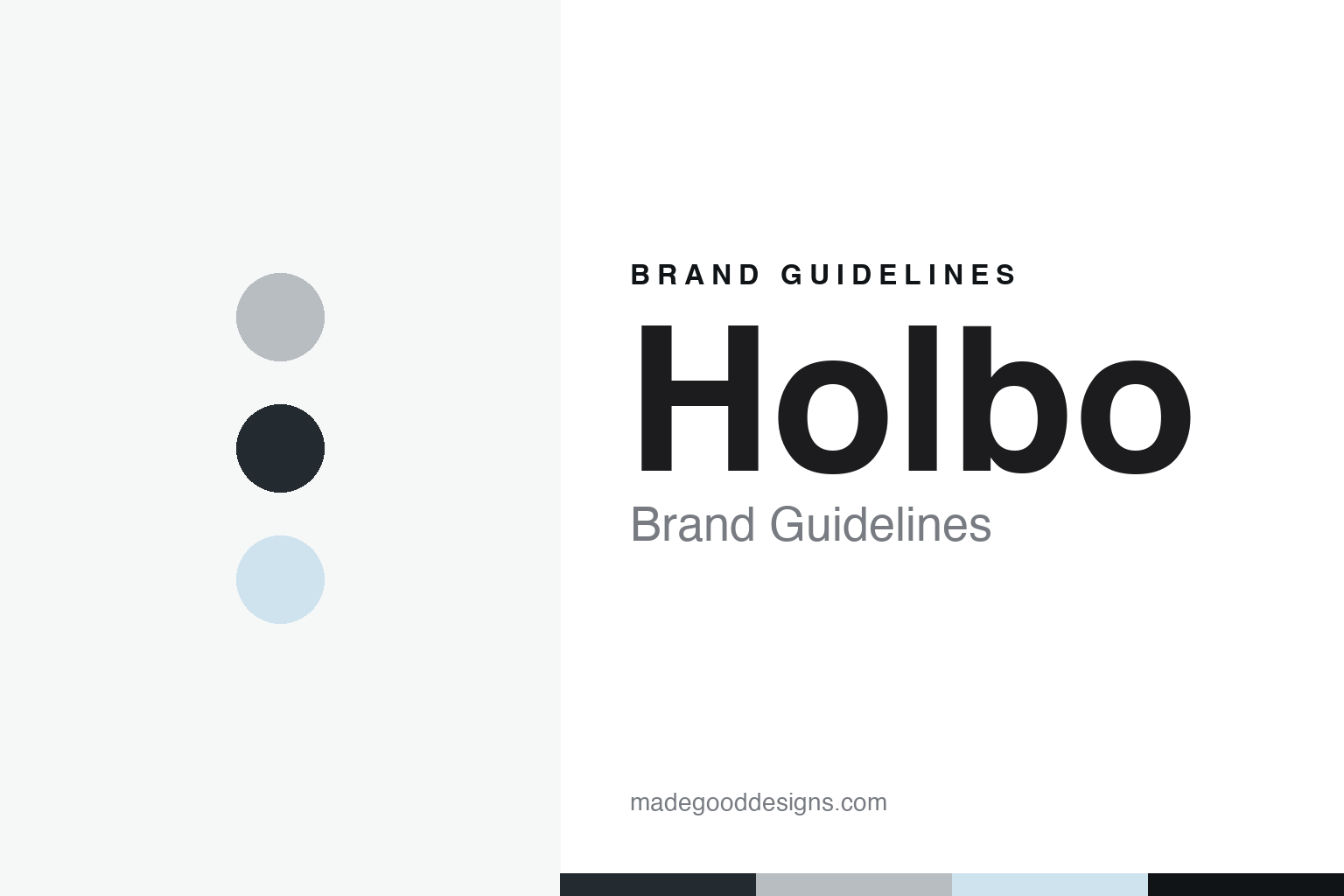
Holbo Brand Guidelines
The Ljubljana turntable whose moving parts never touch.
Aa
Two constants: a Holbo graphite, aluminium and air blue palette and an engineered sans register. Abstract homage — not a Holbo product or mark; no turntable, logo or nameplate is reproduced.
Holc + Boštjan
A one-person company named after its maker.
Holbo is the turntable business of Boštjan Holc, a designer in Ljubljana, the Slovenian capital. The name is his own: the Polish magazine High Fidelity explained it in 2018 as Holc plus Boštjan, and TNT-Audio said there were “no prizes for guessing where the name comes from.” Slovenia’s business register, as summarised by the business directory Bizi.si, lists the firm as HOLBO, Boštjan Holc s.p. — a sole proprietorship — registered on 1 October 2017, with an address in Ljubljana.
The turntable appeared the same month. High Fidelity, which billed its February 2018 test as a world premiere, reported that the deck was first shown in October 2017 at the Hi-Fi Ljubljana show and a month later at a show in Zagreb. In a statement Holc gave the magazine, he said he had built his first turntable about 30 years earlier and his first air-bearing turntable and tonearm about 20 years earlier, and had then spent less than three years simplifying that design into the one he named Holbo. Those dates are his own account.
His aim is set out on the company website in the first person: a record player whose moving parts “do not touch each other,” so that micro-vibrations and mechanical friction are removed. He told High Fidelity that his listening is mostly classical music and opera, and the website opens with the task of recreating “a symphonic orchestra or an opera, featuring eighty or more artists” at home.
Colour
Two air bearings, one product.
Holbo makes one product, the Airbearing Turntable System, which What Hi-Fi? called the company’s “sole product” in 2022. It floats two things on air. The 5 kg aluminium platter turns on an air bearing rather than an oiled spindle, and the tonearm is a linear-tracking air-bearing arm that slides along a rail, keeping the stylus parallel to the groove as a cutting lathe does, instead of swinging on a pivot. Both bearings are fed by an external compressor through a plastic tube. The company gives the arm’s effective length as 163 mm and its effective mass as 7.5 g, and says stylus rake angle, VTA — adjustable while a record plays — and azimuth can all be set.
The first version was widely reviewed from 2018. TNT-Audio’s Graeme Budd, in June 2018, found setup fiddly — “read the instructions. Twice” — but praised the deck’s precision and speed stability, and noted that the compressor on his early sample was “a tad noisy.” High Fidelity reported a 30 mm MDF plinth and a DC motor made in Japan, as Holc described them. Reviews followed in 6moons, Hi-Fi News, Stereo Sound in Japan and others, according to the company’s list.
The Mk II, reviewed from late 2021, combined the air pump and the motor power supply in one box; on the Mk I they had been separate units, What Hi-Fi? reported. The Ear added in January 2022 that the platter’s on/off switch now also starts the pump, which was quiet enough to forget about. What Hi-Fi?, in a review first published by its Australian sister magazine Sound+Image, tested it at £6,000 and listed its weight as 12 kg.
Typography
Turntables and their makers.
The turntable makers in this guide span more than a century. The oldest name is Garrard: Wikipedia says its engineering company was formed in 1915 and moved to Swindon in 1919, and that its 401 turntable was used by the BBC. Since 2018 the brand has belonged to the owners of SME, and Garrard’s website says each revived 301 is rebuilt from an original drive at SME’s works in Steyning, West Sussex.
The other British maker is younger. Vertere is run from north-west London by Roksan co-founder Touraj Moghaddam; its company was registered in 2006, and Hi-Fi News reported that its first turntables followed in 2013.
Two makers share a city: Ljubljana, in Slovenia. Holbo, Boštjan Holc’s air-bearing turntable, debuted at a Ljubljana hi-fi show in 2017, HighFidelity reported. Pear Audio trades there as Pear Audio Europe d.o.o.; AnalogPlanet reported in 2014 that its designs grew from Peter Mezek’s work with the late Tom Fletcher of Nottingham Analogue.
In Germany, Sperling Audio is Ansgar Sperling’s business at Welver, in North Rhine-Westphalia; it showed its first high-mass turntable at the High End show in Munich in 2013 and says its products are made by hand in Germany.
Australasia supplies the rest. Wand comes from Design Build Listen Ltd, incorporated in New Zealand in 2004, which says its products are handmade there; Dohmann Audio, Mark Dohmann’s company, is based in Melbourne and says every product is made in Australia.
This guide sets out what can be checked about each brand — who founded it, who owns it, and what it says about where its products are made — and marks clearly what rests only on the company’s own word.
Aa
A clean, engineered sans — for a deck with almost no branding on it. (Specimen set in Manrope, a sans STAND-IN; NOT the Holbo logo.)
Holbo
Built to order, sold direct.
Holbo sells direct. Its website says the business takes orders by form or email, builds each system to order with a lead time of a couple of days to about a month, and offers auditions by appointment at its Ljubljana address. In 2025 it priced the Mk II at €4,990, including the turntable, the arm, the combined compressor and power supply, worldwide express delivery and a two-year warranty. Earlier prices varied: High Fidelity gave €5,000 in early 2018 and TNT-Audio €6,500 a few months later. High Fidelity labelled the deck “made in Slovenia,” and we found no report of it being made elsewhere, though the magazine said the compressor came from an outside supplier.
Holbo belongs to a small Slovenian analogue scene. High Fidelity pointed out that Kuzma, also Slovenian, is known for tangential tonearms, and compared air-bearing arms run at high pressure, such as Kuzma’s, with low-pressure designs such as the Sindre from Denmark’s Bergmann.
The branding is minimal. TNT-Audio described a “tasteful black on black Holbo logo” on the front corner of the first version; by the Mk II, What Hi-Fi? wrote, the plinth carried no branding beyond its buttons, while the pump box was “proudly branded ‘Holbo Air Pump’.” No typeface or colour values are published. Readers searching online should note that holbo.si is the company’s site, and that Holbo Herred, a historic district in Denmark, and the Norwegian surname Holbø are unrelated.
For a design guide, Holbo shows how a one-person company can build an identity around a single idea — parts that never touch — and let the product carry the name. Compare Kuzma, its Slovenian neighbour in tangential arms, and Bergmann, another air-bearing turntable maker. For this guide we use graphite, aluminium silver and a pale air blue with a sans, an unofficial interpretation; no product or logo is reproduced.
Explore & save
Keep Holbo’s identity on hand — save it to a board in the Made Good inspiration library.
Holbo identity set
Pin the Holbo graphite, aluminium and air blue palette and the engineered sans register to your own board.