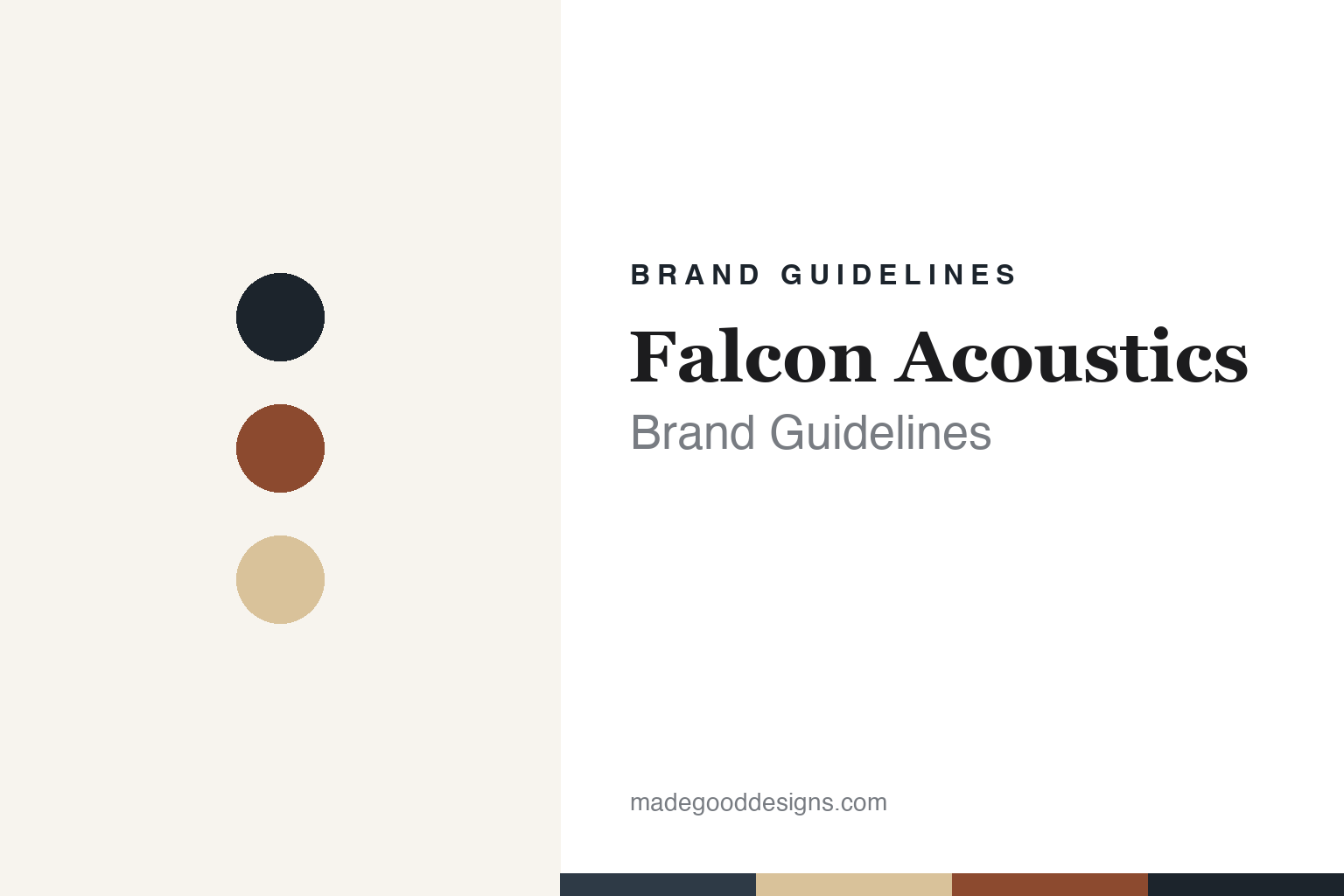
Falcon Acoustics Brand Guidelines
The KEF engineer’s parts firm that brought back the original 15-ohm LS3/5a.
Aa
Two constants: a Falcon slate, birch and amboyna palette and a Workshop serif register. Abstract homage — not a Falcon Acoustics product or mark; no loudspeaker, logo or nameplate is reproduced.
Falcon Electronics
A KEF engineer and a kitchen table.
Falcon Acoustics is older than its best-known product suggests. The company says it was founded in 1972 as Falcon Electronics by Malcolm Jones, whom it describes as the first employee, in 1961, of KEF Electronics, the Kent loudspeaker maker founded that year by Raymond Cooke. Stereophile also called him “KEF’s first employee” in 2015. English Wikipedia’s article on the LS3/5A dates his time at KEF to 1962–1974, so the sources differ by a year on when he started.
At KEF, Jones was senior development engineer. Falcon says he did most of the design and development of KEF’s B139, B200, B110, T15 and T27 drive units, and Stereophile credited him with the B110 woofer and the T27 tweeter — the two units used in the BBC’s original LS3/5A. He left KEF in 1974, the company says, after finishing the Reference Series 104 speaker, to work on Falcon full time.
Falcon began as a supplier to people who build their own loudspeakers. Jones’s own account, dated January 2010, describes a small family business with Valerie and Malcolm Jones as directors, started on a kitchen table in Bexhill, Sussex. It moved to Mulbarton, near Norwich, in 1976 and to Acle, between Norwich and Great Yarmouth, in 2003. Its main advance, he wrote, was winding self-bonded ferrite-cored inductors to order, which let designers outside the big companies build crossovers for drive units from different makers. He said that at one time over two-thirds of British speaker manufacturers used Falcon inductors, a claim we give as his. Falcon also designed the Tabor speaker kit, which Jones said was sold in many countries and built commercially by three companies, and in 1978 it took over Nightingale Acoustics, adding new models such as the NM3, Lyric and Enigma. In the early 1980s, he wrote, it also became a distributor of Focal drive units.
Colour
A licence lost in 1982, won in 2013.
Falcon’s link with the BBC monitor goes back decades. In January 1982, Jones wrote, Falcon applied for a BBC licence to make the LS3/5A through its subsidiary Nightingale Acoustics, but lost out to Goodmans — and then supplied Goodmans’s crossovers. Stereophile told the same story in 2015, and the unofficial LS3/5A timeline at ls35a.org says Falcon made crossovers for Goodmans and RAM in the 1980s.
The business changed hands at the end of the 2000s. Valerie Jones died in June 2008. Malcolm Jones retired and, by his own account, sold Falcon to Jerry Bloomfield, near Oxford, whom he described as having decades of knowledge of IMF speakers. Companies House records Falcon Acoustics Limited as incorporated on 21 December 2009, with Jeremy Bloomfield and Anne Schuster as directors and its registered office in Oxfordshire. Jones stayed on as a technical consultant, the company says.
The licence came next. English Wikipedia says the BBC granted Falcon a licence for the 15-ohm version of the LS3/5A in 2013, and that production began in 2014 — restarting the original version, which had given way to an 11-ohm design in the late 1980s. In Stereophile’s July 2015 review, Herb Reichert described how Jones and Bloomfield, meeting over curries after Valerie Jones’s death, set out to recapture the BBC’s original prototypes; Bloomfield called them a couple of “old farts” working “in a shed.” Rather than substitute modern drivers, Falcon re-engineered the B110 and T27 itself, with a doped Bextrene cone and a Mylar dome, and paired them with the original BBC crossover design. The review priced the speaker at $2,195 a pair and said it was made in Oxfordshire.
Typography
Design and documentation.
Britain’s smaller loudspeaker makers draw on a tradition set by the BBC, whose Research Department at Kingswood Warren in Surrey designed monitors and licensed others to build them. Sound On Sound names the first three LS3/5A licensees as Rogers, Audiomaster and Chartwell; English Wikipedia says Falcon Acoustics now holds the licence for the 15-ohm version.
Their websites and Companies House place the makers in this guide across Britain: Kudos at Willington, County Durham; Acoustic Energy at Trull, near Tetbury, Gloucestershire; Fyne Audio at Bellshill, North Lanarkshire; Russell K at a registered address in Dunstable, Bedfordshire; Falcon Acoustics at Stanton St John, near Oxford; Stirling Broadcast near Carmarthen in Wales, though Stereophile listed it in Somerset in 2007; and the Chartwell name with Graham Audio in Newton Abbot, Devon.
Several have changed hands. Chartwell was sold from receivership to Rogers’ owner in 1978; Graham Audio revived the name by 2016. Falcon says its founder, Malcolm Jones, transferred the business to Jerry Bloomfield in 2009. Companies House shows Acoustic Energy’s original 1987 company, dissolved in 2022, was controlled by the Malaysian-listed Formosa Prosonic Industries; a Tetbury company that calls itself British owned and run now trades as Acoustic Energy.
On manufacturing, the makers speak for themselves. Kudos says each loudspeaker is assembled by hand in its factory in North East England; Fyne Audio says its F700 series is built in the UK; Graham Audio says its loudspeakers are hand-assembled on site.
This guide sets out what can be checked about each brand — who founded it, who owns it, and what it says about where its products are made — and marks clearly what rests only on the company’s own word.
Aa
A workshop serif — a parts supplier since 1972. (Specimen set in Libre Baskerville, a serif STAND-IN; NOT the Falcon Acoustics logo.)
Falcon Acoustics
Parts, repairs and one famous speaker.
Today Falcon sells two kinds of thing. One is its own loudspeakers: the BBC-licensed LS3/5a, including limited editions — its website in 2025 listed a 2024 limited edition at £7,995 a pair and a 2025 “Platinum Edition” in amboyna burr veneer — the Q7, which English Wikipedia says uses the same drive units in a deeper cabinet for more bass, and the F50. The other is the trade it started with: replacement drive units for classic KEF speakers, LS3/5a parts and repairs, and components from makers such as SEAS, Scan-Speak and Accuton for people who build their own. Its 2013 website called it “The Leading DIY Speaker Parts and Kit Supplier since 1972.” The company now calls itself the largest UK supplier of drive units; we could not check that.
On where its speakers are made, the record is consistent: Stereophile said Oxfordshire in 2015, English Wikipedia says the drive units and crossovers are produced in-house, and Companies House lists the manufacture of consumer electronics among its activities. One correction matters for anyone researching the brand: a section of the English Wikipedia LS3/5A article says Falcon was “founded in 2014.” That is the year its LS3/5a went into production, not the year the company began; by its own account, Falcon had been trading for more than four decades by then.
For a design guide, Falcon Acoustics shows how a parts supplier can become a heritage brand by reviving a design its founder helped to make. Compare Harbeth, another LS3/5A licensee, and Stirling Broadcast, which kept the 11-ohm version alive. For this guide we use a slate, a birch and an amboyna brown with a serif, an unofficial interpretation; no product or logo is reproduced.
Explore & save
Keep Falcon Acoustics’s identity on hand — save it to a board in the Made Good inspiration library.
Falcon Acoustics identity set
Pin the Falcon slate, birch and amboyna palette and the Workshop serif register to your own board.