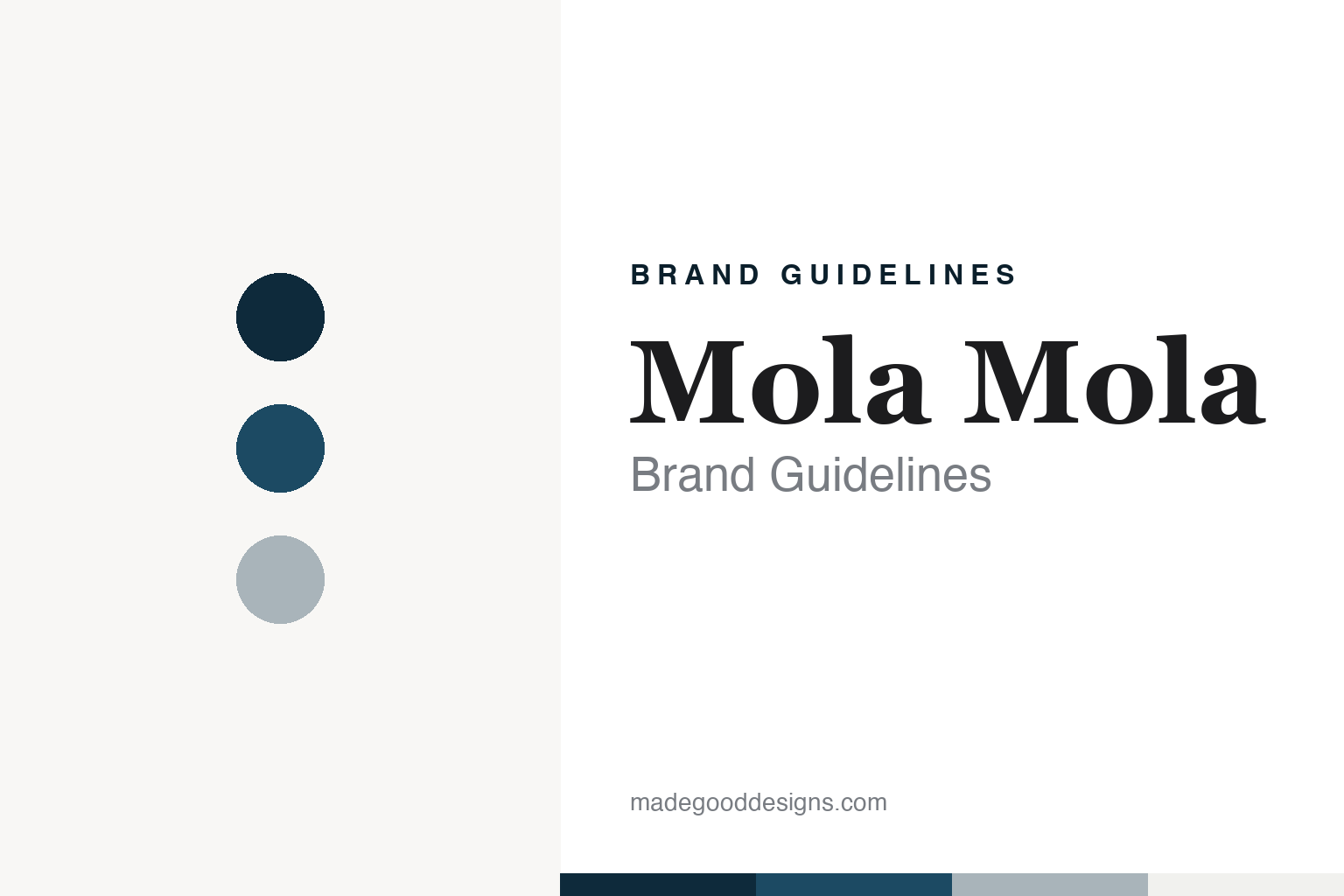
Mola Mola Brand Guidelines
The Hypex spin-off that named its hi-fi after fish.
Aa
Two constants: a Mola Mola deep-sea blue, silver and pearl palette and a calm serif register. Abstract homage — not a Mola Mola product or mark; no amplifier, logo or nameplate is reproduced.
A Hypex spin-off
A module maker builds its own hi-fi.
Mola Mola is the consumer hi-fi brand that grew out of Hypex, the Groningen maker of class-D amplifier modules. It was set up in 2012 by Hypex’s founder, Jan-Peter van Amerongen, and the Belgian engineer Bruno Putzeys, who had developed Hypex’s UcD and Ncore amplifier technologies; Hi-Fi News wrote in 2024 that Putzeys “set up the brand with Hypex founder Jan-Peter van Amerongen.” Reviewing the Kaluga amplifiers in 2014, 6moons called it “a spin-off from Hypex for which Jan-Peter and Bruno design and manufacture turnkey consumer products,” and in 2025 Hifi Pig described Hypex as “the mother company of Mola Mola.”
The brand’s website gives Hypex’s address, Kattegat 8 in Groningen, under a separate entry in the Dutch commercial register. Neither company publishes a shareholder breakdown that we could find, so we describe the link as the trade press does rather than in legal terms.
Putzeys told the story of the start in a blog on the Mola Mola website. “The Mola-Mola project was kicked off in January 2012,” he wrote in May 2013. Jorrit Mozes — “of Hypex,” 6moons noted — “camped down in our lab in Belgium to design the case work while I sat down to do schematics and PCB’s.” Prototypes were assembled in April and shown that May at the 2012 High End show, then held in Munich.
Colour
Makua, Kaluga and Tambaqui.
The first products were a preamplifier and a pair of mono power amplifiers. Feedback from distributors changed the preamp: Putzeys wrote that people asked for a remote control, a balance control, a mono switch, extra outputs and a phone app, and that adding them “added a full year to our schedule.” The preamp, “later baptized Makua,” became a full-width unit with programmable routing, relay-based volume control and room for optional DAC and phono boards. The Kaluga monoblocks used Hypex’s Ncore technology on what the company calls “a Mola Mola specific design” board, rated at 400 watts into 8 ohms. Putzeys’s blog records the first metal cases arriving two months late in April 2014, ahead of a first full batch of 50 sets.
The DAC took longer. Putzeys wrote in 2013 that he was developing a converter based on a ripple-compensated PWM scheme he had published earlier, and decided that December that the first Mola Mola DAC would be a standalone unit; the blog records production of DAC boards starting in June 2015. The standalone Tambaqui followed — Hi-Fi News reviewed it in November 2019 — and the company describes it as “the famous discrete DAC from the Makua as a separate unit,” upsampling incoming audio to 3.125MHz and converting it through a discrete 32-stage FIR output stage. Stereophile, reviewing it in 2021, credited the design to Putzeys.
Later products include the Kula integrated amplifier, whose project the company says began in 2019 and whose name it explains as “a school of fish”; the Perca stereo power amplifier, reviewed by Hi-Fi News in 2024; the Ossetra monoblocks; and the Lupe phono stage. Most of the names come from the water: the ocean sunfish is Mola mola, the kaluga is a sturgeon, ossetra is a sturgeon’s caviar, the tambaqui is an Amazon fish and Perca is, as Hi-Fi News noted, “Latin for perch.” The Perca and the Kula use what Mola Mola calls its Trajectum platform. Hi-Fi News described it as “several development generations on” from the Kaluga design, and the brand’s American distributor told the website pt.audio in 2025 that Trajectum “is based on the same research as Nilai,” a Hypex technology.
Typography
Design and documentation.
The Low Countries have a long record in consumer audio. Philips, founded in Eindhoven in 1891 by Gerard Philips and his father Frederik to make light bulbs, introduced the Compact Cassette in August 1963 — developed, English Wikipedia says, by a team led by Lou Ottens in Hasselt, Belgium — and co-developed the compact disc with Sony; the first CDs went on sale in Japan in October 1982.
Philips is also part of the story of Dutch class-D amplification. The Belgian engineer Bruno Putzeys spent ten years at Philips’s Applied Technologies lab in Leuven, where he invented the “UcD” circuit, which Philips patented. Hypex, a Dutch company formed in 1996, began producing it in the early 2000s after Philips declined to use it, and in 2005 Putzeys left Philips to divide his time between Hypex and Grimm Audio, according to English Wikipedia.
The makers in this guide are spread across the Netherlands: Kharma in Breda; Grimm Audio in Veldhoven, beside Eindhoven; Siltech and Crystal Cable at the same address in Elst, in Gelderland; Hypex and Mola Mola at the same address in Groningen; and Dutch & Dutch in Capelle aan den IJssel, next to Rotterdam, according to their own websites.
A Dutch address does not always mean Dutch manufacture. Hypex has its own production facility in Malaysia, English Wikipedia says, and Dutch & Dutch buys its drivers and amplifiers from outside suppliers, The Absolute Sound reported in 2024.
This guide sets out what can be checked about each brand — who founded it, who owns it, and what it says about where its products are made — and marks clearly what rests only on the company’s own word.
Aa
A calm serif for a brand whose motto is “Truth is Beauty.” (Specimen set in Newsreader, a serif STAND-IN; NOT the Mola Mola logo.)
Mola Mola
“Truth is Beauty.”
Mola Mola’s public claims centre on measurement. Its website carries the line “Truth is Beauty” and says the aim is amplifiers and converters “whose output signal cannot be distinguished, by ear, from the input signal”; it says each sub-circuit is analysed mathematically, measured and then listened to before the whole product goes through the same process. Those are the company’s claims. Hi-Fi News called the Perca “a truly remarkable power amp.”
Putzeys is no longer directly involved. Hi-Fi News wrote in 2024 that he “designed and engineered some of its initial products” but “is no longer directly involved with the company,” and that the brand has “a team of engineers” who know the technology; Hifi Pig wrote in 2025 that he now works at Kii. English Wikipedia says he left Hypex in 2014 to co-found Kii Audio and Purifi. Van Amerongen died in 2021, Hypex says.
Where the products are made is less clear. The Mola Mola pages we checked make no made-in claim. Hi-Fi News lists the company as Mola Mola of the Netherlands; Hifi Pig wrote in 2025 that the Perca is “handcrafted in the Netherlands”; and Stereophile’s 2021 review described the Tambaqui as made in the Netherlands. But pt.audio wrote in 2025 that Mola Mola “shares a factory in Malaysia with Hypex,” which says its own production is in Malaysia. We give both accounts and could not settle the question.
A note for anyone searching the name: molamola.nl leads to an unrelated Dutch island-hopping travel company; the hi-fi brand is at mola-mola.nl.
For a design guide, Mola Mola shows how a parts maker can give its technology a consumer face, with fish names and what Hi-Fi News called a “signature wave-like top-plate.” Compare Hypex, the module maker behind it, and Grimm Audio, another Dutch company Putzeys worked with. For this guide we use deep-sea blue, sunfish silver and pearl with a serif, an unofficial interpretation; no product or logo is reproduced.
Explore & save
Keep Mola Mola’s identity on hand — save it to a board in the Made Good inspiration library.
Mola Mola identity set
Pin the Mola Mola deep-sea blue, silver and pearl palette and the calm serif register to your own board.