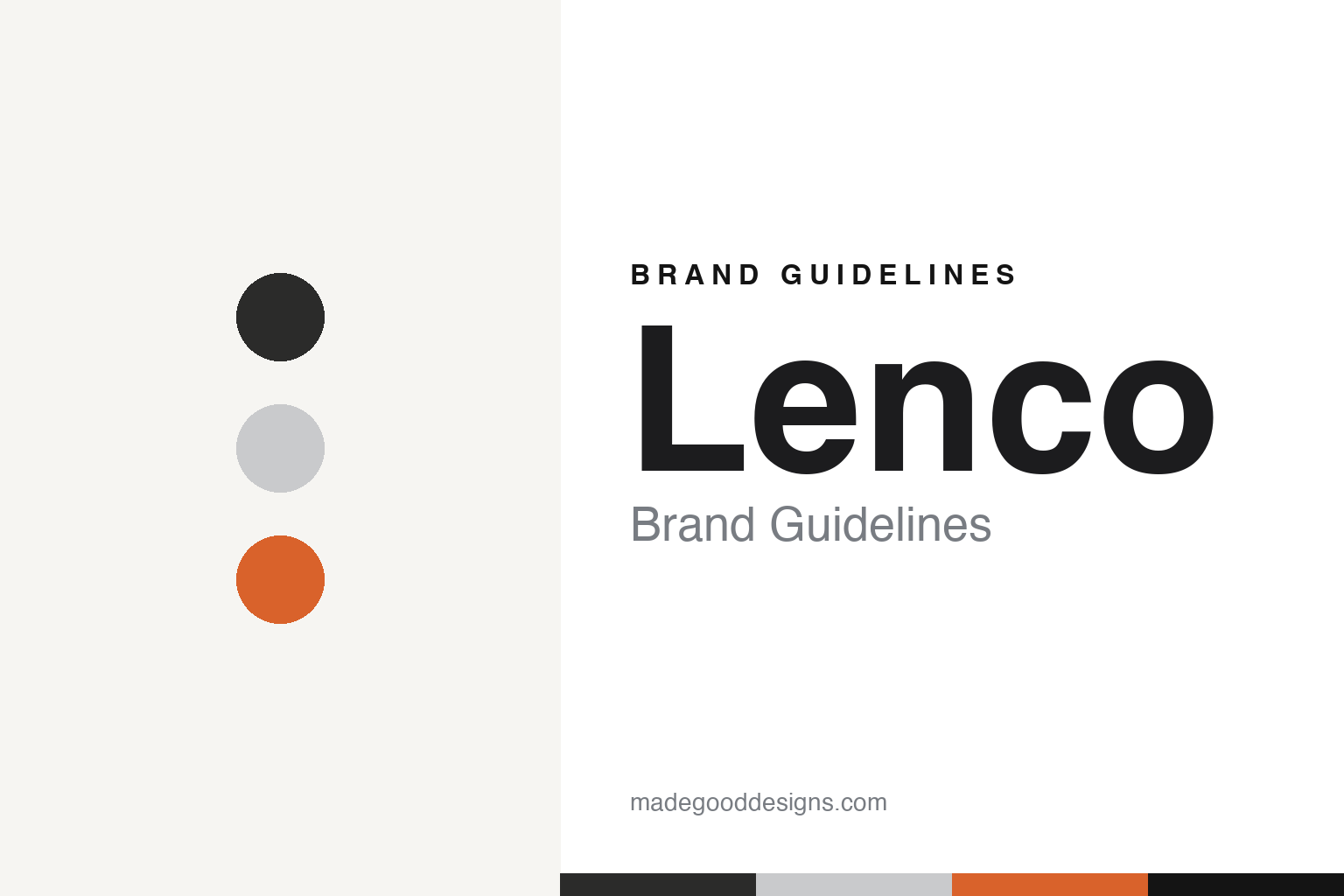
Lenco Brand Guidelines
The Burgdorf turntable maker whose name outlived its factory.
Aa
Two constants: a Lenco graphite, silver and orange palette and an engineered sans register. Abstract homage — not a Lenco product or mark; no turntable, logo or nameplate is reproduced.
Radio Laeng
A radio shop, a married couple and a technician in the Emmental.
Lenco began in Burgdorf, a small town in the Emmental, north-east of Bern. Its roots are in a radio shop: Fritz Laeng (born 1896) opened Radio Laeng in 1925, when Bern’s first radio station went on air, according to a 2024 history published by the Museum Schloss Burgdorf, the town’s castle museum. In 1929 he married Marie Stucki (1905–1974), who had grown up as a foster child and worked in hotels in Italy; she ran the shop alone while Fritz served in the army during the Second World War, German Wikipedia says.
The company itself was founded on 6 December 1946, the museum says, by the Laengs and the radio technician Bruno Grütter; German and English Wikipedia also give 1946 and also name Grütter, although the founding is often credited to the couple alone. The name came from the family name — “Laeng & Co” — and was Marie’s idea, German Wikipedia says. Their son Fritz recalled in the museum’s publication that the aim was a turntable drive for all four record speeds then in use, that his mother was the driving force behind the company, and that Grütter led its technical development. To earn money at first, the firm used a second-hand injection-moulding machine to make garlic presses and graters.
Its first turntable, the three-speed F-50-8, went on sale in 1949, the museum says. What saved the young business was a contract signed in 1953 with Ex Libris, the record and book subsidiary of the Swiss retailer Migros, which Marie Laeng negotiated with Elsa Gasser: 50,000 Lenco players had been sold by 1957 and 100,000 by 1959.
Colour
Osimo, Steg and the L75.
Lenco grew into an international manufacturer. In 1961 it set up Lenco Italiana at Osimo, near Ancona, in the building of an accordion maker, the Antonelli family, partly to sell more easily inside the European Economic Community; by 1974 about 700 people worked there, the museum says, making it the town’s largest employer. Further plants followed at Oberburg, next to Burgdorf, and at Steg in the Valais, which also made electric toothbrushes for Braun. German Wikipedia gives up to 400 staff in Burgdorf, 150 at Steg and 700 at Osimo; the museum counts more than 1,400 in 1974, with products sold in more than 80 countries. In the United States and Britain its turntables were first sold under local partners’ names, Bogen and Goldring, before Lenco used its own, English Wikipedia says.
The best-known model was the L75, presented in 1967 and described by the museum as its most successful turntable. It ran at 16, 33⅓, 45 and 78 rpm and could also be adjusted continuously between about 30 and 86 rpm, which German Wikipedia says made it popular with dance schools and discotheques; many, often modified, still run more than half a century later. A former purchasing manager told the museum that the factory made 300 to 400 L75s a day at its peak. Earlier models included the L70, made from 1958, English Wikipedia says.
Marie Laeng, whom the museum calls one of the first female chief executives in Switzerland, worked in the company until her death in Geneva in August 1974. A vocational school in Osimo was named after her in 1977 and still carries her name as the Istituto di Istruzione Superiore Laeng – Meucci.
Typography
Swiss audio in context.
In the decades after the Second World War, Europe’s radio, television and hi-fi makers were household names. By the 1970s several were losing money. Norwegian Wikipedia says Tandberg faced strong competition from Japanese and other Asian producers and made losses from 1976; German Wikipedia ties Dual’s decline to Japanese competition, and English Wikipedia describes Far East competition in Lenco’s.
Some names were absorbed by larger groups. The French Thomson group took over SABA in 1980, after GTE left consumer electronics, then Dual in 1982 and Telefunken’s television and radio business in 1983–84. Philips took a 31.6 per cent stake in Grundig, with management control, in 1984.
Others failed. Lenco went bankrupt at the end of the 1970s, Tandberg in December 1978 and Dual in 1981; Grundig filed for insolvency in April 2003. Studer, a maker of studio equipment, took another path: Willi Studer sold it in 1990, and it passed to Harman in 1994.
Many of the names lived on as brands rather than factories. Grundig belongs to Turkey’s Arçelik; the Telefunken brand, licensed through Telefunken Licenses GmbH in Frankfurt, was bought by Gordon Brothers in 2023; SABA is a licensing brand of Talisman Brands; the Dual name in Europe belongs to Dual GmbH of Fuchstal, in Bavaria; Lenco to the Dutch Commaxx group; Studer to Canada’s Evertz; and the Tandberg video-conferencing company to Cisco.
This guide sets out what can be checked about each brand — who founded it, who owns it, and what it says about where its products are made — and marks clearly what rests only on the company’s own word.
Aa
An engineered sans for a precision-drive maker. (Specimen set in Manrope, a sans STAND-IN; NOT the Lenco logo.)
Lenco
A Swiss name with a Dutch owner.
The end came quickly. Demand for hi-fi fell in the mid-1970s and competition from Japan and elsewhere in Asia grew; in 1976 a fire and an explosion hit the Oberburg factory, and Fritz Laeng died early in 1978, the museum says. Sources differ on the date of the failure. German and English Wikipedia say Lenco AG went bankrupt in 1977, with a successor, Lenco Audio AG, servicing its products until 1983; the museum’s 2024 history dates the bankruptcy and liquidation to 1979 and the closure in Burgdorf to 1980, when Lenco Audio AG was founded to sell accessories from stock. Lenco Italiana passed to an Italian company, Comint, and closed in 1986, the museum says.
The name lived on separately. According to German and English Wikipedia, Horst Neugebauer KG of Lahr, in Germany, bought it in 1984; in 1997 it passed to the Lenco STL Group of Venlo, in the Netherlands, which used it mainly on products imported from South-East Asia; and in 2015 that business was bought by Commaxx International. Commaxx Group, which says it was founded in 1994 and lists its headquarters in Kerkrade, in Dutch Limburg, sells Lenco turntables, radios and speakers alongside brands such as Alecto and Nedis. Lenco’s website says the name “has been synonymous with Swiss precision” for more than 75 years; it does not say where today’s products are made, saying only that its inspectors regularly visit the factories. What connects them to the Burgdorf company is the name.
For a design guide, Lenco shows how a heritage name can outlast the factory that made it famous. Compare Thorens, another Swiss-born turntable name, and Dual. For this guide we use graphite, a silver-grey and a warm orange with a sans, an unofficial interpretation; no product or logo is reproduced.
Explore & save
Keep Lenco’s identity on hand — save it to a board in the Made Good inspiration library.
Lenco identity set
Pin the Lenco graphite, silver and orange palette and the engineered sans register to your own board.