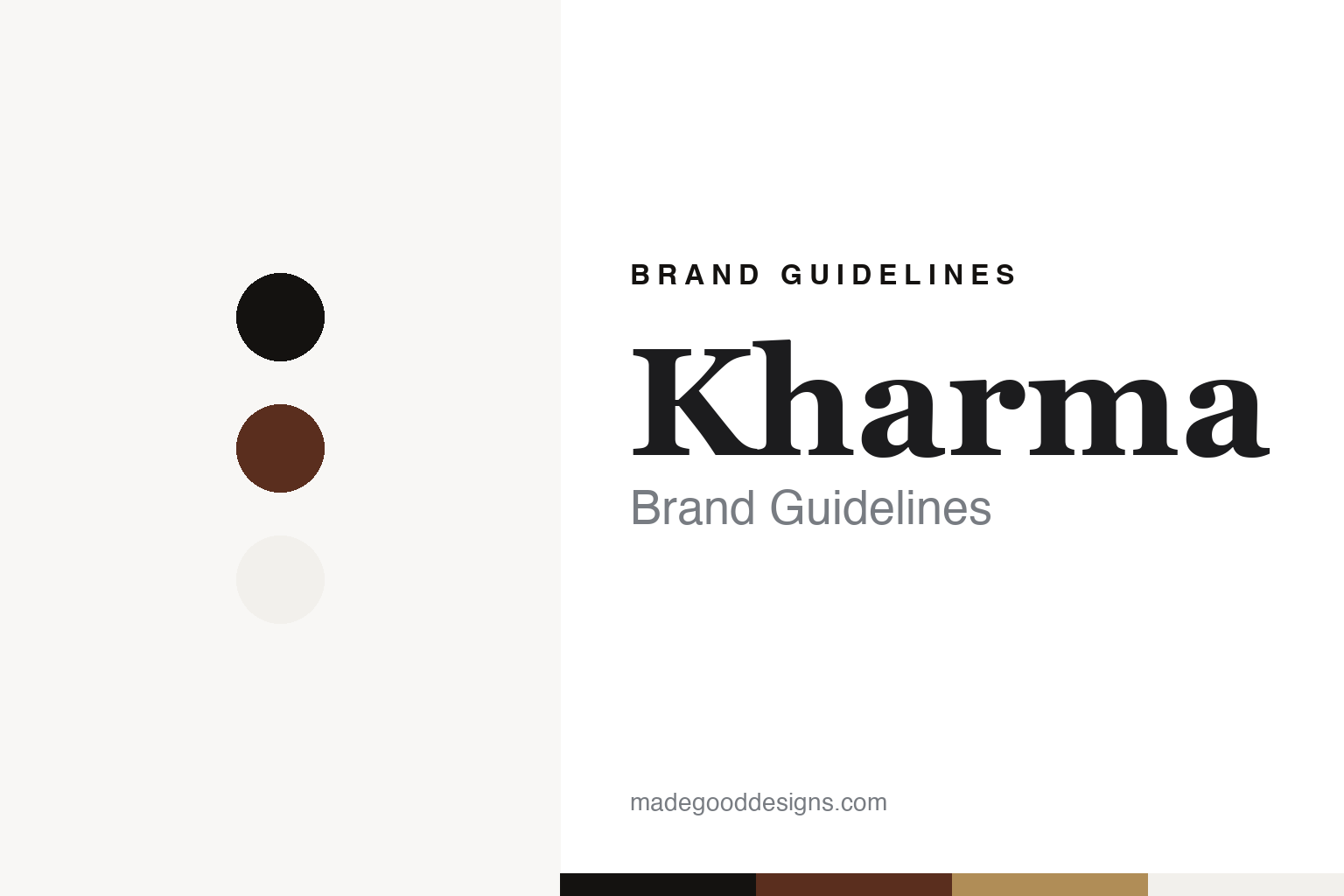
Kharma Brand Guidelines
The Breda loudspeaker maker that grew out of O.L.S.
Aa
Two constants: a lacquer black, bulletwood and brass palette and a classical serif register. Abstract homage — not a Kharma product or mark; no loudspeaker, logo or nameplate is reproduced.
O.L.S.
A teenager’s workbench, a first invoice and a bunker.
Kharma began as another name. Its founder, Charles van Oosterum, started Oosterum Luidspreker Systems, shortened to O.L.S., in 1982, the company’s history page says, selling finished loudspeakers as well as kits for people who wanted to build their own. A 2003 version of the company’s website, preserved by the Internet Archive, says he founded it while studying electronics — electromagnetics and electromechanics in particular — in Eindhoven.
The interest started earlier. In a June 2020 interview with Enjoy the Music.com, van Oosterum said he was about 13 or 14 when he heard an uncle’s home-made speakers playing Simon and Garfunkel’s “Mrs. Robinson,” bought a book on building a pair, and started with a Philips full-range driver. The company says he took speakers out of old radios bought at garage sales and gave them new cabinets to hear what changed, and that by 16 he was selling his own pairs, mostly, he said, to friends of his parents.
He registered the business, he told Enjoy the Music.com, because a professional customer needed a proper invoice: a business in Breda called Charelli, which bought two 15-inch subwoofers and eight small two-way speakers and, he said, was still a customer in 2020. Orders followed, he said, “even from big companies such as Philips.” He also described a setback: a cabinet project for the Swiss electronics maker Swiss Physics, which went bankrupt before paying, “almost bankrupted me,” forcing him to cut staff and taking years to overcome.
The company’s founding story turns on 1992. A customer, described on the 2003 website only as “one of the best known audiophiles,” asked for a system better than the one he had, on the terms that he would pay only if he liked it. The result, the Grand Enigma, is described by the company as a one-million-dollar system installed in an underground room that it calls an atomic-bomb shelter. The company’s own figures for it have changed between versions of its website — the 2003 text describes a 12-tonne active system with 30 kilowatts of amplification, the current one a different driver count — so we give it as the company tells it rather than as a specification.
A year later came the new name. Because O.L.S. sold mainly in the Netherlands, the company says, it set up an internationally oriented brand in 1993 and called it Kharma, after the idea of karma: that the energy you put in comes back to you. English Wikipedia dates Kharma International to 1992, so the sources differ by a year.
Colour
Ceramics, diamonds and a seven-figure system.
The early Kharma range, the 2003 website says, began with the Divine series, followed by the Ceramique and Exquisite lines that the company now calls its real foundation. Ceramic drive units were the signature: the company says O.L.S. was the first to work with them in the mid-1980s, and English Wikipedia repeats a 1984 date without a citation, so we give it as the company’s claim. English Wikipedia says the brand’s appearance at the Consumer Electronics Show in 1997 opened the way to the United States and Asia; that too is uncited.
The company dates its breakthrough in the American press to 2000, when it says the Exquisite Reference 1B was the cover story of issue 125 of The Absolute Sound, reviewed by Jonathan Valin. In 2001 it added diamond tweeters to the Exquisite series, which it describes as a world first, and it says the technology won The Absolute Sound’s Golden Ear award in four consecutive years from 2002. We give both as the company’s account.
The range then widened beyond loudspeakers. According to the company, cables arrived in 2003 and the first electronics, the Matrix series, in 2005; the Grand Exquisite followed in 2006. When O.L.S. reached its 25th anniversary in 2007, the company says, the kit business and the O.L.S. name were retired and everything moved under Kharma. In 2010 the Elegance line replaced the Ceramique, using a composite driver the company says it developed in-house, and in 2015 the flagship Enigma Veyron series arrived with CNC-milled bulletwood cabinets and larger diamond tweeters.
Outside the hi-fi room, a 2009 Spyker press release for the C8 Aileron sports car said every car would carry a Kharma sound system as standard, and called it the brand’s debut in car audio. The prices attract attention of their own: in January 2016 the Sydney Morning Herald described the Enigma Veyron system as “the world’s most expensive speakers” at $1.5 million, and that May the Dutch site HiFi.nl, visiting the company in Breda, put the system at €1.3 million and reported that the first pair of the flagship EV-1 had gone to a buyer in China, with four monoblock amplifiers and eight subwoofers.
Typography
Design and documentation.
The Low Countries have a long record in consumer audio. Philips, founded in Eindhoven in 1891 by Gerard Philips and his father Frederik to make light bulbs, introduced the Compact Cassette in August 1963 — developed, English Wikipedia says, by a team led by Lou Ottens in Hasselt, Belgium — and co-developed the compact disc with Sony; the first CDs went on sale in Japan in October 1982.
Philips is also part of the story of Dutch class-D amplification. The Belgian engineer Bruno Putzeys spent ten years at Philips’s Applied Technologies lab in Leuven, where he invented the “UcD” circuit, which Philips patented. Hypex, a Dutch company formed in 1996, began producing it in the early 2000s after Philips declined to use it, and in 2005 Putzeys left Philips to divide his time between Hypex and Grimm Audio, according to English Wikipedia.
The makers in this guide are spread across the Netherlands: Kharma in Breda; Grimm Audio in Veldhoven, beside Eindhoven; Siltech and Crystal Cable at the same address in Elst, in Gelderland; Hypex and Mola Mola at the same address in Groningen; and Dutch & Dutch in Capelle aan den IJssel, next to Rotterdam, according to their own websites.
A Dutch address does not always mean Dutch manufacture. Hypex has its own production facility in Malaysia, English Wikipedia says, and Dutch & Dutch buys its drivers and amplifiers from outside suppliers, The Absolute Sound reported in 2024.
This guide sets out what can be checked about each brand — who founded it, who owns it, and what it says about where its products are made — and marks clearly what rests only on the company’s own word.
Aa
A classical serif for a lacquer-and-veneer brand. (Specimen set in Cormorant Garamond, a serif STAND-IN; NOT the Kharma logo.)
Kharma
A founder-led company in Breda.
Unlike many of the hi-fi names that have changed hands, Kharma appears to have stayed with its founder. English Wikipedia names van Oosterum as the owner of Kharma International B.V., HiFi.nl called him the brand’s pioneering founder in 2016, and he was still speaking for the company as founder and chief executive in a SoundStage! video interview in September 2021. We found no record of a sale in the sources we checked. The company’s contact page gives its headquarters as Kalshoven 7 in Breda, in the province of North Brabant, and lists dealers and distributors in 29 countries, from Canada and the United States to China, Singapore and Vietnam.
Where the products are made is stated mainly by the company itself. Its website calls them “Dutch Masterpieces” and says parts are produced with techniques including five-axis CNC machining, carbon fibre and chemical vapour deposition, while the products are “hand assembled” and checked individually, with lacquered pieces hand-polished before packing. The 2009 Spyker press release said that “all Kharma sound systems are developed, assembled and tested in the Netherlands,” and a Robb Report review of the car described its Kharma system as “also made in the Netherlands.” We have not seen an independent account of which components are made in Breda and which are bought in, so we give those statements as claims.
The range today, according to the website, runs across three loudspeaker families — Elegance, Exquisite and Enigma Veyron — with matching cables, MP1000 amplifiers, power blocks, an audio rack and furniture, alongside custom projects including home cinemas and car audio. Its pages lean on the language of art rather than engineering: products as “masterpieces,” the brand as a “palette” of materials, and finishes that customers can specify down to the colour of the lacquer.
For a design guide, Kharma shows how a small, founder-led maker can present loudspeakers as furniture and craft as much as equipment, with one name carried across speakers, cables and electronics. Compare Crystal Cable, another Dutch high-end name, and Goldmund. For this guide we use lacquer black, bulletwood brown and brass with a serif, an unofficial interpretation; no product or logo is reproduced.
Explore & save
Keep Kharma’s identity on hand — save it to a board in the Made Good inspiration library.
Kharma identity set
Pin the Kharma lacquer black, bulletwood and brass palette and the classical serif register to your own board.