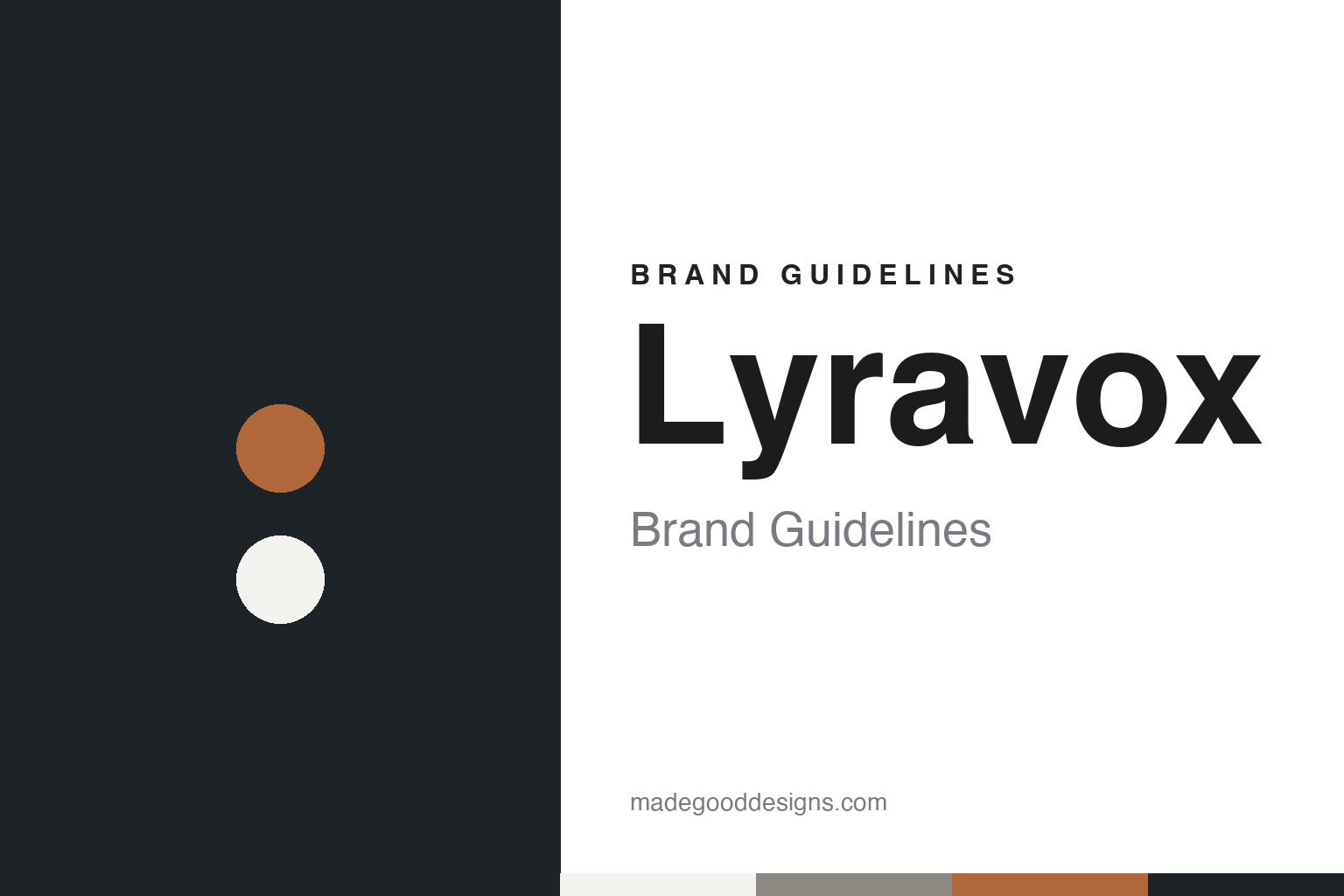
Lyravox Brand Guidelines
The Hamburg workshop that builds the amplifier into the speaker.
Aa
Two constants: a Lyravox white, stone and copper palette and a Geometric sans register. Abstract homage — not a Lyravox product or mark; no loudspeaker, logo or nameplate is reproduced.
Lyra and vox
An engineer and an economist in Hamburg.
Lyravox is a young company. Its operating firm, Lyravox Gerätemanufaktur GmbH & Co. KG, was entered in the commercial register at the Hamburg district court in August 2013, according to the register notices collected by North Data, and the company’s own history says it was founded “in the summer of 2013.” Its stated business is the development, manufacture and sale of audio systems and loudspeakers.
The company’s website and legal notice name two founders. Jens R. Wietschorke, its chief developer, had for more than fifteen years built bespoke loudspeakers and audio components by hand for studios and private homes, the company says; it also calls him an associate professor of loudspeaker acoustics at SAE in Hamburg, and the hi-fi site LowBeats, which visited in January 2024, describes him as an engineer and a long-time lecturer at the city’s SAE Institute. Götz von Laffert is an economist with a doctorate — on smoking, society and the state, LowBeats reports — who, in the company’s words, represents “the other half of the table,” the listener.
The name, LowBeats was told, joins the lyre of the Greek god Apollo with vox, the human voice, and was settled in a single evening. The same report pictures a third “founding member,” Sascha Harbs-Heinsohn; the company’s website lists Sascha Harbs on its development team alongside Marc Schettler, owner of Hamburg’s Hafenklang recording studio, where it says much of its tuning takes place, and the designer Gyde Nissen, whom it describes as formerly of the Hadi Teherani design group.
Colour
From wall-hung music cabinets to stone floorstanders.
Lyravox began with something closer to a modern radiogram than a pair of speakers. The Stereomaster, which the company says it presented at the end of 2014, was a single wall-hung cabinet holding drivers, amplifiers, a CD drive and a network streamer. An archived 2014 version of its website offered widths of 140, 170 and 200 centimetres, finishes from plain lines to Art Deco ornament, and the line “handmade in Hamburg, Germany.” The two-metre Stereomaster 200 was priced at €23,800 when it was shown at the High End show, then held in Munich, in May 2015, lite magazine reported from a company release.
Looking back in 2024, LowBeats wrote that the systems were aimed at penthouses and even yachts, that the audience stayed narrow, and that the founders chose to concentrate on stereo loudspeakers. In February 2017 the company presented Karl and Karlotta, its first active floorstanders, at the Norddeutsche HiFi-Tage in Hamburg, with eight and six amplifier channels respectively, according to its press release. Karlina, Karlos, Karlsson and, in February 2024, the 113-kilogram Karlmann Monolith at €40,000 followed. The names, LowBeats says, began as a whim after the Karls of medieval and Habsburg rulers; the largest, Karl der Große, was announced at a target of €268,000.
The engineering is consistent across the range. Each driver has its own amplifier, and a digital signal processor replaces the passive crossover; Hifistatement’s 2023 test of the Karlos found Hypex NCore amplifier modules inside and a ceramic tweeter made by Accuton to Lyravox’s specification. A tweeter on the top of the cabinet fires at the ceiling to add what the company calls an ambient, diffuse sound field. Systems are measured in the owner’s room and tuned by ear: in that test both founders delivered the speakers, and the €1,000 calibration was priced separately from the €12,800 speakers. For Karl der Große, Wietschorke told Hifistatement in May 2024, the processor moved into an external unit, so owners can choose their own power amplifiers.
Typography
German loudspeaker engineering.
Germany’s high-end loudspeaker makers do not share a single school. Some build on horns, some rethink the driver itself, and some put the amplifiers inside the cabinet and let electronics correct for the box and the room. The seven brands in this guide cover all three approaches, and the electronics that drive them.
Avantgarde Acoustic, at Lautertal in the Odenwald hills of Hesse, builds its range around horn loudspeakers, according to its website. Manger took a different route: its company timeline says Josef W. Manger filed his first patent in 1968 for what became a bending-wave transducer, the Manger Schallwandler, and that small-series production began in Mellrichstadt, in northern Bavaria, in 1990.
Active designs are the third strand. Backes & Müller, in Saarbrücken, marks fifty years of active, sensor-controlled loudspeakers on its website. Kii Audio, registered in Bergisch Gladbach near Cologne and building its speakers at Hamminkeln, near Wesel, sells active speakers with what it calls cardioid technology, meant to cut reflections from the room. Lyravox, in Hamburg, gives each driver its own amplifier and uses a digital signal processor in place of a passive crossover.
The electronics makers have roots in the Ruhr. Einstein Audio Components is registered in Bochum, and Audionet’s legal notice gave a Bochum address in 2015 and a Berlin one by 2018, according to archived versions of its website; the brand now belongs to audionet GmbH, registered in Berlin.
This guide sets out what can be checked about each brand — who founded it, who owns it, and what it says about where its products are made — and marks clearly what rests only on the company’s own word.
Aa
A geometric sans — a nod to the Bauhaus, which Wietschorke has named as a reference. (Specimen set in Jost, a geometric sans STAND-IN; NOT the Lyravox logo.)
Lyravox
Handmade in Hamburg, by its own account.
Lyravox has stayed independent. The limited partnership’s general partner is Lyravox Verwaltungs GmbH, the register notices show, and LowBeats reported in 2024 that the two founders hold the shares and run the business as managing partners, with no plans for a stock-market listing. We found no acquisition or outside investor in the sources we checked.
The company works from Jaffestraße in Hamburg-Wilhelmsburg, where its legal notice is registered and where it runs a showroom by appointment. LowBeats described an old industrial building south of HafenCity, once used to process palm oil, with a loft holding the workshop, its machines and a listening room. Cabinets come in wood or in a cast mineral stone delivered as 19-millimetre slabs and cut to size in-house, the report said, and each speaker’s rear plate is signed by the founders. Lyravox says every system is built by hand “from start to finish” in Hamburg; we give that as its claim. The parts come from outside: drivers from Accuton in Pulheim and Scan-Speak in Denmark, amplifier modules from Hypex in the Netherlands, according to the trade press.
Lyravox publishes no brand guidelines, logo specification or colour codes that we could find. Its look comes from the products: wide, shallow cabinets built as stacked blocks with narrow gaps, which Wietschorke explained to Hifistatement as a way to cut diffraction; the pure white coating the company calls the Karl “Signature Look”; and veneers that buyers can choose at the workshop. In the same interview he named the Bauhaus as the design tradition he admires, while saying, “we don’t make design products.”
For a design guide, Lyravox shows how a speaker maker can treat the electronics, the cabinet and the room as one product, and sell the set-up as part of it. Compare Kii Audio, another German maker of DSP-driven active speakers, and Backes & Müller, an older name in active loudspeakers. For this guide we use white, stone grey and copper with a geometric sans, an unofficial interpretation; no product or logo is reproduced.
Explore & save
Keep Lyravox’s identity on hand — save it to a board in the Made Good inspiration library.
Lyravox identity set
Pin the Lyravox white, stone and copper palette and the Geometric sans register to your own board.