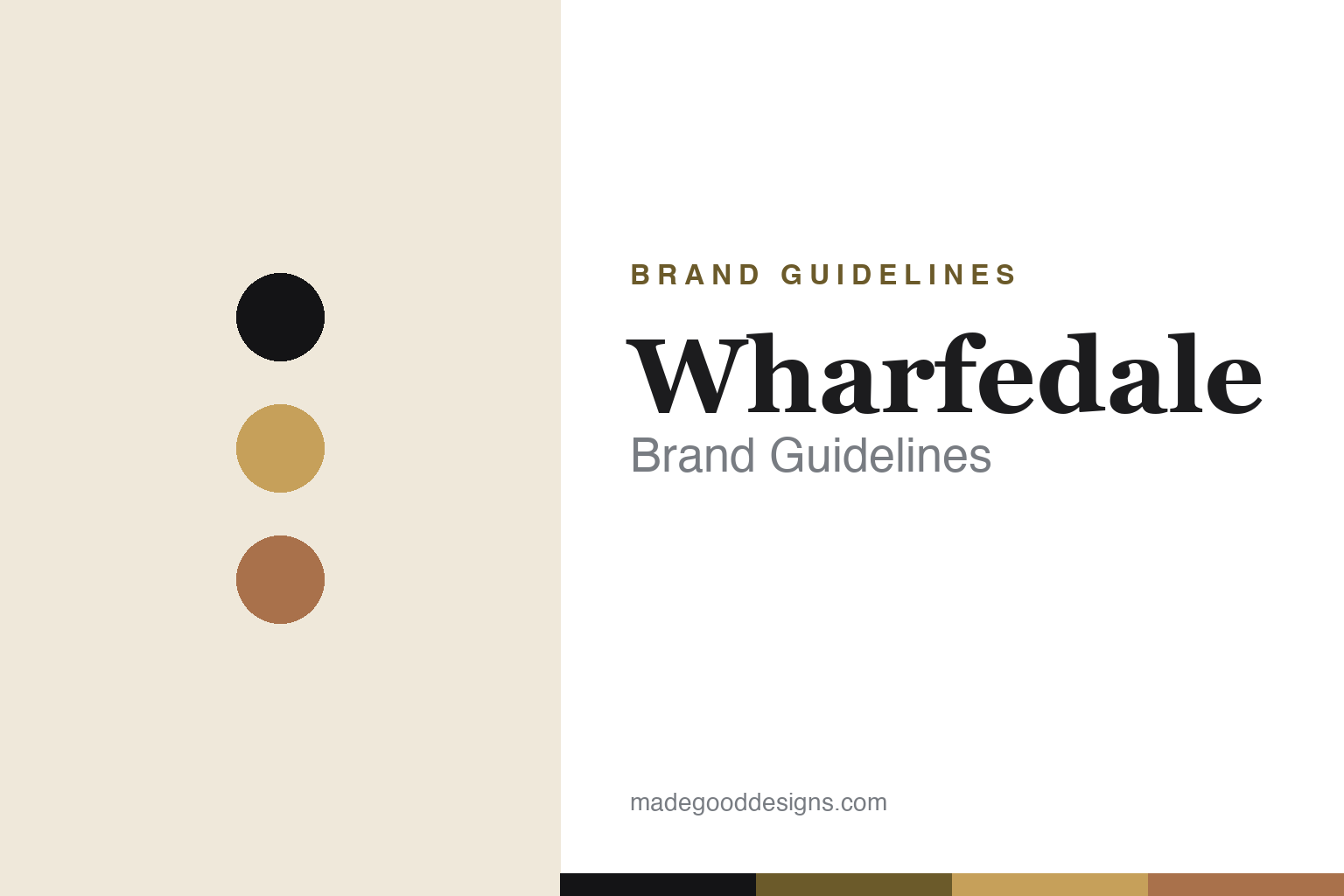
Wharfedale Brand Guidelines
One of the oldest loudspeaker names — born in 1932 Yorkshire, famous for live-vs-recorded demos and the Diamond.
Aa
Two constants: a black-and-gold heritage palette and a classic serif. Abstract homage — not the Wharfedale wordmark.
Since 1932
Wharfedale is one of audio’s oldest names.
Wharfedale is a lesson in deep heritage as a brand asset. It was founded in 1932 by Gilbert Arthur Briggs (1890–1978) in Yorkshire, England — as “Wharfedale Wireless Works” in Idle, Bradford (Briggs lived in nearby Ilkley and famously started building drivers in his cellar). The name comes from Wharfedale, the Yorkshire dale (the valley of the River Wharfe). Wharfedale is one of the world’s oldest continuously-operating loudspeaker brands. (Honest caveats: no official brand hex is published — the tones below are observed — and the wordmark typeface is undocumented.)
Two heritage stories define the brand. First, Briggs’ famous live-vs-recorded concert demonstrations: partnering with Peter Walker of Quad, he staged public events inviting audiences to compare live performers with recordings played through Wharfedale/Quad systems — the Royal Festival Hall event (London, 1954) sold out in four days, and the series toured to Carnegie Hall in New York, remarkably on only modest amplification. Second, the sand-filled cabinets of the 1950s–60s: double-walled enclosures packed with sand between the shells to kill resonance — and Wharfedale famously shipped the sand from Wharfedale, England, tying the product to the brand’s Yorkshire name.
Wharfedale’s modern icon is the Diamond series — launched in the early 1980s, one of the longest-running, best-selling budget loudspeaker lines in hi-fi history, still in production across many generations. On ownership: since 1997 Wharfedale has been owned by IAG (International Audio Group), a Chinese company based in Shenzhen (run by twin brothers Bernard and Michael Chang) that also owns Mission, Quad, Audiolab, Castle and Leak — so Wharfedale and its 1950s collaborator Quad are now stablemates. The identity is heritage-rich: a “WHARFEDALE” wordmark, black-and-white with historic gold accents. Nearly a century of British sound.
Colour
Wharfedale lives in black and heritage gold. Click a swatch to copy the hex.
Wharfedale’s identity is heritage-rich: black and white with warm gold/amber accents drawn from its long history. The black-and-white reads as classic, serious and timeless — fitting a brand that has been around since 1932 — while the gold adds warmth, heritage and a sense of earned prestige, evoking nearly a century of British loudspeaker-making. It’s a dignified, timeless scheme that wears its age as a badge of honour rather than chasing trends, matching a brand whose whole story is longevity and legacy. The palette feels like a heritage marque. The honest caveat: Wharfedale publishes no official brand hex — the black and gold here are observed approximations, not first-party values.
The lesson is a timeless, heritage palette for a legacy brand. Wharfedale’s black-and-gold reads as classic and earned, matching a 90-year history. For designers, it’s a reminder that a dignified, timeless scheme suits a heritage marque. The takeaways: use a classic, timeless palette for a legacy brand (black-and-gold); let the history be the story; and treat specific hexes as approximate when no official spec is published.
Typography
The wordmark is a heritage serif — timeless and British.
Wharfedale’s identity carries a heritage, serif-flavoured spirit befitting one of audio’s oldest names. The classic letterforms read as established, dignified and quietly British, matching a brand founded in 1932 whose whole value is legacy and longevity, and the restraint signals earned prestige rather than trend-chasing. Set in black-and-white with warm gold accents, the type feels timeless and heritage-rich — exactly the nearly-a-century-of-sound personality Wharfedale cultivates. It’s classic and dignified rather than flashy, mirroring the brand’s deep history (the live-vs-recorded demos, the sand-filled cabinets). Because the exact face is undocumented, the honest description is “a heritage serif spirit,” not a named font. The type behaves like the brand: timeless, dignified and heritage-rich.
Aa
A heritage serif spirit — timeless and British. (Specimen set in Newsreader, a classic reading serif in the heritage spirit of the Wharfedale name; the real face is undocumented.)
Longevity as the brand
Wharfedale’s age is its asset.
Wharfedale is a lesson in heritage and longevity as brand equity. Founded in 1932, it is one of the oldest loudspeaker brands still making speakers — and that near-century of history is a genuine, hard-to-copy asset: it signals experience, trust and a place in audio history no new brand can claim. The heritage is rich with real, quotable stories — Briggs’ live-vs-recorded demos that filled the Royal Festival Hall and Carnegie Hall, the sand-filled cabinets shipped with Yorkshire sand, the enduring Diamond series — all of which give the brand depth and character. Even after Chinese ownership (IAG, 1997), the Wharfedale name carries that legacy. It’s proof that in a category where trust matters, a long, storied history is a powerful, ownable identity — as long as the brand keeps honouring it. Age, honoured, becomes the brand.
For designers and brand-builders, Wharfedale offers a clear takeaway: a long, storied heritage — kept alive with real stories — is a powerful, ownable brand identity. The lessons: lean into genuine history and longevity (since 1932); keep the heritage vivid with real anecdotes (the live-vs-recorded demos, the sand cabinets); and let a timeless identity carry it. It’s also a reminder to keep the facts precise — Wharfedale was founded in 1932 in Yorkshire by Gilbert Briggs, is famous for the live-vs-recorded demos and the sand-filled cabinets and the Diamond series, and has been owned by IAG (International Audio Group) since 1997. Wharfedale’s age is its asset — proof that heritage can be a brand.
Explore & save
Keep Wharfedale’s identity on hand — save it to a board in the Made Good inspiration library.
Wharfedale identity set
Pin the black-and-gold palette and the heritage-serif spirit to your own board.


