Zojirushi Brand Guidelines
The elephant mark — a century of Japanese vacuum flasks and rice cookers, precision engineering, and quiet heritage.
Aa
Two constants: a heritage red mark colour on near-black and a refined Japanese serif spirit. Abstract homage — no elephant, not the Zojirushi mark.
A century of the flask
Zojirushi has kept things hot since 1918.
Zojirushi is a lesson in quiet, century-long craft. The company — full name Zojirushi Mahobin Corporation (“mahobin” means “vacuum flask”) — traces to 1918 in Osaka, founded as the Ichikawa Brothers Trading Company, making glass vacuum bottles. It was renamed Kyowa Manufacturing in 1948 and adopted the Zojirushi name in 1961. (Two honest notes up front: no official brand hex is published, and the wordmark typeface is undocumented — so the tones here are observed.)
The name and mark are the heart of the identity. “Zojirushi” means “elephant mark” in Japanese (象 zō = elephant, 印 jirushi = mark/brand), and the elephant is the logo. Here’s a myth-corrector worth getting right: the elephant trademark dates to 1923 — when the firm began making finished thermos bottles — so it predates the “Zojirushi” name by nearly four decades; the 1961 name simply formalised a long-standing mark. And an honest caution: Zojirushi’s own corporate history records adopting the elephant without stating a reason, so the popular explanations (an elephant “keeps things warm,” or signifies longevity or memory) are unverified folk-rationalisations — the real reason isn’t officially documented.
Zojirushi is famous for premium vacuum-insulated stainless flasks and travel mugs — plus, beyond drinkware, its celebrated rice cookers (including fuzzy-logic and induction-heating models, the “Neuro Fuzzy” line), electric water boilers and air pots. Its reputation is built on precision engineering and durability — the sort of product families keep for decades. (An honest note: “SlickSteel,” the electropolished interior, is Zojirushi marketing best treated as such rather than an independently verified spec.) Corporately, Zojirushi is publicly traded on the Tokyo Stock Exchange (ticker 7965) — an independent Japanese public company, not family-owned or private — and it marked its 100th anniversary in 2018. A century of the flask.
Colour
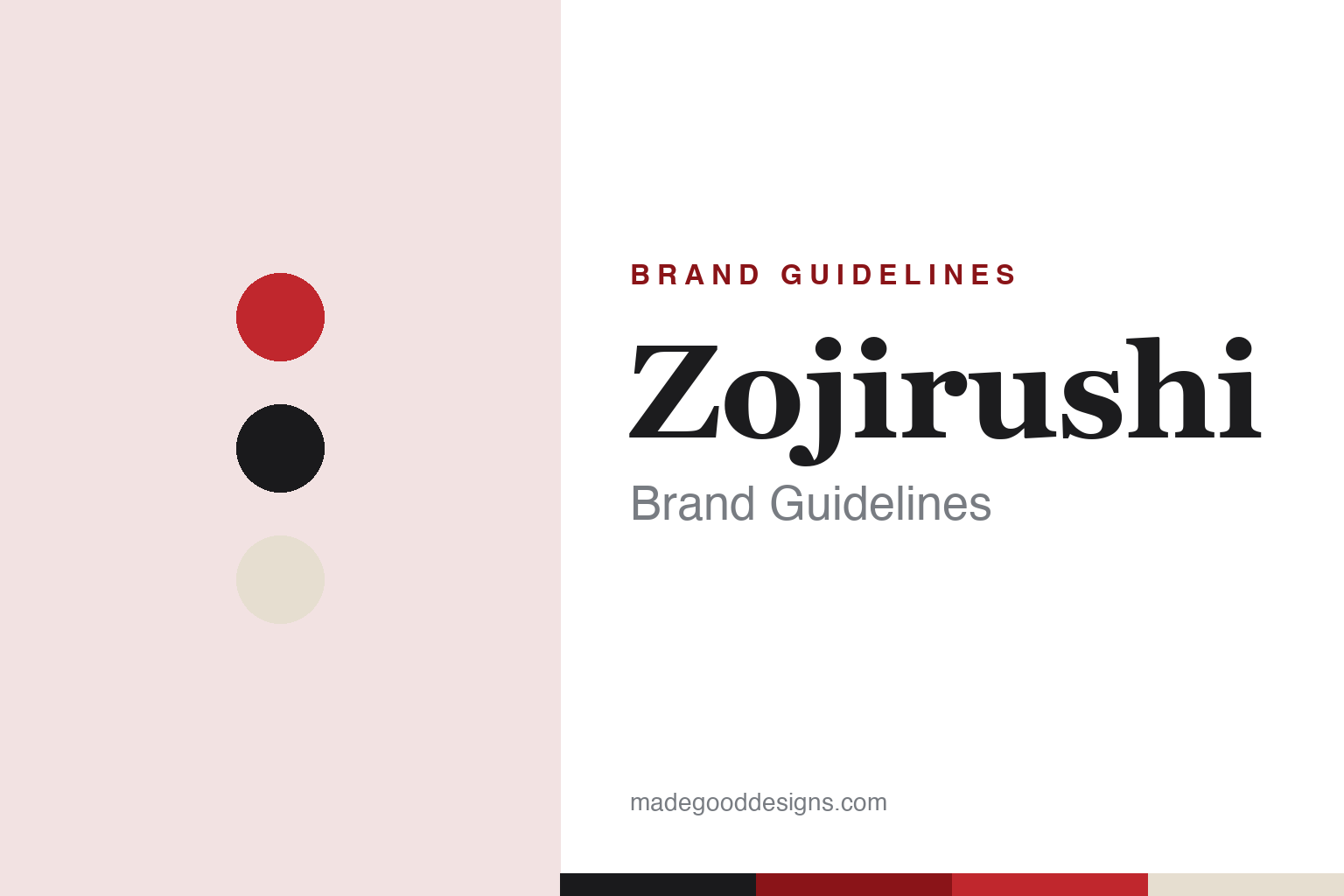
Zojirushi lives in a heritage red mark on near-black. Click a swatch to copy the hex.
Zojirushi’s identity is anchored by its red elephant mark, usually set against black or near-black, with cream and steel supporting tones. The red reads as heritage, confident and quietly premium — a mark colour carried for generations — while the near-black and metallics signal precision engineering and durability. It’s a restrained, grown-up palette that fits a century-old Japanese manufacturer known for products that last, rather than fashion novelty; the colour says “trusted craft,” not “seasonal trend.” The honest caveat: Zojirushi publishes no official brand hex, so the red and near-black here are observed approximations, not first-party values — and no elephant is reproduced.
The lesson is a single heritage mark-colour can carry a century of trust. Zojirushi’s red-on-black world reads as durable, precise and quietly premium — matching a long-lived engineering brand. For designers, it’s a reminder that a restrained, consistent heritage palette can signal reliability better than novelty. The takeaways: anchor on a confident heritage mark-colour (the red); support it with precise, grown-up neutrals (near-black, steel); and treat specific hexes as approximate when no official spec is published.
Typography
The wordmark is a refined Japanese serif spirit — precise and heritage.
Zojirushi’s identity carries a refined, heritage, precise spirit — a considered feel befitting a century-old Japanese manufacturer of vacuum flasks and rice cookers. A Japanese mincho-style serif captures it well: the elegant, traditional letterforms read as crafted, durable and quietly premium, matching a house built on precision engineering and long-lived products rather than fashion. Set with a heritage red mark on near-black, the type feels dignified and trustworthy — exactly the “trusted craft” personality Zojirushi cultivates. It’s refined and heritage rather than loud, mirroring the engineered products. Because the exact wordmark face is undocumented, the honest description is “a refined Japanese serif spirit,” not a named font. The type behaves like the brand: precise, heritage and enduring.
Aa
A refined Japanese serif spirit — precise and heritage. (Specimen set in Shippori Mincho, a traditional Japanese serif in the spirit of the Zojirushi identity; the real wordmark is undocumented.)
Craft that outlasts trends
Zojirushi sells engineering that lasts.
Zojirushi is a lesson in durable craft as a brand. For over a century, Zojirushi has done one thing consistently: engineer everyday vessels — flasks, mugs, rice cookers, boilers — to a level of precision and longevity that earns quiet, deep loyalty. It doesn’t chase fashion drops or viral moments; its authority comes from reliability, the kind of product a family buys once and keeps for decades. That patience is itself the identity: a heritage mark carried since 1923, a restrained palette, and an obsessive focus on getting the engineering right (insulation that genuinely holds, rice cooked precisely). In a drinkware world increasingly driven by colour, hype and celebrity, Zojirushi’s durable differentiator is the opposite — trusted, understated, engineering-led craft that outlasts trends. It’s proof that consistency and quality, sustained over generations, can be as powerful a brand as any marketing campaign. Build things that last, and the reputation lasts too.
For designers and brand-builders, Zojirushi offers a clear takeaway: consistent, engineering-led craft can be a durable brand in a hype-driven category. The lessons: earn authority through reliability and longevity (products families keep for decades); hold a restrained, heritage identity for generations (the elephant mark, the red); and let the engineering — not marketing spectacle — lead. It’s also a reminder to keep the facts precise — Zojirushi traces to 1918 in Osaka, adopted the elephant mark in 1923 and the name in 1961, is publicly traded on the TSE (7965), and is known for vacuum flasks and rice cookers. Zojirushi sells engineering that lasts — proof that quiet craft can be a lasting brand.
Explore & save
Keep Zojirushi’s identity on hand — save it to a board in the Made Good inspiration library.
Zojirushi identity set
Pin the heritage red-on-black palette and the Japanese-serif spirit to your own board.