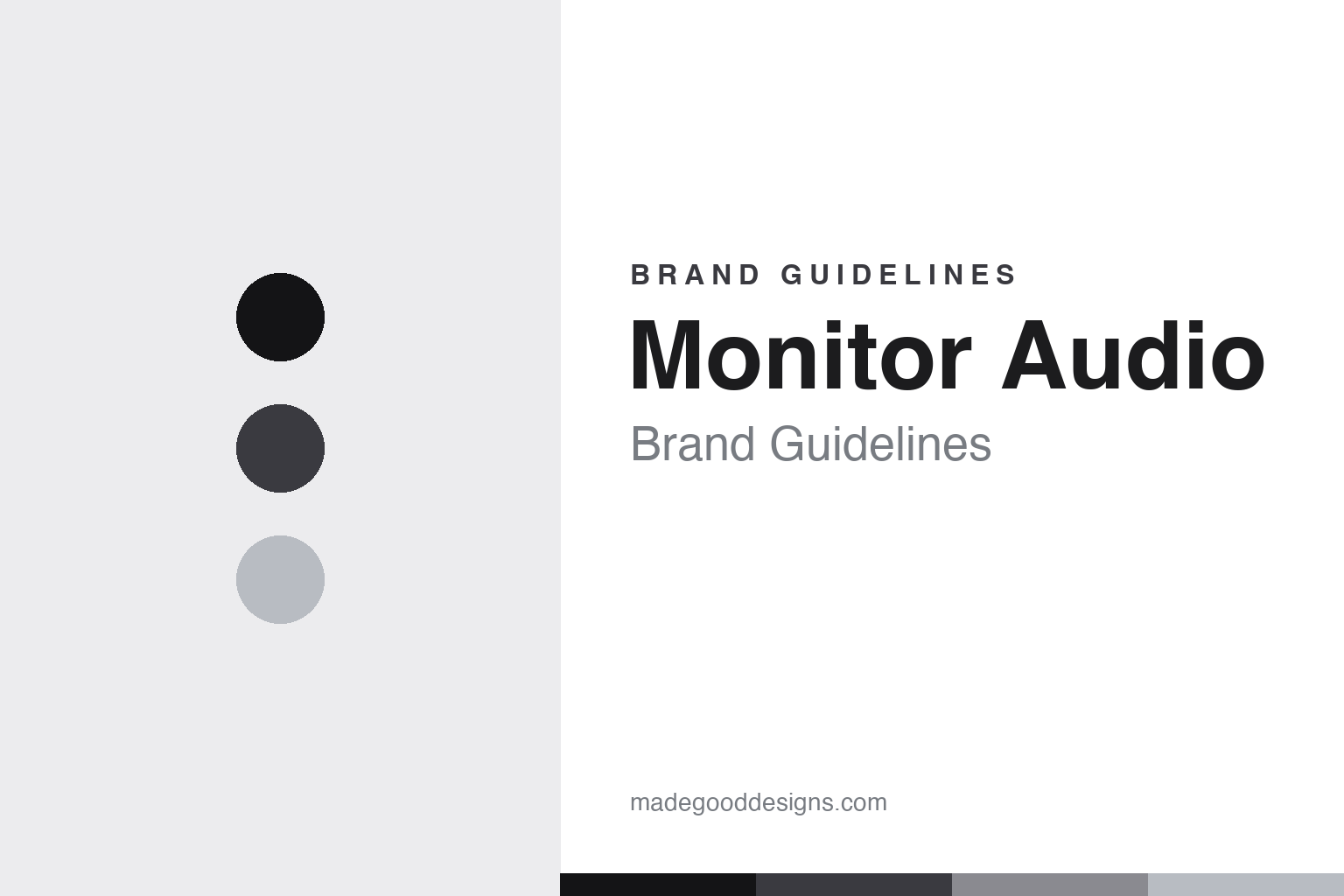
Monitor Audio Brand Guidelines
British speaker engineering since 1972 — metal-dome drivers and C-CAM, in a restrained monochrome identity.
Aa
Two constants: a restrained black-and-silver monochrome palette and a clean sans. Abstract homage — not the Monitor Audio wordmark.
Metal drivers, British-made
Monitor Audio pioneered metal cones.
Monitor Audio is a lesson in a signature driver material as brand identity. It was founded in 1972 by Mo Iqbal in England — near Cambridge, later relocating to Rayleigh, Essex — and it built its reputation on metal drivers. Monitor Audio was an early champion of metal (aluminium) dome tweeters in the mid-1980s, when most rivals used soft fabric domes — a genuinely differentiating move. (Honest caveats: no official brand hex is published — the tones below are observed — and the wordmark typeface is undocumented. Design and R&D are UK-based, but manufacturing moved to China in 2004, so it’s designed/engineered in Britain rather than entirely made there.)
Its signature technology is C-CAM — Ceramic-Coated Aluminium/Magnesium — an alloy originally developed for the aerospace industry, which Monitor Audio adapted to make stiffer, lower-distortion speaker cones and domes. C-CAM (and later ceramic/MPD driver work) runs across its ranges: the Bronze, Silver, Gold and flagship Platinum series.
Monitor Audio is a privately held British company that has grown from a small operation into a globally-exported brand, and it functions as a small group — it owns Roksan (electronics, 2016) and Blok (hi-fi furniture, 2019). Its current brand line is “Listen Again.” The identity is restrained and premium — a clean “Monitor Audio” wordmark in a black-and-white monochrome with metallic accents, letting the engineering and the beautifully-finished speakers lead. Metal drivers, engineered in Britain.
Colour
Monitor Audio lives in black and silver. Click a swatch to copy the hex.
Monitor Audio’s identity is restrained and premium: predominantly black and white with metallic silver accents (echoing its metal drivers). The black-and-white reads as sophisticated, engineering-led and quietly upscale — the understated look of a British brand whose reputation rests on driver technology (C-CAM) and beautiful finishes, not flash — while the metallic silver ties the palette to the signature metal cones and domes. It’s a clean, confident monochrome scheme that signals precision and premium craft, letting the products speak. The restraint feels grown-up and technical. The honest caveat: Monitor Audio publishes no official brand hex — the black, white and silver here are observed approximations, not first-party values.
The lesson is a restrained monochrome for an engineering brand. Monitor Audio’s black-and-silver reads as premium and precise, tied to its metal-driver signature. For designers, it’s a reminder that a metallic-accented monochrome can signal engineering and craft. The takeaways: keep the palette restrained and premium for an engineering brand (black-and-silver); tie the metallic accent to a real product detail (the metal drivers); and treat specific colours as approximate when no official spec is published.
Typography
The wordmark is a clean sans — precise and premium.
Monitor Audio’s clean, modern “Monitor Audio” sans wordmark is precise and premium. The even, contemporary letterforms read as sophisticated, engineering-led and confident, matching a British loudspeaker maker known for its metal-driver technology (C-CAM) and beautifully-finished speakers, and the restraint keeps the focus on the products. Set in a black-and-white monochrome with metallic accents, the type feels grown-up and technical — exactly the substance-first, premium personality Monitor Audio cultivates. It’s clean and refined rather than decorative, mirroring the precision-engineered drivers and the polished cabinets. Because the exact face is undocumented, the honest description is “a clean sans,” not a named font. The type behaves like the brand: precise, premium and engineering-led.
Aa
A clean sans — precise and premium. (Specimen set in Spline Sans, a clean modern sans in the spirit of the Monitor Audio wordmark; the real face is undocumented.)
Own a material, own a niche
Monitor Audio owns the metal driver.
Monitor Audio is a lesson in owning a signature material and technology. By committing early to metal drivers — aluminium dome tweeters in the mid-1980s, then its aerospace-derived C-CAM cones and domes — Monitor Audio built a distinctive, ownable engineering identity in a crowded loudspeaker market. That material choice differentiates its speakers on a genuine technical basis (stiffer, lower-distortion drivers) and gives the brand a clear, credible story across every range from Bronze to flagship Platinum. It’s a strong model: pick a distinctive core technology, invest in it, and apply it consistently so it becomes synonymous with the brand. Paired with a restrained, premium identity and beautiful cabinet finishes, the metal-driver focus makes Monitor Audio recognisable and respected. It’s proof that owning a specific material and technology — and applying it across the line — can carve out a durable niche and a credible brand. Own the material, own the niche.
For designers and brand-builders, Monitor Audio offers a clear takeaway: owning a signature material and technology, applied across the range, can be a durable, ownable brand identity. The lessons: commit to a distinctive core technology (metal drivers, C-CAM); apply it consistently from entry to flagship (Bronze to Platinum); and wrap it in a restrained, premium identity (black-and-silver). It’s also a reminder to keep the facts precise — Monitor Audio was founded in 1972 by Mo Iqbal in England, pioneered metal-dome and C-CAM drivers, makes the Bronze/Silver/Gold/Platinum ranges, uses “Listen Again,” and owns Roksan and Blok. Monitor Audio owns the metal driver — proof that a signature material can be a brand.
Explore & save
Keep Monitor Audio’s identity on hand — save it to a board in the Made Good inspiration library.
Monitor Audio identity set
Pin the black-and-silver palette and the clean-sans spirit to your own board.