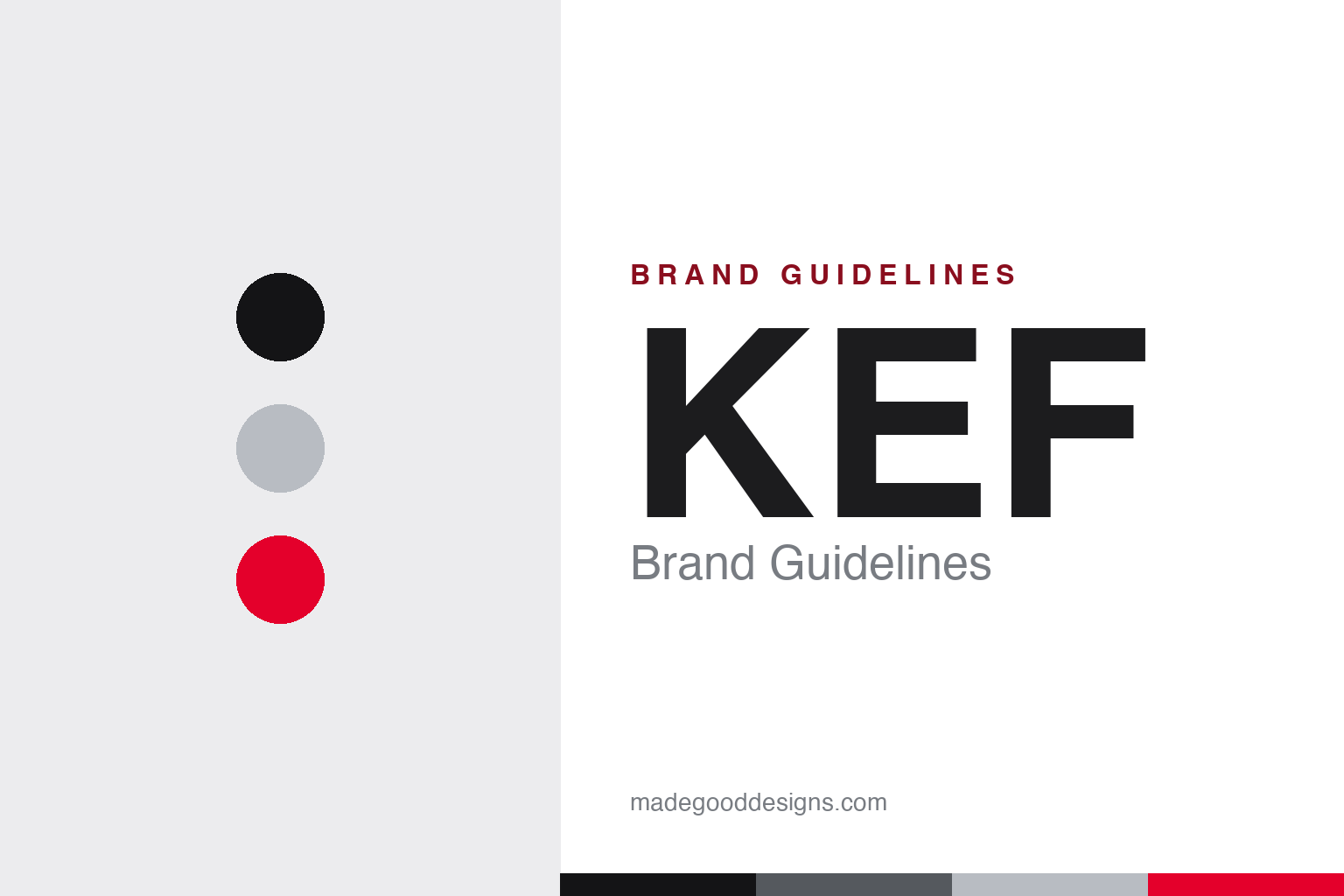
KEF Brand Guidelines
British speaker engineering since 1961 — the Uni-Q single-point-source driver, the Blade, and a restrained identity.
Aa
Two constants: a silver-and-black palette (with a red accent) and a clean sans. Abstract homage — not the KEF wordmark.
Engineering the single source
KEF built its brand on a driver.
KEF is a lesson in a signature engineering technology as brand identity. It was founded in 1961 by Raymond Cooke, an ex-BBC design engineer, and the name stands for Kent Engineering & Foundry — the firm in whose buildings, at Tovil near Maidstone in Kent, Cooke set up. KEF’s reputation was built on precision: it was among the first loudspeaker makers to use computers for design and measurement (early 1970s) and won Queen’s Awards for Export. (Honest caveats: no official brand hex is published — the tones below are observed — and the wordmark typeface is undocumented.)
KEF’s defining technology is the Uni-Q driver (introduced 1988): it places the tweeter in the exact acoustic centre of the mid/bass cone, making the two behave as a single point source and widening the sweet spot. (An honest note: coaxial drivers predate KEF — its genuine claim is Uni-Q as an advanced coincident-source design, not the first coaxial ever.) Uni-Q is now KEF’s signature across the range. It also supplied drivers for the legendary BBC LS3/5A monitor and built licensed versions.
KEF pairs that engineering with real industrial design: the LS50 (2012, celebrating 50 years), the flagship Blade (2011, embodying KEF’s “Single Apparent Source” ideal), the sculptural aluminium Muon (2007, designed by Ross Lovegrove, 100 pairs), and the LS Wireless active speakers. The identity is restrained and modern — black, white and metallic silver with a red accent, a clean “KEF” wordmark — letting the engineering and the products lead. KEF is owned by GP Acoustics, part of the Gold Peak Group of Hong Kong. British speaker engineering, single-source.
Colour
KEF lives in silver and black. Click a swatch to copy the hex.
KEF’s identity is restrained and modern: black, white and metallic silver, with a historic KEF red/orange accent. The silver-and-black reads as precise, engineering-led and premium — the understated look of a brand whose reputation rests on measurement and driver technology (Uni-Q), not flash — while the red accent adds a spark of energy and heritage. It’s a clean, sophisticated scheme that lets KEF’s sculptural products (the Blade, the Muon, the LS50) speak, signalling substance and design pedigree. The restraint feels confident and technical. The honest caveat: KEF publishes no official brand hex — the silver, black and red here are observed approximations, not first-party values.
The lesson is restraint plus a heritage accent for an engineering brand. KEF’s silver-and-black reads as precise and premium; the red carries a bit of history. For designers, it’s a reminder that an engineering-led brand can be deliberately understated. The takeaways: keep the palette restrained and metallic for a precision brand (silver and black); use a heritage accent sparingly (the red); and treat specific colours as approximate when no official spec is published.
Typography
The wordmark is a clean sans — modern and engineering-led.
KEF’s clean, uppercase “KEF” sans wordmark is modern and engineering-led. The even, geometric letterforms read as precise, contemporary and confident, matching a British loudspeaker maker whose identity rests on measurable driver technology (Uni-Q) and sculptural industrial design, and the restraint keeps the focus on the products. Set in silver and black with a red accent, the type feels technical and premium — exactly the substance-first, design-forward personality KEF cultivates. It’s clean and modern rather than decorative, mirroring the precision-engineered, beautifully-made speakers. Because the exact face is undocumented, the honest description is “a clean sans,” not a named font. The type behaves like the brand: modern, precise and engineering-led.
Aa
A clean sans — modern and engineering-led. (Specimen set in Onest, a clean geometric sans in the spirit of the KEF wordmark; the real face is undocumented.)
A technology you can own
KEF’s Uni-Q is its identity.
KEF is a lesson in a proprietary technology becoming a brand’s identity. Since 1988, the Uni-Q driver — tweeter at the acoustic centre of the mid/bass cone, creating a single point source — has been KEF’s signature, differentiating its speakers on a genuine engineering idea rather than styling alone. That ownable technology gives KEF a clear, credible story across its whole range, from affordable to flagship, and pairs with real industrial-design pedigree (the Blade, the Muon by Ross Lovegrove) to make the brand both technical and beautiful. It’s a strong model: invest in a distinctive, hard-to-copy core technology, name it, apply it everywhere, and let it — plus considered design — carry the identity. KEF’s ex-BBC engineering roots and measurement culture make the story authentic. Own a technology, and it becomes the brand. Uni-Q is KEF.
For designers and brand-builders, KEF offers a clear takeaway: a distinctive, named, proprietary technology — applied across the range and paired with strong design — can be a brand’s core identity. The lessons: build on an ownable technology (Uni-Q, the single point source); apply it consistently from entry to flagship; and pair it with genuine industrial design (the Blade, the Muon). It’s also a reminder to keep the facts precise — KEF was founded in 1961 by ex-BBC engineer Raymond Cooke (Kent Engineering & Foundry), is known for the Uni-Q driver (1988), the LS50 and the Blade, and is owned by GP Acoustics / Gold Peak (Hong Kong). KEF’s Uni-Q is its identity — proof that an ownable technology can be a brand.
Explore & save
Keep KEF’s identity on hand — save it to a board in the Made Good inspiration library.
KEF identity set
Pin the silver-and-black palette and the clean-sans spirit to your own board.