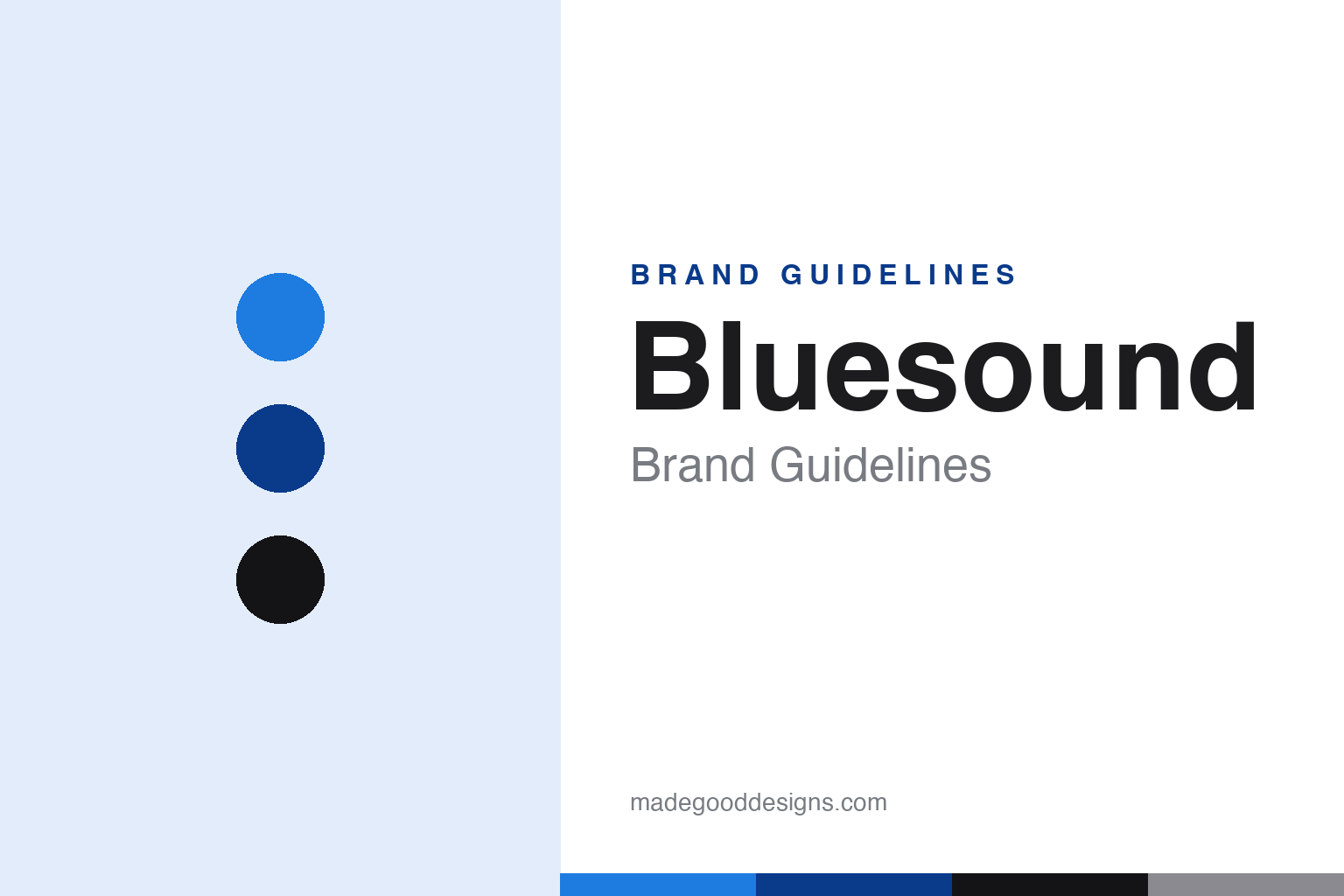
Bluesound Brand Guidelines
Hi-res multi-room streaming, done the audiophile way — the BluOS platform, backed by decades of hi-fi.
Aa
Two constants: a blue palette and a clean modern sans. Abstract homage — not the Bluesound wordmark.
Hi-res, the audiophile way
Bluesound streams for audiophiles.
Bluesound is a lesson in a serious hi-fi heritage behind a modern platform. It’s a brand of Lenbrook Industries — the Canadian company (founded 1978, Pickering, Ontario) that also owns NAD Electronics and PSB Speakers — launched around 2013, with products shipping in early 2014. Unlike consumer-tech rivals, Bluesound arrived with decades of audio engineering behind it, positioning itself from day one as the audiophile alternative to Sonos, with genuine hi-res support. (Honest caveats: no official brand hex is published — the blue below is approximate — and the wordmark typeface is undocumented.)
The heart of Bluesound is BluOS — its wireless, hi-res multi-room streaming platform. BluOS streams lossless audio up to 24-bit/192kHz, manages up to 64 zones, and natively integrates 20+ streaming services. The hardware is well known: the NODE (streamer/DAC), the POWERNODE (streamer plus amplifier), the PULSE speaker line, plus VAULT (ripping/storage) and EDGE. (An important distinction: BluOS is the software platform/app — not the hardware; NODE, PULSE and POWERNODE are the products.)
The most distinctive part of the story is that BluOS is a cross-brand platform, not a walled garden: it’s licensed well beyond the Lenbrook family, running on NAD, PSB, DALI, Monitor Audio, Cyrus, Roksan and Peachtree gear — so a Bluesound speaker and a NAD amplifier can live in one multi-room system under one app. The identity fits a hi-res streaming brand: a clean “Bluesound” wordmark in a distinctive blue, under the line “Multi-room Music. The Hi-Res Way.” A modern platform with a hi-fi soul.
Colour
Bluesound lives in blue. Click a swatch to copy the hex.
Bluesound’s identity is built — literally — around blue, with black and white. The blue reads as modern, digital and trustworthy — the language of streaming and connected tech — while signalling calm, hi-fidelity reliability, fitting a brand whose whole pitch is serious multi-room audio done well. It’s the colour in the name, so it does double duty as the brand’s most recognisable asset. Paired with clean black-and-white, it feels contemporary and premium rather than gadgety — appropriate for an audiophile-grade streaming platform. The blue is Bluesound. The honest caveat: Bluesound publishes no official brand hex — the blue here is an observed approximation, not a first-party value.
The lesson is own the colour in your name. Bluesound’s blue is its most recognisable, ownable asset — reinforced by the name itself. For designers, it’s a reminder that a brand named for a colour should commit to and own that colour fully. The takeaways: own the colour your name implies (the blue); pair it with clean neutrals for a modern, premium feel; and treat specific hexes as approximate when no official spec is published.
Typography
The wordmark is a clean modern sans — digital and premium.
Bluesound’s clean modern “Bluesound” sans wordmark — often with a small circular play-dot device — is digital and premium. The even, contemporary letterforms read as modern, trustworthy and tech-forward, matching a hi-res streaming platform, while staying clean enough to signal audiophile seriousness rather than gadget hype. Set in the signature blue with black and white, the type feels contemporary and reliable — exactly the “hi-res, the audiophile way” personality Bluesound cultivates. It’s clean and modern rather than decorative, mirroring the sleek streamers and speakers and the polished BluOS app. Because the exact face is undocumented, the honest description is “a clean modern sans,” not a named font. The type behaves like the brand: digital, premium and trustworthy.
Aa
A clean modern sans — digital and premium. (Specimen set in Gabarito, a clean modern sans in the spirit of the Bluesound wordmark; the real face is undocumented.)
A platform, not a walled garden
BluOS ties the family together.
Bluesound is a lesson in a licensed platform as a strategic brand asset. Rather than lock BluOS to its own speakers, Lenbrook turned it into a cross-brand ecosystem — licensing it to NAD, PSB, DALI, Monitor Audio, Cyrus, Roksan and others — so a whole hi-fi world can share one hi-res multi-room system and one controller app. That openness is a genuine differentiator against walled-garden rivals: it lets Bluesound punch above its size by riding on other respected brands’ hardware, and it makes BluOS the connective tissue of the Lenbrook family (NAD amps, PSB and Bluesound speakers) and beyond. Combined with the hi-res-from-day-one positioning and a hi-fi heritage (Lenbrook since 1978), it’s a smart strategy: own the platform, not just the boxes, and let it spread. It’s proof that a well-designed, openly-licensed software platform can be more valuable — and more defensible — than any single product. Own the platform, open the garden.
For designers and brand-builders, Bluesound offers a clear takeaway: an openly-licensed platform can be a more strategic, defensible asset than a single product line. The lessons: build the platform, not just the hardware (BluOS); license it openly to become industry connective tissue (NAD/PSB/DALI/Monitor Audio); and back it with a real heritage (Lenbrook’s hi-fi lineage). It’s also a reminder to keep the facts precise — Bluesound is a Lenbrook brand launched 2013–14, built on the BluOS hi-res multi-room platform (up to 24/192), with products the NODE and PULSE, positioned as an audiophile alternative to Sonos; BluOS runs on many partner brands. Bluesound owns a platform, not a walled garden — proof that a licensed platform can be a brand’s deepest asset.
Explore & save
Keep Bluesound’s identity on hand — save it to a board in the Made Good inspiration library.
Bluesound identity set
Pin the blue palette and the modern-sans spirit to your own board.


