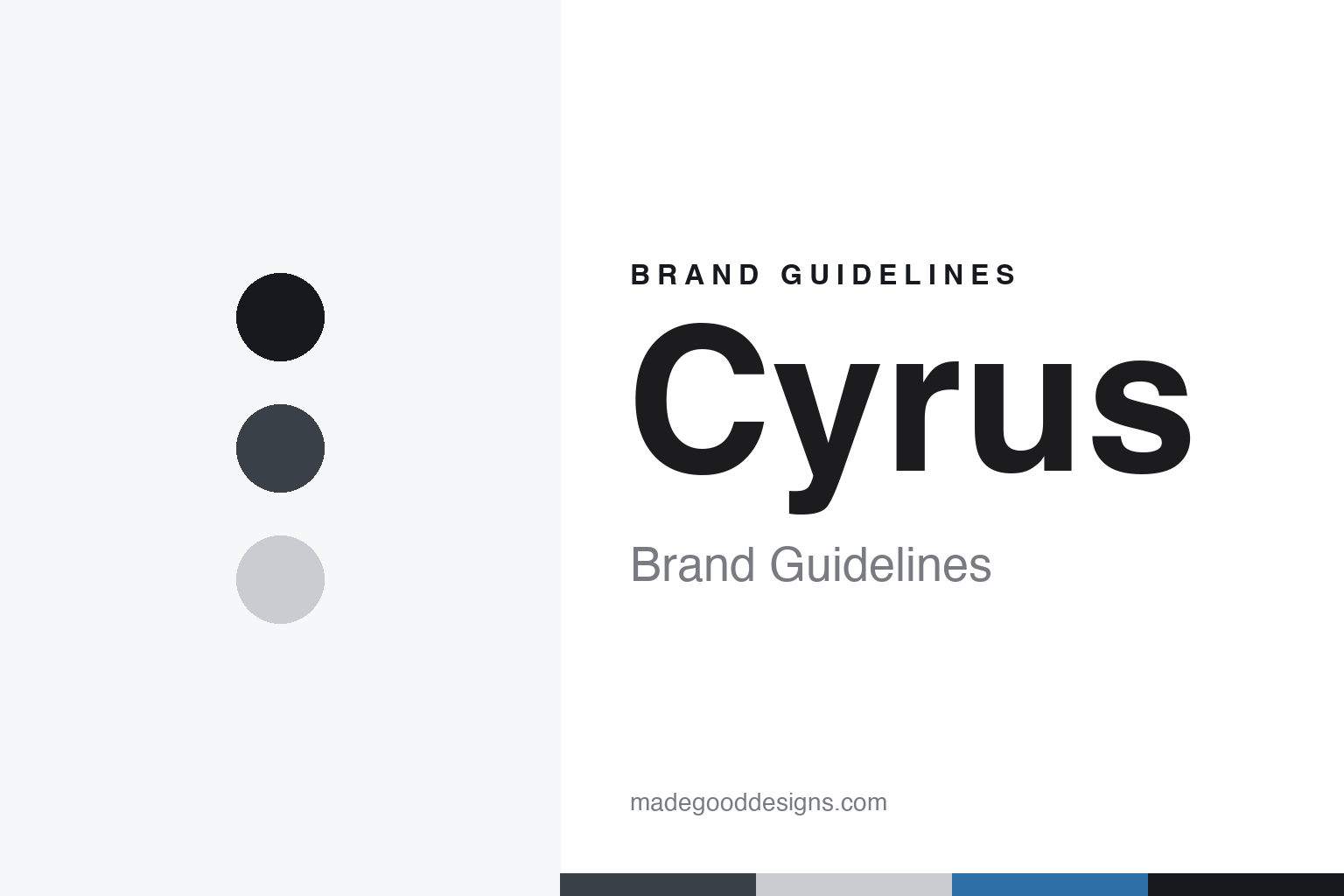
Cyrus Brand Guidelines
The half-width hi-fi maker from Huntingdon.
Aa
Two constants: a Cyrus gunmetal, silver and blue palette and a geometric sans register. Abstract homage — not a Cyrus product or mark; no amplifier, logo or nameplate is reproduced.
Mission Cyrus
An amplifier line from a loudspeaker company.
Cyrus began as an amplifier line inside the loudspeaker maker Mission. Mission was founded by the engineer and entrepreneur Farad Azima — in Cambridge in 1976, according to English Wikipedia, though other accounts give 1977 and Huntingdon — and Azima went on to found Cyrus Electronics and, later, the flat-panel loudspeaker company NXT, English Wikipedia says.
The company dates itself to the early 1980s, but it has given two different years. Its website said in 2017 that “Cyrus started in 1983 in Huntingdon, Cambridgeshire”; today it says Cyrus was founded in 1984 with the original Cyrus One amplifier. SoundStage!, which visited the company in 2014, reported that Mission hired the engineer Peter Bartlett from NAD in 1983 and that “six months later Mission/Cyrus was born.” Early models were sold as Mission Cyrus, with both names on the product.
From the start the products were compact. Cyrus amplifiers were built to half the width of a standard hi-fi component, in die-cast cases. Bartlett told Hifizine in 2013 that the die-cast chassis grew out of work in Mission’s research department on how loudspeaker cones interact with their frames, and that he set out to move Cyrus from budget components to audiophile ones. That half-width shape has been the brand’s most recognisable feature ever since; What Hi-Fi? still calls it the company’s “trademark half-width proportions.”
The products were also meant to be upgraded rather than replaced. Cyrus has long sold external power supplies, such as the PSX-R, that plug into its amplifiers and players, and it developed its own CD mechanism, called Servo Evolution, SoundStage! reported in 2014. The company says it still services products up to 40 years old, and that many of its original 1984 models remain in daily use.
Colour
From a group business to a buy-out.
Mission’s parent grew into a listed company and changed shape. In January 2000 NXT, by then a developer of flat-panel loudspeaker technology, sold Mission, its conventional loudspeaker business, to a management buy-out team for £5.24 million, Telecompaper reported. Cyrus, the amplifier, CD player and tuner maker, was then “the only one of NXT’s original businesses to still be part of the group.”
Cyrus left the group a few years later. Bartlett told Hifizine that when the parent company wished to spin off its smaller hi-fi makers, he bought Cyrus, in 2005; SoundStage! also describes a 2005 management buy-out. The company that trades today, Cyrus Audio Limited, was set up a little earlier: Companies House shows it was incorporated in June 2004 under a shelf-company name, renamed the following month, with Bartlett appointed a director in August 2004.
For years the company stressed that everything happened in one place. In 2013 Hifizine reported that all Cyrus products were assembled by the company’s 35 employees in Huntingdon, and in 2017 the company’s website said all its models were “designed and manufactured in our headquarters in Huntingdon.”
That changed in 2019. In May that year Cyrus announced a wide-ranging agreement with SMS – Smart Made Simple, a Nottingham electronics manufacturer, which took “a substantial minority stake” in the business and would manage component sourcing and build sub-assemblies, Hi-Fi Pig reported. Simon Freethy, then Cyrus’s chairman, said the deal “creates an excellent framework for growth.” The company now says that in early 2019 it moved its “entire manufacturing process from Huntingdon to SMS in Nottingham,” after SMS had supplied its circuit boards for more than 20 years. Research and development stay in Huntingdon, the company says.
Typography
British hi-fi in context.
Much of Britain’s hi-fi electronics trade clusters in Cambridgeshire. Quad, founded in London by Peter Walker in 1936, moved to Huntingdon in 1941 after being bombed out during the war, English Wikipedia says. Meridian, founded in 1977 by Bob Stuart and Allen Boothroyd, is based in the town, and Cyrus says its research team has worked from its Huntingdon head office since 1984.
Several old British names now belong to one group. International Audio Group (IAG), a Chinese company based in Shenzhen, says it set up its UK arm in Huntingdon in September 1997 after acquiring Wharfedale, Quad, Leak, Ekco and Castle, then added Audiolab in 2004 and Mission in June 2005. It says its manufacturing is centralised at its own factory in Ji’an, in Jiangxi province.
Scotland’s Linn, founded in Glasgow by Ivor Tiefenbrun — in 1973, by the company’s timeline and the company register, though the opening line of English Wikipedia gives 1972 — says each system is built by hand at its factory at Waterfoot, outside the city.
Today, by their own accounts and the records we checked, Audiolab, Leak and Mission give IAG’s address on Glebe Road in Huntingdon; Cyrus, still based in Huntingdon, says it moved its manufacturing to SMS Electronics in Nottingham in 2019; Meridian, on Latham Road in Huntingdon, says its research, design and engineering have been led from Britain since 1977; and Roksan, founded in 1985, has belonged since November 2016 to Monitor Audio, of Rayleigh in Essex.
This guide sets out what can be checked about each brand — who founded it, who owns it, and what it says about where its products are made — and marks clearly what rests only on the company’s own word.
Aa
A geometric sans for a brand built on one proportion. (Specimen set in Manrope, a sans STAND-IN; NOT the Cyrus logo.)
Cyrus
Half-width, then full-width.
Today Cyrus Audio Limited is registered at Ermine Business Park in Huntingdon and describes itself as an “independent British brand.” Companies House lists a holding company at the same address, Audyus Limited, as owning more than 75 per cent of its shares; Audyus in turn reports that it has no registrable person with significant control, meaning no single individual or company is recorded as controlling it. The company names Nick Clarke as its managing director.
The range has also been reset. In 2024 Cyrus launched the 40 Series — an amplifier, a streamer, a CD player and a power supply — in new half-width casework. In May 2025 What Hi-Fi? reported that the company had “done something it has never done before: made full-width products,” with the 80 Series; its head of marketing, Chris Hutcheson, told the magazine that “the 40 series was created to reset the Cyrus brand.” In November 2025 the 40 AMP won a What Hi-Fi? Award as the magazine’s premium stereo amplifier, which it called “a welcome return to form for the Cyrus Audio brand.”
For a design guide, Cyrus shows how a single proportion — half the width of everything else on the rack — can carry a brand through four decades and several changes of ownership. Compare Mission, the loudspeaker company it came from, and Naim Audio, another British electronics maker that sells add-on power supplies as upgrades. For this guide we use gunmetal, brushed silver and a signal blue with a geometric sans, an unofficial interpretation; no product or logo is reproduced.
Explore & save
Keep Cyrus’s identity on hand — save it to a board in the Made Good inspiration library.
Cyrus identity set
Pin the Cyrus gunmetal, silver and blue palette and the geometric sans register to your own board.