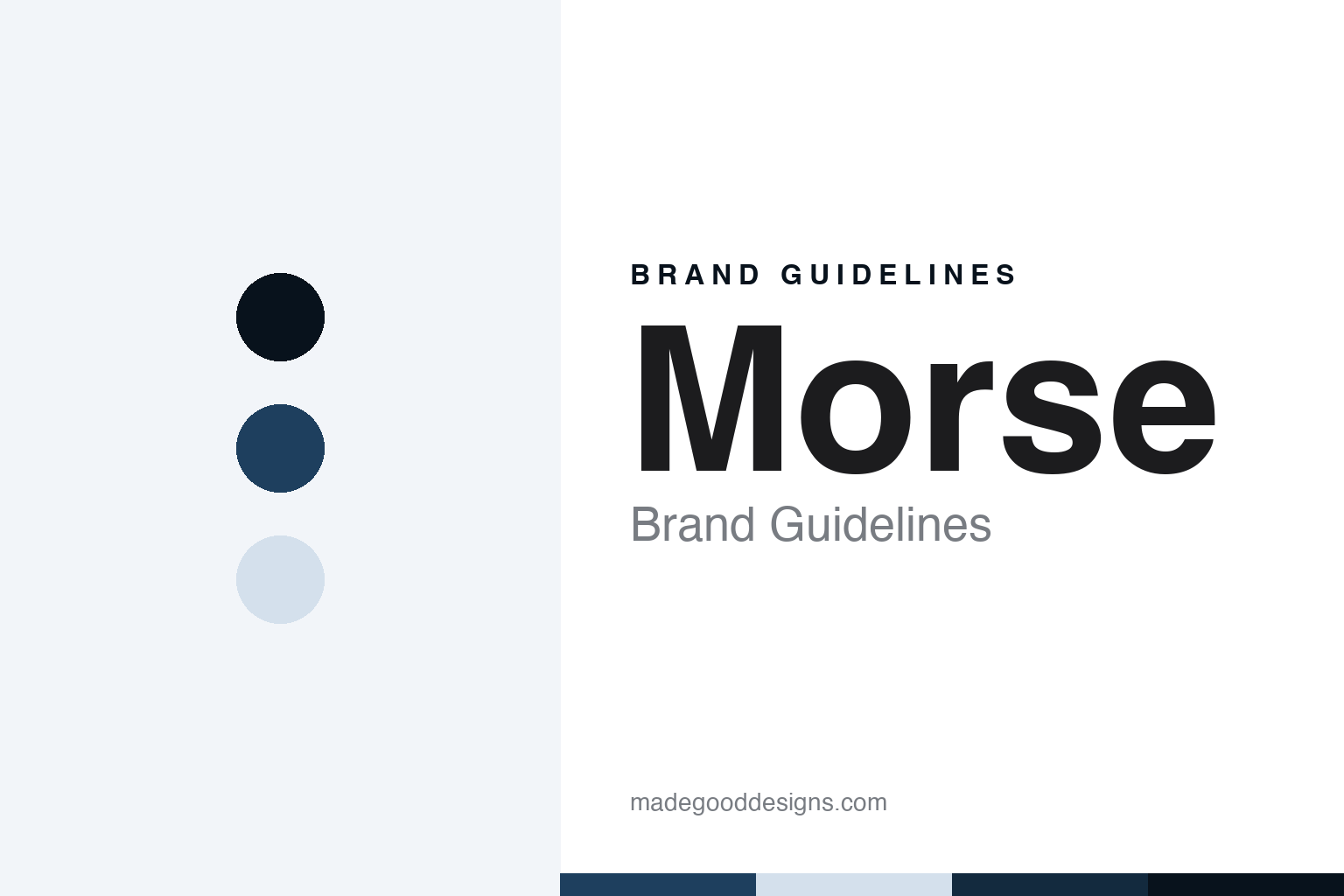
Morse Concertinas Brand Guidelines
The Button Box’s own concertinas, 1999–2022.
Aa
Two constants: a Morse blue and pale blue palette and a New England sans register. Abstract homage — not a Morse product or mark; no instrument, logo or nameplate is reproduced.
A hobby gone wild
Richard Morse’s Button Box.
Morse concertinas were the house brand of The Button Box, a Massachusetts shop for concertinas and button accordions. Its founder, Richard Morse — “Rich Morse,” as the shop’s history calls him — was, the shop’s history says, “a melodeon- and concertina-playing architect living in rural Vermont,” who began repairing instruments around 1980. “By 1985 … Thus officially began the Button Box, a hobby gone wild.”
It grew in stages, each one recorded on the shop’s own history page. The business moved from a Vermont cabin to Sunderland, Massachusetts; in 1990 Doug Creighton became manager and the shop opened a storefront in Amherst; in 1995 it set up a repair and fabrication garage under its chief repair technician, Bob Snope. Then, the history says: “1999 was a watershed year for us as we started production of our R. Morse & Co. brand concertinas.” That year it became The Button Box, Inc. In 2004 it moved back to Sunderland.
Its models, in time, covered all three systems: the Ceili Anglo, the Albion English and the Beaumont duet.
Colour
A founder’s death, and a closure.
The founder died in 2009, ten years after the brand’s launch. The shop’s history says: “in March of 2009 Button Box founder Rich Morse succumbed to a recurrence of the melanoma.” Doug Creighton continued, first as manager and then as owner.
The business then wound down over the following years, in two clear steps. A notice quoted on the forum The Session read: “THE BUTTON BOX RETAIL STORE IS CLOSING ITS DOORS PERMANENTLY AT THE END OF THE DAY ON MARCH 31, 2022.” By August 2023 the shop’s website said: “After over 35 years … The Button Box is now permanently closed.” Its domain has since been parked.
Under our rule for defunct businesses we say it plainly: R. Morse & Co. concertinas are no longer being made, as far as the sources show. Some support continues. Bob Snope, who says he was “intimately involved in the design and production of the R. Morse & Co. line,” opened The Squeezebox Garage in western North Carolina in October 2023, and offers “R. Morse & Co warranty work.” He was not the brand’s founder or its owner, but its long-serving repair technician.
Typography
Three systems under one roof.
There are three main systems. The International Concertina Association explains that on the English concertina “Each button plays one note – the same whether pulling or pushing the button,” while “Anglos are bisonoric: each button sounds two different notes, depending on whether the bellows are compressed (pushed) or opened (pulled),” and duets play the same note in both directions with higher notes on the right. The Anglo, it says, “is popular for Irish traditional music and for Morris and other traditional dance forms”; the historian Gearóid Ó hAllmhuráin writes that “the Anglo-German concertina arrived in Clare during the middle decades of the nineteenth century.” Morse offered all three — English, Anglo and duet.
The concertina’s paper trail starts with patents. Charles Wheatstone’s British Patent No. 5803 of 1829, “Improvements in the Construction of Wind Musical Instruments,” covered the symphonium — which the Whipple Museum in Cambridge calls “the precursor to his better known invention, the English concertina” — and the reference site concertina.com notes it is “The first of the Wheatstone patents to show a concertina, even though the word is not used.” His Patent No. 10041 of 1844, “Improvements in the Action of the Concertina, &c. by Vibrating Springs,” was, the same site says, “The most important of the concertina patents, establishing the characteristic features of the English concertina.”
Much of what we know about the London trade comes from one firm’s books. In 1996 the Horniman Museum in London bought “almost all the contents of the Concertina Museum in Belper, Derbyshire,” more than six hundred free-reed instruments, its keeper of musical instruments, Margaret Birley, writes. “Among the highlights are twelve ledgers from the C. Wheatstone & Co. concertina factory dating from 1834 to 1891,” saved from destruction by a manager, Henry Minting. The ledgers “chart the weekly wages paid to employees such as Messrs Lachenal, Dove, Chidley and Nickolds, all of whom later left the Wheatstone factory to set up their own concertina workshops, in competition with the parent company.”
Of the London names, only Wheatstone still has a working owner: Steve Dickinson, a concertina maker who bought it in 1975 and trades as C. Wheatstone & Co. from Stowmarket in Suffolk. Lachenal, founded under his own name in 1858 by a Swiss former Wheatstone employee, made by one estimate about 250,000 instruments before closing in the 1930s.
Jeffries, the Praed Street family firm, left no price list, brochure or advertisement that anyone has found, yet modern makers still cite its Anglos as their models. Crabb, the Islington family firm founded by another Wheatstone employee, traded from 1860 until its shop closed in 1989.
Among modern makers, Colin Dipper has restored and made concertinas in Wiltshire since the mid-1960s and Jürgen Suttner in Siegen says he has made about 1,100,.
The Horniman also holds later Wheatstone ledgers, covering 1910 to 1974, lent by the present owner of the name, Steve Dickinson; together, the museum says, the notebooks chronicle production “from 1834 to 1974 — albeit with some gaps.”
Aa
A New England sans — a founder’s name on a shop’s own brand. (Specimen set in Inter Tight, a sans STAND-IN; NOT the Morse logo.)
Morse
A founder’s name on a shop’s own brand.
Morse’s brand was a founder’s surname and a shop’s reputation. The concertinas carried “R. Morse & Co.”; the shop carried “The Button Box.” Two of its three model names — Ceili and Albion — pointed to Irish and English traditions.
For a design guide, Morse shows how a retailer’s house brand can outlive its founder by more than a decade and then end with the shop. The warranty work that continues in North Carolina is the brand’s last practical presence, carried on by the technician who helped design it. Compare Dipper, a family workshop that sells under its makers’ names, and Suttner, a single maker with a waiting list.
For this guide we use a blue and a pale blue with a sans serif, an unofficial interpretation. No instrument or mark is reproduced.
Explore & save
Keep Morse Concertinas’s identity on hand — save it to a board in the Made Good inspiration library.
Morse identity set
Pin the Morse blue and pale blue palette and the New England sans register to your own board.