Suttner Concertinas Brand Guidelines
A thousand parts, made by hand in Siegen.
Aa
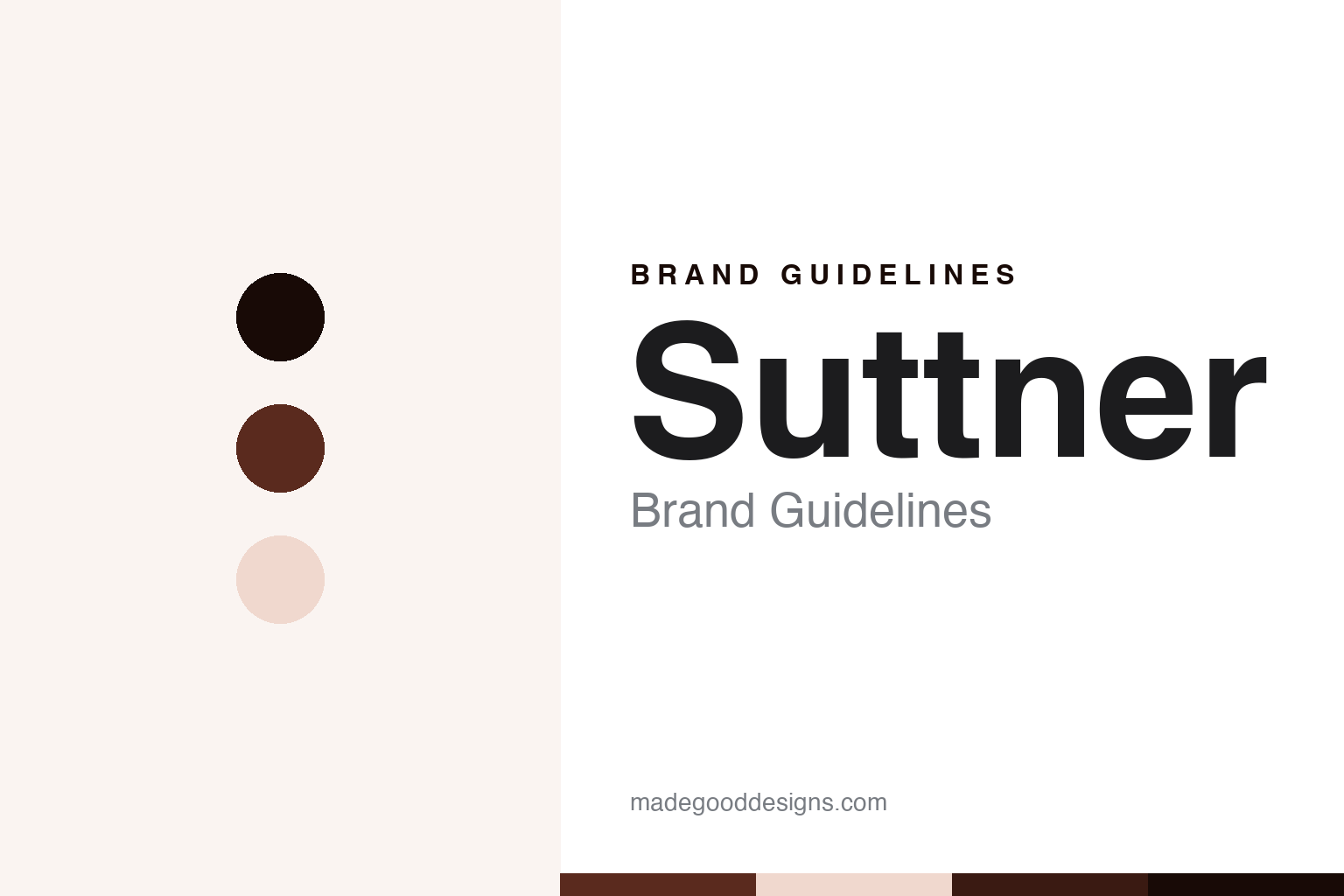
Two constants: a Suttner rosewood and blush palette and a Workshop sans register. Abstract homage — not a Suttner product or mark; no instrument, logo or nameplate is reproduced.
A thousand parts, made by hand
Jürgen Suttner of Siegen.
Suttner concertinas are made by Jürgen Suttner in Siegen, in western Germany. His website’s headline is simple — “HAND CRAFTED CONCERTINAS” — and it describes the work in numbers: “about 1000 individual parts are manufactured and assembled. Each reed is individually made from hardened steel, mounted in a brass frame and finally tuned by hand.” A counter on the site says “1100 Concertinas made.”
He looks back, deliberately and by his own account, to nineteenth-century London. Suttner says he designs “according to the historical models of Wheatstone and Jeffries,” and that the endplates’ “filigree ornamentation is sawn out according to the old original patterns,” in German silver, ebony or rosewood. The reed pans are maple, the bellows leather, and the buttons, he says, have a “metal cape and a POM core.” Instruments are tuned to A=440 and come with a hard case.
We could not confirm a founding year, so we give none, and we did not check any company register. Forum accounts of his earlier career and of early serial numbers are second-hand, and we leave them out.
Colour
A closed order book.
Suttner’s current online catalogue lists Anglo models only, in several sizes, from a 31-key C/G instrument of the Jeffries type to a 38-key model and a Wheatstone “Linota” type. As listed in October 2026, prices started at €4,700 for the A2 and ran to €5,850 for the TC, with prices indexed to inflation above two per cent a year.
Demand is the brand’s strongest signal, and its clearest selling point. The site says: “The order book for Suttner Concertinas is now closed once again, due to a large number of orders having been placed in a short period of time.” The same site still gives waiting times “For Anglo concertinas: one to two years.” The closure notice is undated, so we report both as they appeared.
A closed order book is unusual marketing: it tells a buyer, more clearly than any slogan, that the instruments are scarce. For a maker working alone, it is also simply a fact of capacity.
Typography
Wheatstone and Jeffries, revisited.
The concertina’s paper trail starts with patents. Charles Wheatstone’s British Patent No. 5803 of 1829, “Improvements in the Construction of Wind Musical Instruments,” covered the symphonium — which the Whipple Museum in Cambridge calls “the precursor to his better known invention, the English concertina” — and the reference site concertina.com notes it is “The first of the Wheatstone patents to show a concertina, even though the word is not used.” His Patent No. 10041 of 1844, “Improvements in the Action of the Concertina, &c. by Vibrating Springs,” was, the same site says, “The most important of the concertina patents, establishing the characteristic features of the English concertina.”
There are three main systems. The International Concertina Association explains that on the English concertina “Each button plays one note – the same whether pulling or pushing the button,” while “Anglos are bisonoric: each button sounds two different notes, depending on whether the bellows are compressed (pushed) or opened (pulled),” and duets play the same note in both directions with higher notes on the right. The Anglo, it says, “is popular for Irish traditional music and for Morris and other traditional dance forms”; the historian Gearóid Ó hAllmhuráin writes that “the Anglo-German concertina arrived in Clare during the middle decades of the nineteenth century.” Suttner builds Anglos, the instrument of that tradition.
Much of what we know about the London trade comes from one firm’s books. In 1996 the Horniman Museum in London bought “almost all the contents of the Concertina Museum in Belper, Derbyshire,” more than six hundred free-reed instruments, its keeper of musical instruments, Margaret Birley, writes. “Among the highlights are twelve ledgers from the C. Wheatstone & Co. concertina factory dating from 1834 to 1891,” saved from destruction by a manager, Henry Minting. The ledgers “chart the weekly wages paid to employees such as Messrs Lachenal, Dove, Chidley and Nickolds, all of whom later left the Wheatstone factory to set up their own concertina workshops, in competition with the parent company.” Suttner’s models look back to two of those London names: Wheatstone, whose ledgers survive, and Jeffries, whose records do not.
Of the London names, only Wheatstone still has a working owner: Steve Dickinson, a concertina maker who bought it in 1975 and trades as C. Wheatstone & Co. from Stowmarket in Suffolk. Lachenal, founded under his own name in 1858 by a Swiss former Wheatstone employee, made by one estimate about 250,000 instruments before closing in the 1930s.
Crabb, the Islington family firm founded by another Wheatstone employee, traded from 1860 until its shop closed in 1989. Among modern makers, Colin Dipper has restored and made concertinas in Wiltshire since the mid-1960s, and The Button Box in Massachusetts made R. Morse & Co. concertinas from 1999 until about 2022.
The Horniman also holds later Wheatstone ledgers, covering 1910 to 1974, lent by the present owner of the name, Steve Dickinson; together, the museum says, the notebooks chronicle production “from 1834 to 1974 — albeit with some gaps.”
Jeffries, the Praed Street family firm, left no price list, brochure or advertisement that anyone has found, yet modern makers still cite its Anglos as their models. Suttner’s Jeffries-type A2 is the entry model in his catalogue.
Aa
A workshop sans — a maker’s name and a part count. (Specimen set in Inter Tight, a sans STAND-IN; NOT the Suttner logo.)
Suttner
A maker’s name and a part count.
Suttner’s brand is a maker’s name, a number and a promise of handwork: about a thousand parts, each reed tuned by hand, endplates cut to old patterns. Its website is plain, practical and specific, with prices, specifications and waiting times set out openly.
For a design guide, Suttner shows a one-person brand built on transparency — what it is made of, what it costs, how long it takes — and on a clear lineage from the London makers. Compare Dipper, a family workshop with no website of its own, and Morse, a shop brand that ended in 2022.
For this guide we use a rosewood and a blush with a sans serif, an unofficial interpretation. No instrument, endplate or mark is reproduced.
Explore & save
Keep Suttner Concertinas’s identity on hand — save it to a board in the Made Good inspiration library.
Suttner identity set
Pin the Suttner rosewood and blush palette and the Workshop sans register to your own board.