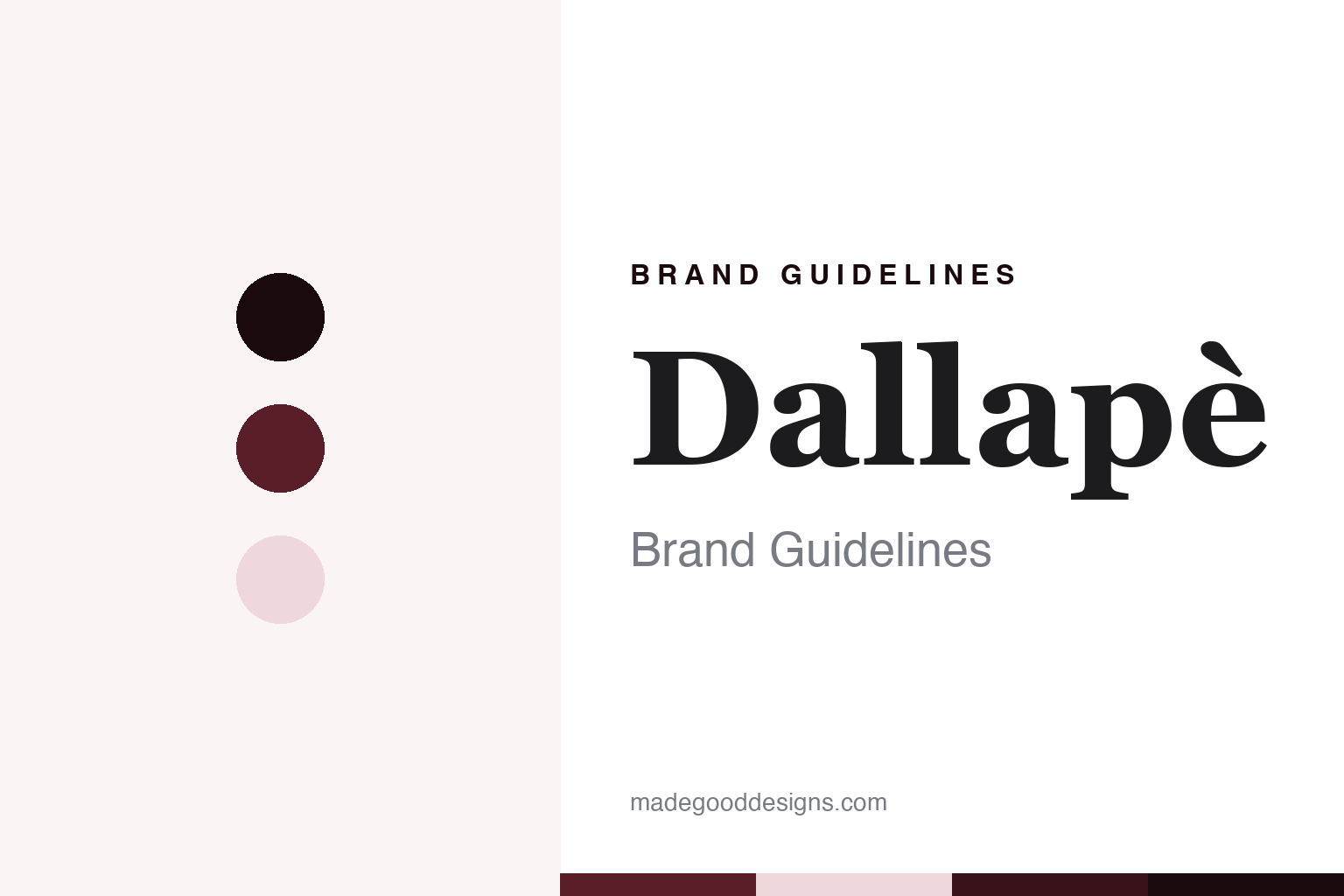
Dallapè Brand Guidelines
The Stradella accordion and a name now owned by Roland.
Aa
Two constants: a Dallapè wine and ivory palette and a Lombard serif register. Abstract homage — not a Dallapè product or mark; no instrument, logo or nameplate is reproduced.
The Stradella accordion
A miner from Trentino who settled in Lombardy.
Dallapè is the founding name of the accordion in Stradella, a town in the Oltrepò Pavese in Lombardy. Mariano Dallapè was born on 12 May 1846 in Brusino di Cavedine, in Trentino — then Austrian territory — and arrived in Stradella in 1866. He died in 1928.
The company told its own origin story. Dallapè, it said, worked as a miner and blaster on the port works in Genoa until a mine went off early and left him lame; walking home to Trentino, he played an old Austrian organetto for his food, and when it broke in Stradella he repaired it, then built a new and better one. We give that as the company’s account.
The dates that can be checked are two. Roland, which now owns the name, says the first accordion prototype was made in 1871, and Stradella’s town museum holds that instrument. Series production began in 1876, under the name Fabbrica Armoniche Mariano Dallapè & Figlio, in modest premises with about twenty collaborators.
Colour
A factory, a knighthood and an organ in a box.
The business grew quickly. In 1898 Dallapè was made a knight of the Order of the Crown of Italy, and by 1900 a trade paper, L’Italia Industriale, described a large factory with forty skilled workers that had won prizes at world exhibitions. At its peak the factory employed more than three hundred people. Local sources credit the factory with the “Stradella bass” system, an attribution we have not confirmed in an independent history.
After the founder’s death the firm stayed with his family — later his nephew Giuseppe’s line, and from 1969 Giuseppe’s three sons. Its best-known instrument was the Liturgica, an accordion voiced like a pipe organ; Roland says Giuseppe Dallapè gave one to Pope Pius XII in 1942. A special Centenario model marked the hundredth year in 1976.
The end came in 2010. Its instruments were built essentially for professionals and concert players, and collectors still prize models such as the Organtone and Super Maestro. The family signed an agreement with Roland in Stradella on 14 September 2010, and Roland says that “in October 2010, after 134 years,” the factory “closed their doors forever.” Roland recorded Dallapè instruments, from the 1871 prototype onward, into a sound library for its digital V-Accordions, and later sold a limited FR-8x Dallapè edition of 500 numbered instruments with a metal grille bearing the original Dallapè logo; that model is now discontinued.
Typography
Accordions, by the numbers.
The accordion is younger than most instruments. In Vienna, Cyrill Demian received a patent on 23 May 1829 for an instrument he called the Accordion: a box of free reeds sounded by a bellows.
Accordions still have their own line in the European customs code. Under CN code 9205 90 10, “Accordions and similar instruments,” Eurostat records that Italy exported €22.37 million of them in 2024 — 9,998 instruments, an average of about €2,240 each. In 2007 Italy exported 16,905, worth €14.47 million: fewer instruments now, but more money for each one.
The United States is Italy’s largest market for them, at €5.46 million in 2024, followed by Germany at €2.82 million and China at €2.56 million. Germany’s own exports that year were €3.91 million, about a sixth of Italy’s.
The same figures show the price gap at the bottom of the market. In 2024 the European Union imported 69,520 accordions and similar instruments from China for €2.56 million, about €37 each — against Italy’s average export price of more than €2,000.
The accordion has also lost ground in the tariff tables. Until 2007 the Harmonized System gave it its own heading, 9204, “Accordions and similar instruments; mouth organs”; since then it has been folded into heading 9205, among the wind instruments. In March 2022 the European Union banned exports to Russia of musical instruments worth more than €1,500 as luxury goods, accordions among them (Regulation 2022/428).
Many accordion makers cluster in and around Castelfidardo, in the Marche, but it was never the only accordion town. In Stradella, in Lombardy, Mariano Dallapè began series production in 1876, and the town says 44 accordion factories have existed there since. In 2026 Stradella is marking the 150th anniversary with a project called “Formazione armonica,” which includes a new accordion museum in the town’s former court building.
Outside Italy the trade has been fragile. France’s oldest maker, Maugein of Tulle, was placed in liquidation in September 2024 and revived by a former employee in 2025; in Germany, the Weltmeister manufactory in Klingenthal, a town that has made accordions since the nineteenth century, filed for insolvency in autumn 2023.
The instrument sits inside protected traditions, too. UNESCO’s 2015 inscription of the traditional vallenato music of Colombia’s Greater Magdalena region, on its list of heritage in need of urgent safeguarding (decision 10.COM 10.A.2), names the accordion alongside the caja drum and the guacharaca.
Stradella has kept Dallapè’s memory in public. Its civic accordion museum, named after Mariano Dallapè, opened on 20 May 1999 with the singer-songwriter Paolo Conte as its godfather, and in July 2022 the town unveiled a bronze of a young accordionist holding a Dallapè in Piazza Trieste. The old factory, by contrast, is abandoned; in 2014 its machinery and 1930s offices were still inside, and local voices hope it will become a museum.
Aa
A Lombard serif — a founder’s name over a closed factory. (Specimen set in Fraunces, a serif STAND-IN; NOT the Dallapè logo.)
Dallapè
A founder’s name over a closed factory.
Dallapè’s brand is a person and a place: one man’s surname, attached for 134 years to one Lombard town. Its signature products — an organ-voiced accordion for churches, an anniversary model — speak of a house that built for professionals rather than the mass market. That the name now lives on as a set of digital samples, and once as a limited Roland edition, makes it an unusual case: a heritage brand whose factory is closed but whose sound is still sold.
For a design guide, Dallapè shows how a founder’s name can outlast the place that made it. Compare Paolo Soprani, Castelfidardo’s founding name, and Roland, which bought the Dallapè name. We say plainly that Dallapè no longer makes accordions; the name belongs to Roland.
For this guide we use a wine red and an ivory with a serif, an unofficial interpretation. No instrument or logo is reproduced.
Explore & save
Keep Dallapè’s identity on hand — save it to a board in the Made Good inspiration library.
Dallapè identity set
Pin the Dallapè wine and ivory palette and the Lombard serif register to your own board.