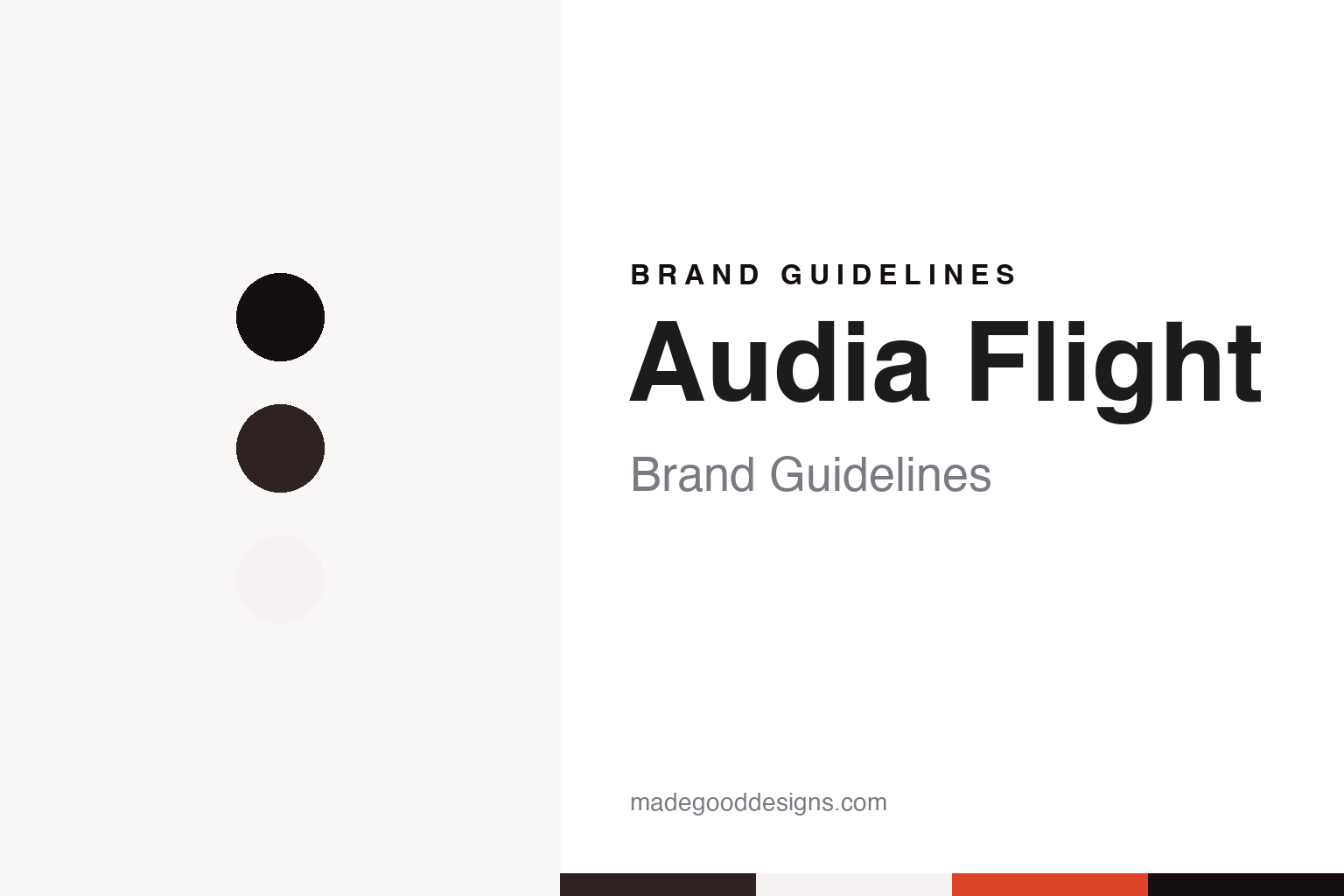
Audia Flight Brand Guidelines
Civitavecchia’s current-feedback amplifiers.
Aa
Two constants: a Audia warm black and red-orange palette and a Clean sans register. Abstract homage — not a Audia Flight product or mark; no instrument, logo or nameplate is reproduced.
A different kind of feedback
Marzi and Nardini.
Audia Flight says it was “founded in 1996 by Massimiliano Marzi and Andrea Nardini,” after a period of research from 1994. Its history says the founders questioned the usual voltage-feedback approach to amplifier design and turned to current feedback instead — a circuit approach in which the feedback signal is taken as a current rather than a voltage: “With this breakthrough, Audia Flight was born.”
Its first product, in 1997, was the Flight 100 power amplifier, followed by the Flight Pre preamplifier and the Flight 50; its first integrated amplifier, the Flight One, came in 2001, later paired with a three-channel Flight 3.100 for home cinema.
The company is Audia Snc, a general partnership whose other partners, if any, we could not identify, on Via Alfio Flores in Civitavecchia, Rome’s port, north-west of the city. The word “Flight” has stayed in its range names for 30 years — Flight, FLS, FL Three S. We found no parent company or outside investor. Marzi is its chief executive, according to Stereophile; Andrea Nardini’s current role is not stated on the pages we read, and we found no founder biographies or Wikipedia article.
Colour
FLS and Strumento.
Its current ranges run from the entry-level FL Three S through the FLS series — the FLS1, FLS4, FLS8, FLS9, FLS10, FLS20 and, announced in September 2026, the FLS22 digital-to-analogue converter — to the flagship Strumento — Italian for “instrument” — and Strumento Signature lines, numbered No.1, No.4 and No.8. The company says the Strumento took “over three years of dedicated development.”
Stereophile reviewed the FLS10 integrated amplifier in January 2025. Its reviewer, Rogier van Bakel, described it as “proudly made in Civitavecchia (a coastal town 40 miles northwest of Rome),” — about 64 kilometres — quoted Marzi on the aim of “power and details together,” and confirmed its current-feedback stage. The magazine listed the amplifier at $16,997 as reviewed, or $12,999 in a line-level-only version, weighing 36 kilograms, in black or silver, sold through about 20 American dealers and distributed in the United States by Fidelity Imports.
The company lists many awards — from Stereophile for the FLS10, from the French magazine Diapason, from Italy’s Fedeltà del Suono, from Milan’s Top Audio show and from the Japanese magazine Stereo Sound. We give them as its own list: Diapason’s award for the Flight Two in 2011 and the FL CD Three S in 2022; Fedeltà del Suono’s for the Flight Phono in 2009; Top Audio’s for the Strumento n.1 and n.4 in 2012; and Stereo Sound’s for the Strumento n.4 MKII in 2016 and n.8 in 2017.
Typography
Small makers, strong claims.
Italy’s best-known hi-fi brand shows how ownership can travel. Sonus faber was founded in 1983 by Franco Serblin near Vicenza; in 2007 the investment firm Quadrivio bought it and built a group, Fine Sounds, that went on to buy Audio Research, Sumiko and McIntosh, later renaming itself McIntosh Group and moving its headquarters to New York. Fine Sounds had sales of €50 million in 2011; a management buyout with LBO France followed in 2014, the group took the McIntosh name in 2016, and Highlander Partners bought it in 2022. In November 2024 the American company Bose announced that it would buy McIntosh Group, Sonus faber included, according to What Hi-Fi?. Serblin himself had left Sonus faber in 2006, and died in 2013.
Italian audio design also has a longer history. Brionvega, founded in Milan in 1945, worked with designers such as Marco Zanuso and Richard Sapper, and its radios and televisions are held by museums including MoMA and the V&A, according to English Wikipedia. It took the Brionvega name in 1963 and was sold to Sèleco in 1992; in 2016 David Bowie’s Brionvega RR 126 radiogram sold at Sotheby’s for £257,000.
That design tradition is collected and exhibited. Brionvega worked with Achille and Pier Giacomo Castiglioni and Mario Bellini as well as Zanuso and Sapper, won Compasso d’Oro design awards, and has products in the Centre Pompidou and Milan’s ADI Design Museum; in 2025 its pieces appeared in the San Francisco Museum of Modern Art’s exhibition “The Art of Noise,” according to English Wikipedia. Sonus faber, for its part, is based at Arcugnano, just outside Vicenza.
The makers in this guide are much smaller. They are private companies or partnerships, some still led by their founders, and they describe their own work in strong terms — handmade, entirely Italian, patented. We give each of those claims as the company’s own, and say where we could not check them.
Audia Flight is one of those founder-led makers: a partnership that has built three decades of amplifiers on one technical choice.
Aa
A clean sans — a black wordmark. (Specimen set in Inter Tight, a sans STAND-IN; NOT the Audia Flight logo.)
Audia Flight
A black wordmark.
On manufacturing the company is explicit. It “designs and manufactures high-end home audio components entirely in Italy. Every Audia Flight product is meticulously handcrafted at our own facility,” it says, “in Civitavecchia, a coastal town just over 70 kilometers from Rome.” Stereophile’s “40 miles” and the company’s “just over 70 kilometres” measure the distance differently; both put the factory near Rome. We give the manufacturing statement as the company’s own.
Its old audiaflight.com address now leads to audia.it, where its awards have a page of their own. The entry-level FL Three S range includes a CD player, the FL CD Three S, which won the Diapason award in 2022. Its homepage carries the line “30 years in service of music,” counting from 1996. Its logo file shows a black wordmark, and its website uses the Roboto typeface with a warm near-black, a warm off-white and a red-orange accent; we found no published brand guidelines, and no staff or revenue figures.
For a design guide, Audia Flight shows a brand defined by a single engineering idea. Compare Grandinote, another Italian amplifier maker led by its designer, and Pathos Acoustics, which also names its own circuit. For this guide we use the website’s warm black and red-orange with a sans, close to the company’s own but an unofficial interpretation; no product or logo is reproduced.
Explore & save
Keep Audia Flight’s identity on hand — save it to a board in the Made Good inspiration library.
Audia Flight identity set
Pin the Audia warm black and red-orange palette and the Clean sans register to your own board.