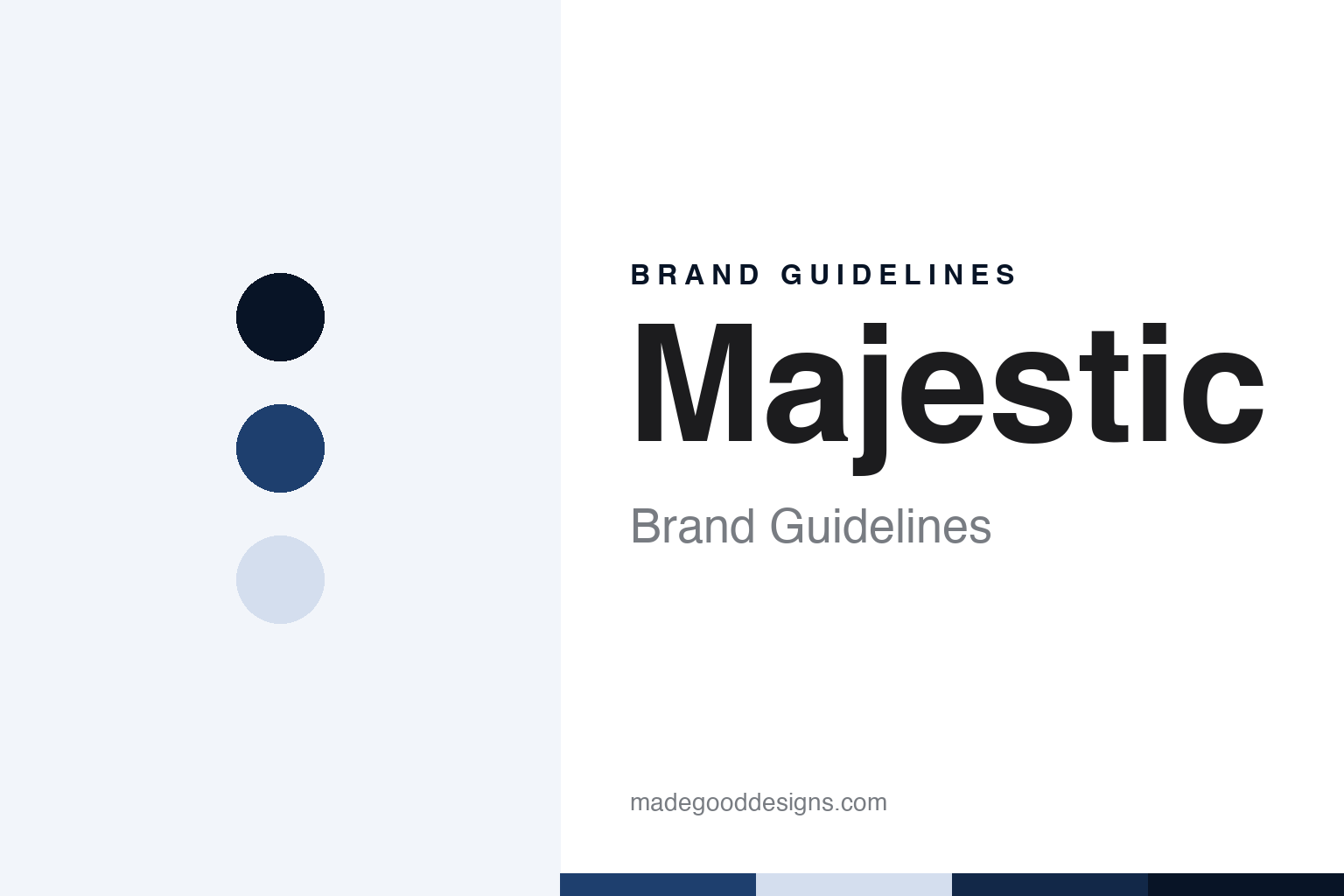
Majestic Percussion Brand Guidelines
Dutch roots, Taiwanese owner.
Aa
Two constants: a Majestic royal blue and pale blue palette and a Capital sans register. Abstract homage — not a Majestic product or mark; no instrument, logo or nameplate is reproduced.
A music shop in Heerenveen
Organs and pianos first, then drums.
Majestic traces itself to a Dutch family shop in Friesland, in the north of the Netherlands. Its own history says: “Majestic traces its beginning to the family firm of van der Glas B.V. founded in 1921 by Willem Klazes van der Glas, the grandfather of the present proprietor Wim van der Glas.” The firm began in “the old city center of Heerenveen, the Netherlands,” in Friesland, selling “organs, pianos and wind instruments.”
The percussion came later. “In 1960 the ‘Majestic’ brand name was introduced for these percussion instruments,” the company says; its drum sets were popular with Dutch rock bands of the time. Over the following decades it became a specialist in orchestral percussion, especially timpani, the area its Dutch factory still serves. Wikipedia notes that Majestic “claims to be the oldest timpani manufacturer in the Netherlands” — a claim, and one we attribute.
The name itself was a choice. “Majestic” is an English word with no connection to the van der Glas family — a brand name that could travel without the family name attached.
Colour
KHS, Tianjin and Taiwan.
In 2003, the company says, “Majestic joined the KHS group of musical instrument brands,” and a new company, Majestic Holland b.v., was set up for the division. KHS — K.H.S. Musical Instrument Co. — is a Taiwanese group; Wikipedia says Majestic’s US sales have gone through Jupiter Band Instruments, another KHS company. Majestic’s own page still calls Wim van der Glas the “present proprietor” and says “Product development, engineering and production are overseen by family members,” so we describe it as a KHS brand with continuing van der Glas involvement, as Majestic puts it.
The production story is told most plainly by KHS. Its brand timeline says that in 2002 “K.H.S. established the JMP factory in Tianjin, China… produced mainly Mallet Instruments components”; that in 2006 “The Majestic mallet instruments inherited the marimba production know-how from the Ross Mallet. The Majestic mallet instruments were manufactured in Tianjin, China”; and that in 2017, “By researching and developing new ways to produce mallet instruments in Taiwan, Majestic was able to redesign marimba models,” launching the Reflection series.
Majestic’s Dutch side continues. The company says “a large new factory in Nijehaske, near Heerenveen was established for continued select timpani production.” So the honest summary is: Dutch roots, Dutch timpani, Taiwanese ownership, and mallet instruments made in China and developed in Taiwan, by KHS’s own account.
Typography
A wood under treaty.
KHS lists other markers of the brand’s modern life: its Prophonic timpani in 2007, and appreciation awards from WGI Sport of the Arts, the American marching and indoor percussion circuit, from 2014 to 2016. KHS also says Majestic’s mallet line “inherited the marimba production know-how from the Ross Mallet” in 2006.
The vibraphone has a precise history. According to a 2021 article in the Percussive Arts Society’s journal Percussive Notes, Herman Winterhoff of the Leedy company fitted rotating fans to a metal-barred instrument in 1921, Leedy’s sales manager George Way “first coined the name ‘vibraphone,’” and Deagan’s design was “released in 1927 as the first ‘Vibraharp,’ Deagan model no. 145,” with aluminium bars and a damper pedal. Leedy, the article says, “did not feel it necessary to apply for a patent.”
The classic marimba bar is cut from Honduras rosewood, Dalbergia stevensonii, and that wood has been a treaty matter for years. Guatemala listed it in CITES Appendix III in 2008; in 2013 the convention moved it to Appendix II on a proposal from Belize, whose filing called it “the preferred species for the manufacture of bars for marimbas and xylophones,” noting “a high level of wastage, up to 80% … as only logs of the straightest grain are used to make marimba bars.” In 2017 the whole rosewood genus went into Appendix II, and only from 26 November 2019 did the listing exempt “finished musical instruments, finished musical instrument parts and finished musical instrument accessories.” Appendix II regulates trade through permits; it is not a ban. Belize’s filing added that the species is “superior to Brazilian Rosewood for this purpose due to greater density, toughness and resonance qualities,” that it is “restricted in distribution to broadleaf evergreen swamp forests of southern Belize and nearby regions of Guatemala and Mexico,” and that Belize had imposed a moratorium on cutting and export in March 2012.
The marimba also has a place on UNESCO’s list of intangible heritage — though not the concert-hall kind. In 2015 UNESCO inscribed “Marimba music, traditional chants and dances from the Colombian South Pacific region and Esmeraldas Province of Ecuador,” replacing a 2010 Colombian listing, and describes an instrument “played on a palm wood xylophone with bamboo tube resonators, accompanied by drums and maracas.” The tradition is palm wood and bamboo; the concert marimba usually pairs rosewood or synthetic bars with metal resonator tubes.
Aa
A capital sans — MAJESTIC in full capitals. (Specimen set in Inter Tight, a sans STAND-IN; NOT the Majestic logo.)
Majestic
MAJESTIC in full capitals.
Majestic’s site sets its name in capitals and runs lines such as “Our History of Tradition and Innovation” and “Join the Majestic Percussion Movement,” with instruments “thoughtfully designed … for the professional, the educator, and today’s percussion student.” It speaks to schools and marching programmes as much as to orchestras, and its awards from WGI Sport of the Arts point the same way.
For a design guide, Majestic is the clearest case in this round of a heritage story and a production story pointing in different directions. Its history is Dutch and familial; its ownership is Taiwanese; its mallet instruments, by KHS’s account, come from China and Taiwan. A brand can carry all three honestly if it says so, and KHS, to its credit, publishes the factory history on its own website. Compare Adams, a Dutch rival founded in 1970 that says it is a family business “without external investors” and makes its instruments in-house in the Netherlands, and Musser, an American name inside a piano group.
For this guide we use a royal blue and a pale blue with a sans serif, suited to a name that means regal, an unofficial interpretation. No instrument, kettle or logo is reproduced.
Explore & save
Keep Majestic Percussion’s identity on hand — save it to a board in the Made Good inspiration library.
Majestic identity set
Pin the Majestic royal blue and pale blue palette and the Capital sans register to your own board.