BlueBird Clay Brand Guidelines
A Colorado mark, passed on.
Aa
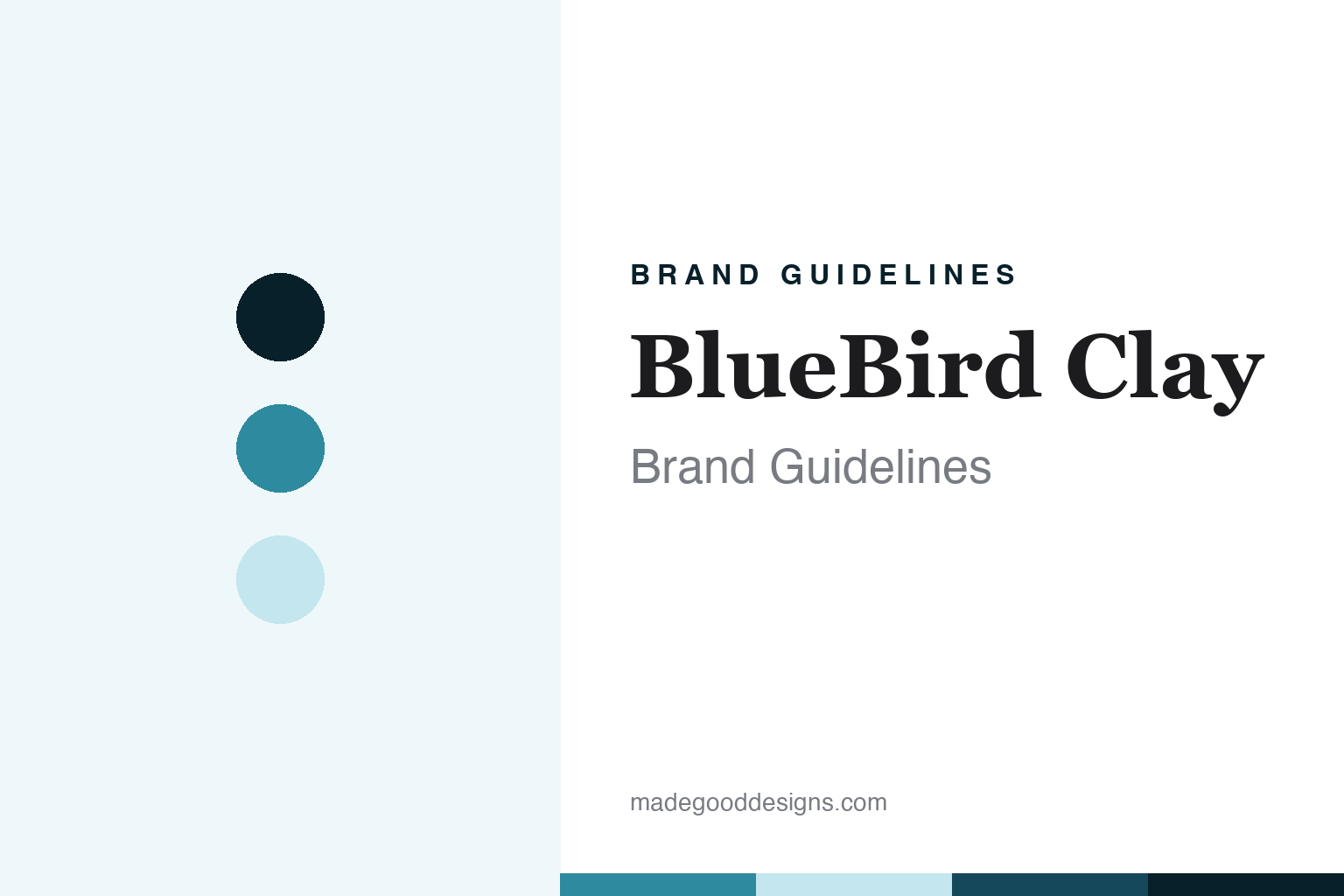
Two constants: a BlueBird-teal palette and a small-caps serif register. Abstract homage — not a BlueBird product or mark; no machine or logo is reproduced.
A potters’ mark in an old canning factory
Bluebird began as a mark on machines made by working potters.
The earliest trace of Bluebird is in a potters’ magazine. In 1975, in an article for Studio Potter called “Twelve Colorado Potters,” the ceramicist Betty Woodman described Carl and Jeanne Judson of Fort Collins, “a team since 1948”: “They make functional pottery and clay mixers under the ‘Bluebird’ mark.” Their pottery, machine shop and home, she wrote, were “in an old Charles Adams-type canning factory.” We found no founding year for the business and no record linking the Judsons formally to the later company, so we give the 1975 description and no more.
For decades the name traded as Bluebird Manufacturing, Inc., of Fort Collins; its website, registered in 1996, still carried that name in early 2024, with a post-office box in Fort Collins as the address. Then the brand moved. In April 2024 the old domain began redirecting to a new one, bluebirdclay.com, and by September it had become a parked page. The business that trades as BlueBird today is The Cut Shop, LLC, “DBA BlueBird Clay, LLC,” at Webster Avenue in Fort Collins — a Colorado company formed in 2018 and in good standing, whose registered agent is Jordan Kloppe. The older company does not appear under its own name in the Colorado open business records we searched, so we do not say what became of it; the name itself, in any case, has passed to the new owners.
The handover was announced in the trade. In June 2024 the potters’ podcast Wheel Talk introduced “Jordan Kloppe, new owner of Bluebird Clay… a name that’s been around our industry for decades,” and summed up its range in a phrase: “pugmills, clay mixers, and Soldner pottery wheels.” A 2026 buyer’s guide said only that the company had been “purchased by a new owner in 2022 or 2023,” so we say it changed hands around 2023. The new owners write: “As the new owners of BlueBird Clay…”
Colour
Pugmills, mixers and the Soldner wheel.
Bluebird’s reputation rests on heavy machines for preparing clay. Its archived 2024 catalogue listed the 425 and de-airing 440 studio pugmills, “300 pounds per hour”; mid-sized 675 and 800 machines at “1000 and 1200 pounds per hour”; and a de-airing 3000, “rated at 3000 pounds per hour,” with an optional tile-cutting table. Its mixers ran from a Model 12, for a 50-pound wet batch, to a tilting 24S, and a “Powerstar” pugmill came with a one-horsepower motor. In a studio, those machines take over some of the heaviest work in a pottery — mixing, reclaiming and de-airing clay — and in this series they compete with the pugmills of Peter Pugger. Today the range includes 125- and 250-pound stainless-steel mixers, studio and production pugmills, wedging tables and a potter’s stool.
It also carries a famous wheel. BlueBird sells Soldner pottery wheels, named for the ceramicist Paul Soldner, and says “BlueBird Clay continues the Soldner legacy” — its claim. The 2024 catalogue listed older P100, P200 and P400 and S50 and S100 models; the current wheels come in brushless S150, P250 and P450 models and DC S100, P200 and P400 models, and BlueBird says “All wheelheads are 14” solid cast aluminum.” The DC wheels, its FAQ says, can turn so slowly that “one revolution taking between 30 to 45 seconds,” and the S100 motor costs “about three times the cost of the S150 motor.”
The company keeps a repair line in Fort Collins, quoting “$125 to completely disassemble, clean, and lubricate the pedal.” We found no “Made in USA” statement on its pages and do not attach one; we describe it as a Fort Collins-based maker.
Typography
The listing mark — and a safety switch.
A pugmill and a clay mixer are powerful electrical machines with moving blades, which makes them a natural subject for workplace electrical rules. In the United States, the Occupational Safety and Health Administration says electrical equipment in a covered workplace is “acceptable only if approved,” usually by being “listed, or labeled” by a Nationally Recognized Testing Laboratory such as UL, CSA or Intertek, whose mark signals that the laboratory “makes periodic inspections of the production of such equipment.” Listed equipment, OSHA adds, “shall be installed and used in accordance with any instructions included in the listing or labeling.” Approval can also come by other routes, including inspection by a local authority.
We found no UL, ETL or CSA wording on BlueBird’s pages. That is a statement about its website, not about its machines, which may carry marks on their plates, and we do not say whether they are listed. What its pages do describe is a mechanical safeguard: its mixers have “a safety switch that automatically stops the blade action when the lid is opened.” For a studio buyer, both matter — the electrical approval for the motor, the interlock for the hands.
Across the border, the rule is stricter at the point of sale: Ontario’s Electrical Safety Authority says equipment must be approved “before an electrical product… is used, sold, displayed or advertised for sale.”
BB
A small-caps serif — a mirrored double initial around a vase. (Specimen set in Fraunces, a serif STAND-IN; NOT the BlueBird logo.)
A bluebird without a bird
A monogram and a vase.
The new BlueBird logo has no bird in it. It is a mirrored “BB” monogram in a light teal-blue, framing a silver-grey silhouette of a vase, with “BlueBird” in teal serif small capitals and “CLAY” letter-spaced in grey between rules. The vase tells buyers what the machines are for; the colour keeps the name’s blue. The old website, plain HTML on a lavender-grey background, had no such identity at all; the redesign, set on a modern template in Inter and Oswald type, is the clearest visual sign of new ownership.
Its stated vision is “to be a beacon of quality and craftsmanship in an age of mass production and disposability.” For a design guide, BlueBird shows how a long-standing equipment name can be refreshed without losing its trade recognition: keep the name and the colour, add a clear symbol for the craft, and tell the customers the name has changed hands.
For this guide we use a teal and a pale teal with a small-caps serif. These are an unofficial interpretation, not BlueBird’s colour values, and nothing of its logo is reproduced.
Explore & save
Keep BlueBird Clay’s identity on hand — save it to a board in the Made Good inspiration library.
BlueBird identity set
Pin the BlueBird-teal palette and the small-caps serif register to your own board.