Highwater Clays Brand Guidelines
A clay maker the river took.
Aa
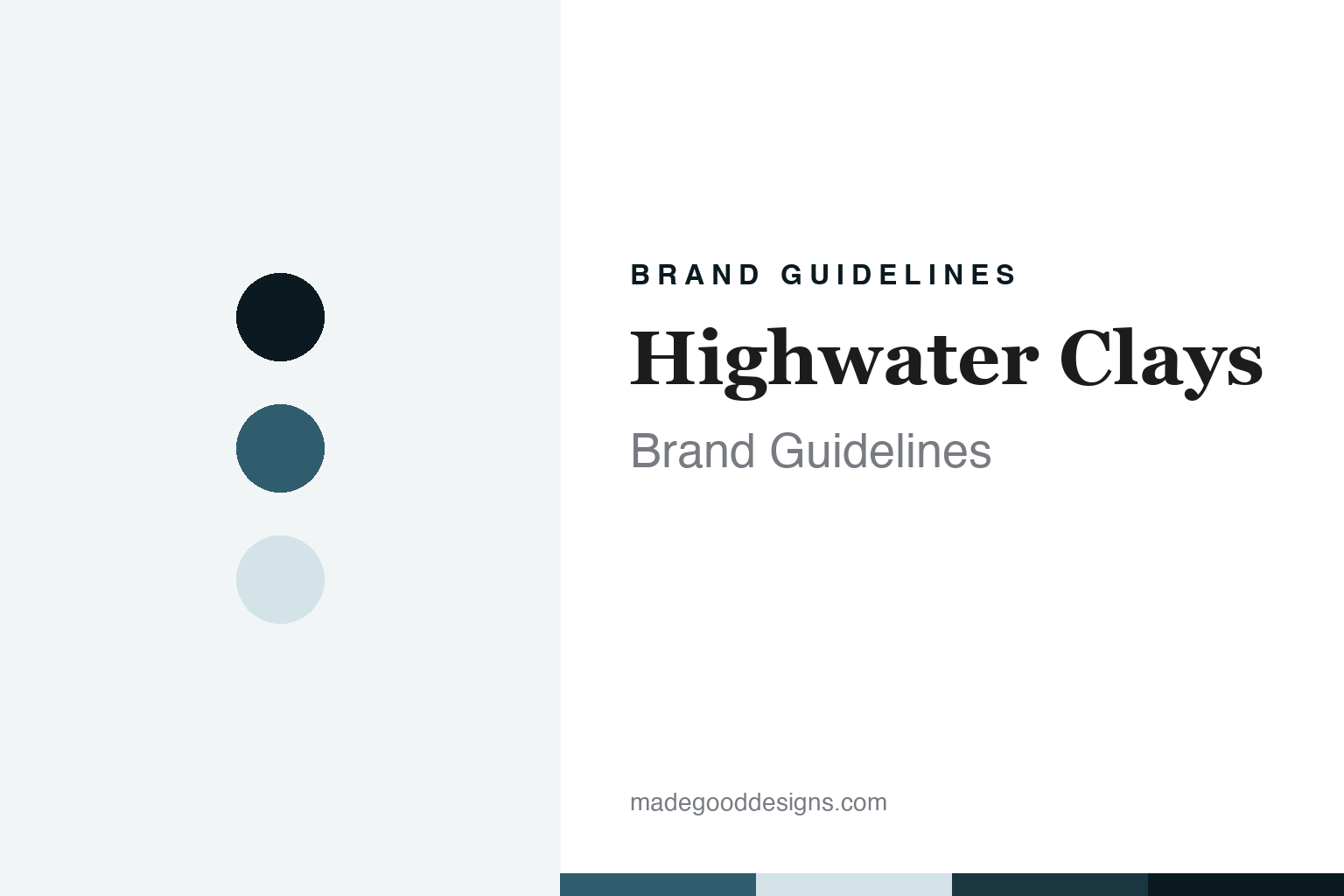
Two constants: a French-Broad-blue palette and a riverside-serif register. Abstract homage — not a Highwater product or mark; no clay, bag or logo is reproduced.
A pickup, a tent and a dream
Highwater began with a young family in 1979.
The Mountain Xpress told Highwater’s origin in 2007 in one sentence: “back in 1979, Brian and Gail McCarthy drove their pickup into Asheville with two toddlers, a tent and a dream. They wanted to formulate and sell clay.” They began, an arts award citation later recorded, “blending clays in an artists’ cooperative studio on the Swannanoa River,” and grew into a 40,000-square-foot operation at 600 Riverside Drive in Asheville’s River Arts District — a district whose open-studio tradition, the same citation says, the McCarthys helped start with the “Studio Stroll.”
Highwater made “high-quality wet clays, processed onsite,” and sold them across the region and by mail; its website once said that all web orders were “fulfilled by and shipped from the NC location.” The Xpress called it “one of a tiny handful of successful ball-clay suppliers in North America” — the paper’s description. By 2007 it had also opened a retail outlet in St. Petersburg, Florida; the Florida store is now in Clearwater, though we could not date the move. In 2023 the McCarthys received Asheville’s John Cram Arts Leadership Award, and the business also ran an education arm, Odyssey, for ceramic artists, on Clingman Avenue. In 2002 its website named the company Highwater Clays, Inc., with a post-office box in Asheville.
The company’s name now reads differently. Highwater was named, as far as we know, without irony; in September 2024 the high water came.
Colour
“Submerged in flood water.”
Hurricane Helene struck western North Carolina at the end of September 2024, and the River Arts District, on the banks of the French Broad, flooded. Highwater’s own announcement, posted in the spring of 2025, is the record: “It is with deep sadness and regret that we announce the permanent closure of Highwater Clays in Asheville, North Carolina as a direct result of the damages caused by Hurricane Helene in September of 2024. … our facilities were submerged in flood water. … Rebuilding and recovery are unfortunately unattainable.” The business had run, the letter said, “since the founding of the business in 1979.”
The brand has not wholly disappeared. The same letter said “our retail (only) store in Clearwater, Florida is still in operation,” and the website’s footer now announces that “Highwater Clays of Florida has reopened!” at an address in Clearwater — while warning that the site is “CURRENTLY UNDER CONSTRUCTION. ALL PRODUCT AND INVENTORY INFORMATION IS INVALID.” Highwater no longer makes clay in Asheville; we do not suggest otherwise. What continues under the old name is a shop, not a clay works, and the company’s own website says as much.
Something was saved. Before deciding not to rebuild, the McCarthys and their staff rescued more than 400 works of ceramic art from the flooded building, and the Asheville Art Museum mounted an exhibition, “Highwater Clays: A Story in Survival,” which ran into April 2026. It is an unusual ending for a supplier: a clay company remembered by a museum through the ceramic art rescued from its flooded building.
Typography
Clay, and the ground it comes from.
A clay maker blends what the ground provides. The US Geological Survey estimates American clay output at 26 million tonnes in 2025, from about 120 companies in 38 states, with about 990,000 tonnes of ball clay — led, its 2019 yearbook says, by Tennessee — and 4.8 million tonnes of kaolin, 92 per cent of it from Georgia in 2019. Highwater, by the Xpress’s account, was a ball-clay supplier. Most American ball clay does not go to potters: the USGS puts its leading use at floor and wall tile, 53 per cent in 2025, and only a fifth of kaolin goes to ceramics of any kind. A studio clay maker is a small, specialised customer of a large mining industry, buying materials worth, at the mine, about $47 a tonne for ball clay and $170 for kaolin. We found no statement from Highwater naming the mines it bought from, and we do not supply one.
The name “ball clay” itself, a 1975 British government dossier says, is “believed to be derived” from the old practice of cutting the clay in open pits into cubes, or “balls,” of about 15 to 17 kilograms. The British Geological Survey explains what a clay house adds: blending “is very important as it reduces the natural variability of the clays.” Highwater’s thirty-odd house bodies were that work made visible — recipes that turned raw clays into a product a potter could rely on. Its glazes, by contrast, were other makers’ — AMACO, Mayco, Spectrum and others — resold beside its own clays. Its own range ran from earthenwares and stonewares to Helios, a porcelain for cone 7 to 11, two further porcelains, P-10 and P-5, and a raku body.
Highwater’s fate shows a risk that clay makers share with the clay: both sit in river valleys, where clay is laid down by water. Highwater began on the Swannanoa and ended on the French Broad; for forty-five years Asheville’s rivers were its neighbours, until the water came in.
Aa
A riverside serif — the lettering of a studio district sign. (Specimen set in Fraunces, a serif STAND-IN; NOT the Highwater logo.)
Buncombe White, Craggy Crunch
Local names on a local clay.
Highwater’s clay bodies carried local names: Buncombe White, after the county; Craggy Crunch, after the mountains; Riverside Grit, after the street. Others were named for colours, myths and people — Brownstone, Moon White, Phoenix, Hestia, Aurora, Lyman Red, Stan’s Red, Trina Buff, Zella Stone — and a few for the pottery’s own humour, such as Loafer’s Glory and Little Loafer’s. Each carried a WC- catalogue number, like a call number in a library. Those names were the brand’s voice, a catalogue that read like a map of Asheville.
For a design guide, Highwater is a reminder that a brand can be lost to forces no design can manage, and that what survives — a name, a store, an exhibition, the memory of a district — is still a brand. We describe it as it is: a closed manufacturer whose name continues at a single retail store.
For this guide we use a river blue and a pale water tone with a serif. These are an unofficial interpretation, not Highwater’s colours, and nothing of its logo is reproduced.
Explore & save
Keep Highwater Clays’s identity on hand — save it to a board in the Made Good inspiration library.
Highwater identity set
Pin the French-Broad-blue palette and the riverside-serif register to your own board.