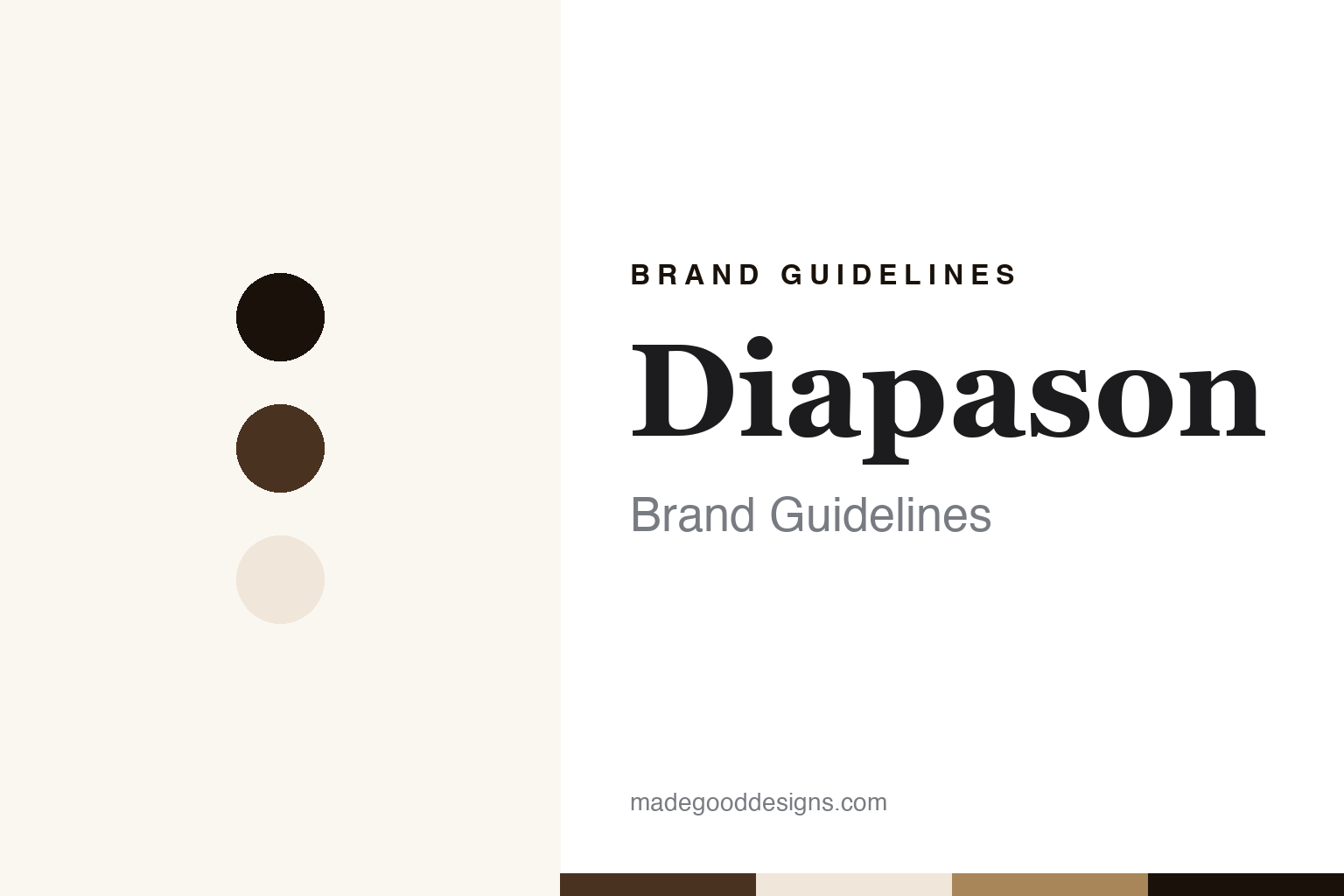
Diapason Brand Guidelines
Alessandro Schiavi’s Brescia loudspeakers in solid walnut.
Aa
Two constants: a Diapason walnut and grey palette and a Humanist serif register. Abstract homage — not a Diapason product or mark; no instrument, logo or nameplate is reproduced.
A recording engineer’s speakers
Alessandro Schiavi.
Diapason — Italian for a tuning fork — makes loudspeakers in Brescia, in eastern Lombardy. Its website calls itself “Audio Technologies Development Since 1987” and names Alessandro Schiavi as its “founder and president.” A 1999 interview with the online magazine TNT-Audio confirms him as the company’s owner and designer.
Schiavi came to speakers through recording. In that interview he said that at the beginning of the 1980s he and Alessandro Orizio set up a purist recording studio, and both the interview and the company say he worked as recording engineer for the International Piano Festival at Brescia’s Teatro Grande, the city’s opera house. The company’s website, archived since 1998, says he was only a young teenager in 1987, which sits awkwardly with that account, so we do not give his age.
The 1987 founding date is the company’s own; we found no registry or press record of it. Its first product, it says, was the Prelude — a musical term, like the brand’s own name.
Colour
The diamond and the walnut.
Diapason’s best-known model is the Adamantes — from the Latin for diamond. Milan’s Top Audio show, where it first appeared, is also where Norma launched its range in 1997. The company says the first Adamantes was shown at Milan’s Top Audio show in 1989, in solid chestnut; TNT-Audio, comparing the Adamantes I and III in a later review, confirmed the 1989 date, dated the Adamantes III to 1999 in Canaletto walnut, and said the faceted, diamond-like cabinet gave the model its name and won a design award from the American magazine Audio Video Interiors. That 1999 interview and review are the earliest independent records of the company we found.
Other models followed, by the company’s account: the Micra in 1991, the Karis — from the Greek for grace — in 1998 and the Ástera, a star, in 2009. The first Adamantes was built in chestnut; by 1999, TNT-Audio recorded, the model had moved to walnut. The current Adamantes V is the fifth version. Its current range is divided into a Reference collection — the Didascalia, Dynamis and Ástera, names drawn like most of its others from Greek and Latin — and a Classic collection — the Adamantes V, Monitor Karis III and Micra III Excel — with the Karis Wave alongside. TNT-Audio also records an early review in the Italian magazine Audio Review, by Bebo Moroni, in 1991.
Wood is the brand. The company describes its speakers as born “from the expert hands of master craftsmen, guardians of the Italian cabinet-making tradition,” built mainly in solid Canaletto walnut, with internal wiring by the Dutch cable maker Van den Hul and drivers from makers it names, including Norway’s Seas, France’s Audax and Denmark’s Scan-Speak. It does not say who builds the cabinets, or where; since it names other firms’ drivers, its own contribution, by its account, lies in design and cabinetwork. It does not say in so many words that every speaker is built in Brescia, and we do not say so either.
Typography
Design and documentation.
Italy has a long record of treating audio equipment as design. The Compasso d’Oro, the industrial-design award associated with Italy’s ADI design association, went to Brionvega’s Doney television in 1962 and to the company as a whole in 1970, according to Italian Wikipedia; Brionvega’s radios and record players are now held by museums including London’s Victoria and Albert Museum.
The country’s hi-fi makers range from that design-led tradition to small engineering workshops. Sonus faber, the loudspeaker maker founded near Vicenza in 1983, has passed through several investors and in November 2024 was included in Bose’s announced purchase of McIntosh Group, according to What Hi-Fi?. Many smaller makers remain private, and some are hard to document beyond their own websites.
Italy’s hi-fi trade has its own shows and press. Milan’s Top Audio show is where Norma says it launched its range in 1997, and where Audia Flight says its Strumento amplifiers won an award in 2012; Italian magazines such as Audio Review and Fedeltà del Suono review the country’s equipment and appear in the makers’ own lists of press coverage.
The makers in this guide are spread across northern and central Italy rather than gathered in one district: Brionvega in Milan, Diapason in Brescia, Lector near Pavia, Norma near Cremona, Mastersound at Arcugnano outside Vicenza, Viva Audio’s research workshop at Camisano in the same province — with a legal address in Latvia — and Synthesis at Morrovalle in the Marche, according to their own websites.
This guide sets out what can be checked about each brand — who founded it, who owns it, and what it says about where its products are made — and marks clearly what rests only on the company’s own word.
Diapason is one of the better-documented smaller makers: its founding story rests on its own word, but its best-known model is confirmed by independent reviews.
Aa
A humanist serif — “Hear the truth.” (Specimen set in Fraunces, a serif STAND-IN; NOT the Diapason logo.)
Diapason
“Hear the truth.”
Its website sets the name in capitals, DIAPASON, with the strapline “Hear the truth,” neutral greys, the Quicksand, DM Sans and Arsenal typefaces, and photographs of wooden cabinets; the strapline fits a brand named after a tuning fork, an instrument of exact pitch; we found no published brand guidelines. The Ástera page also cites an “Audio Excellence Award” of 2013, which we give as the company’s claim.
Readers searching online should be careful. The address diapason.it belongs to a music and soundscape consortium in Vigevano, and diapasonhifi.com to a hi-fi shop in Apulia; the loudspeaker maker’s site is diapason-italia.com. We found no staff or revenue figures and no sign of a change of ownership. Brescia is also home to Outline, the touring-loudspeaker maker based at nearby Flero.
For a design guide, Diapason shows how a single shape — the faceted Adamantes — and a single material can carry a brand for decades. Compare Opera Loudspeakers, another Italian maker that builds its identity on wood, and Chario, also from Lombardy. For this guide we use a walnut brown and a brass with a serif, an unofficial interpretation; no product or logo is reproduced.
Explore & save
Keep Diapason’s identity on hand — save it to a board in the Made Good inspiration library.
Diapason identity set
Pin the Diapason walnut and grey palette and the Humanist serif register to your own board.