Opera Loudspeakers Brand Guidelines
The Treviso speakers named after singers.
Aa
Two constants: a Opera green, red and near-black palette and a Theatre serif register. Abstract homage — not a Opera product or mark; no instrument, logo or nameplate is reproduced.
Two audiophiles
An Italian and an Englishman.
Opera Loudspeakers dates itself to 1989 in every version of its website. Its pages from 1999 and 2003 traced its origins to the early 1980s and “an unusual but highly fruitful synergy between two cultures and two audiophiles, one Italian and the other English,” without naming them; we could not identify either audiophile. Its website was archived as early as 1999.
Its account of its founder has changed. Its website in 2015 was signed by “Gianni Maria Sacchetti, founder” — the founder of the valve-amplifier maker Unison Research. Its current website says instead that Opera “was born from Giovanni Nasta’s passion for music,” and that “the Nasta family has, for generations, carried forward a know-how.” We give both accounts, attributed, and do not merge them; neither page explains the change.
Its tagline is “The Voice of Italy,” which casts the speakers themselves as singers. Its footer says the brand is “owned by UK Distribution,” U.K. Distribution Srl, the same company named on the site in 2012 and 2014, at Via Barone in Dosson di Casier near Treviso.
Colour
Caruso, Callas and Tebaldi.
Opera, as its name suggests, names its speakers after singers and the language of opera, the art form that began in Italy. Its first model, its 1999 site says, was the Caruso, after the Neapolitan tenor Enrico Caruso, followed by the Callas, after the soprano Maria Callas, the Operetta — a light opera — and the Divina, a diva; a new Seconda was announced in March 2012. A “Grand Callas” announced in July 2014 combined, the company said, “the previous Grand Callas and Tebaldi models” — after the soprano Renata Tebaldi. Its current ranges are the Classica line, with the Mezza, Prima, Grand Mezza and Quinta — Italian for half, first and fifth — and an SP1 stand, and the Callas line, with the Callas, Callas Diva and Grand Callas.
The details are specific. The Mezza is a two-way speaker with a 26-millimetre soft-dome tweeter and a 150-millimetre aluminium cone, finished in cement grey or rosewood; the Callas uses a Scanspeak 9700 tweeter, has a sensitivity of 89 decibels and comes in lacquered walnut or mahogany, with special editions in padouk, an African hardwood.
Materials are part of the brand, and the company describes them in some detail. The company speaks of “fine woods and leathers, carefully selected from local craftsmen,” and of “beauty and musicality, made in Italy.”
Typography
Small makers, strong claims.
Italy’s best-known hi-fi brand shows how ownership can travel. Sonus faber was founded in 1983 by Franco Serblin near Vicenza; in 2007 the investment firm Quadrivio bought it and built a group, Fine Sounds, that went on to buy Audio Research, Sumiko and McIntosh, later renaming itself McIntosh Group and moving its headquarters to New York. Fine Sounds had sales of €50 million in 2011; a management buyout with LBO France followed in 2014, the group took the McIntosh name in 2016, and Highlander Partners bought it in 2022. In November 2024 the American company Bose announced that it would buy McIntosh Group, Sonus faber included, according to What Hi-Fi?. Serblin himself had left Sonus faber in 2006, and died in 2013.
Italian audio design also has a longer history. Brionvega, founded in Milan in 1945, worked with designers such as Marco Zanuso and Richard Sapper, and its radios and televisions are held by museums including MoMA and the V&A, according to English Wikipedia. It took the Brionvega name in 1963 and was sold to Sèleco in 1992; in 2016 David Bowie’s Brionvega RR 126 radiogram sold at Sotheby’s for £257,000.
That design tradition is collected and exhibited. Brionvega worked with Achille and Pier Giacomo Castiglioni and Mario Bellini as well as Zanuso and Sapper, won Compasso d’Oro design awards, and has products in the Centre Pompidou and Milan’s ADI Design Museum; in 2025 its pieces appeared in the San Francisco Museum of Modern Art’s exhibition “The Art of Noise,” according to English Wikipedia. Sonus faber, for its part, is based at Arcugnano, just outside Vicenza.
The makers in this guide are much smaller. They are private companies or partnerships, some still led by their founders, and they describe their own work in strong terms — handmade, entirely Italian, patented. We give each of those claims as the company’s own, and say where we could not check them.
Opera is one of those makers: a speaker brand that sells its Italian identity as openly as its sound.
Aa
A theatre serif — the tricolore in a logo. (Specimen set in Fraunces, a serif STAND-IN; NOT the Opera logo.)
Opera
The tricolore in a logo.
On manufacturing the company, which calls its speakers diffusori, the usual Italian word, says “every loudspeaker is born in our Treviso workshop” — in Italian, “Ogni diffusore nasce nel nostro laboratorio di Treviso.” It does not say who designs its speakers today. We give that as its claim. Its 2015 website said it was a member of the CEA, the American consumer-electronics trade association. We found no staff or revenue figures, and no reviews of its speakers in the sources we could reach. By the companies’ own dates, Opera, from 1989, is two years younger than Unison, from 1987. Its website, operaloudspeakers.com, publishes its statements in both Italian and English.
Opera shares its address and telephone number with Unison Research, the Treviso valve-amplifier maker that dates itself to 1987. The two brands are run by separate companies — U.K. Distribution for Opera, A.R.I.A. for Unison — and we found no record that either owns the other, so we call them sister brands sharing premises.
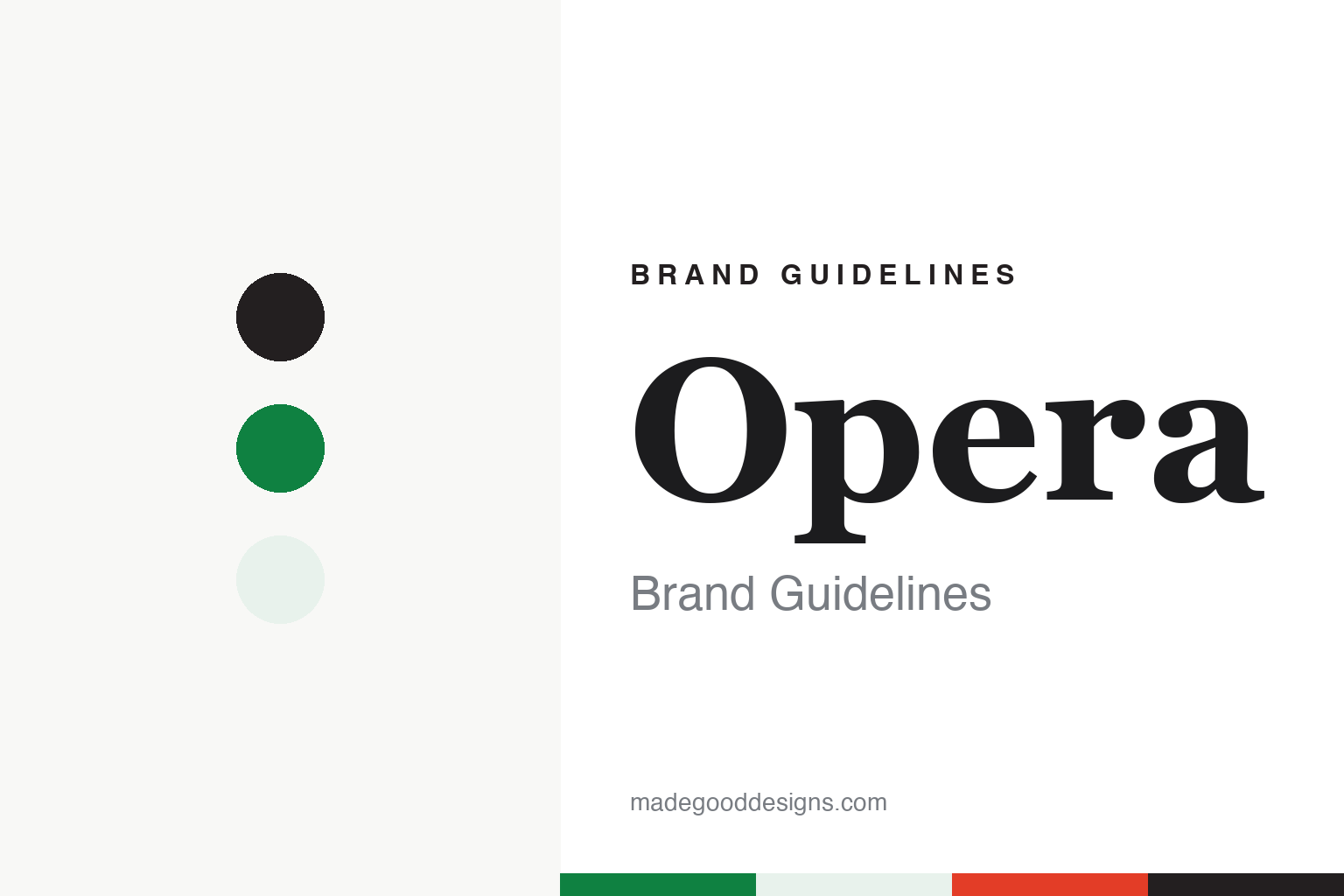
Its logo uses a green (#0F8141), a red (#E33D27), near-black and a light grey — the colours of the Italian flag. The singers’ names, the walnut and leather, and the tricolore all point the same way: an identity built on being Italian. For a design guide, Opera shows how naming can carry a whole identity: every model a singer or a role. Compare Unison Research, its neighbour, and Sonus faber, another Italian speaker maker, now part of the McIntosh Group. For this guide we use the logo’s green and red with a serif, an unofficial interpretation; no product or logo is reproduced.
Explore & save
Keep Opera Loudspeakers’s identity on hand — save it to a board in the Made Good inspiration library.
Opera identity set
Pin the Opera green, red and near-black palette and the Theatre serif register to your own board.