Sonus faber Brand Guidelines
The wooden voice.
Aa
Two constants: a walnut-and-brass palette and a luthier serif register. Abstract homage — not a Sonus faber cabinet or wordmark.
The wooden voice
Sonus faber builds violin-inspired wooden loudspeakers by hand in Vicenza, Italy.
Sonus faber is a lesson in craft as the identity. An Italian loudspeaker house near Vicenza, it builds high-end speakers with curved, lute-shaped wooden cabinets — hand-finished walnut, leather and brass — as a deliberate homage to the violin-makers of Cremona. Sound, made a piece of cabinetmaking.
Its identity is the wooden voice. Sonus faber’s hand-built wooden cabinets, shaped like instruments, are the work it is known for. A material, made a signature. A house that builds speakers like violins.
(Honest notes, so the story stays precise. Sonus faber is still designed and hand-built in Arcugnano, near Vicenza, in Italy — that has not changed. Its ownership has: founder Franco Serblin left in 2006 and died in 2013, and the brand passed through Fine Sounds and the McIntosh Group before being acquired by Bose in 2024, though it is run as an independent Italian brand and its production stays in Italy, so we say “owned by Bose, made in Italy,” not “a Bose speaker.” On drivers: it designs bespoke drivers such as its Damped Apex Dome tweeter in-house, produced with manufacturing partners, so we say “custom-designed,” not that it forges every component. One clarification: the separate “Franco Serblin” brand, founded by Serblin in 2010, is a different company we keep distinct. Its cabinets, designs and name are its IP, described but never reproduced, and there is no official brand hex — these tones are an unofficial interpretation. This is design commentary and does not promote any product.)
Colour
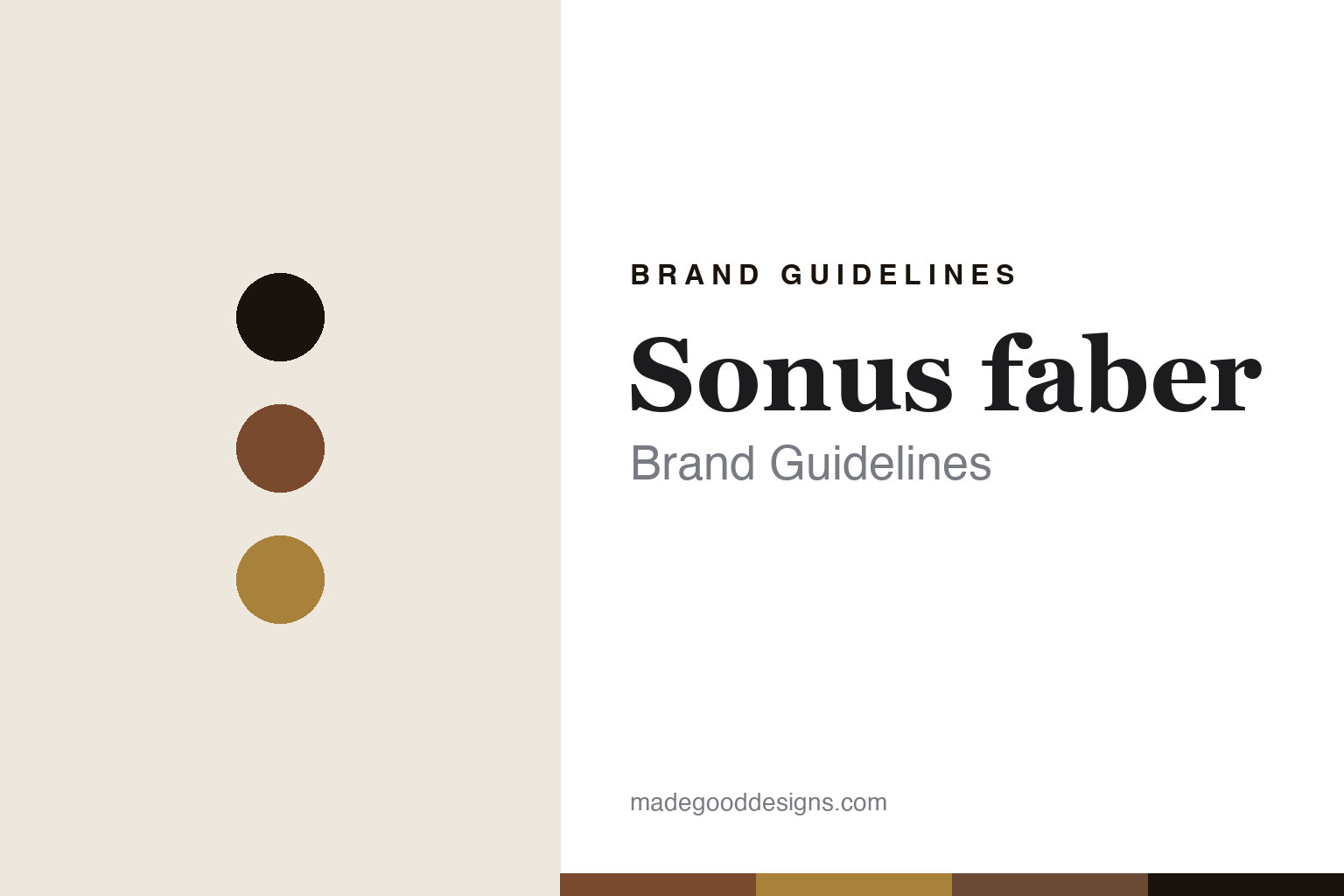
Sonus faber lives in a walnut-and-brass palette. Click a swatch to copy the hex.
Sonus faber’s identity is warm, crafted and luxurious — a walnut, an ink, a brass, an umber, and a cream. The palette leans walnut and brass: the register of hand-finished wood and metal detail. It signals craft and warmth over gloss. The honest caveat: with no published brand hex, these values are an original, unofficial interpretation, not first-party colours.
The lesson is a walnut-and-brass palette signals a craft, wooden identity. Sonus faber’s world is a warm, hand-finished, luxurious object. For designers, it is a reminder that a rich, natural palette can carry a brand built on cabinetmaking — the walnut of a wooden cabinet and the brass of its details. Because these tones can fail as small text, keep type dark and let the colour live in the accents, palette and band. The takeaways: build in wood; craft it by hand; be honest about ownership; and treat any single hex as unofficial.
Typography
The register is a luthier serif — warm, classical, crafted.
Sonus faber’s identity carries a warm, classical, crafted spirit — a hand-made object, not a mass-made one. A luthier serif captures the mood: elegant, high-contrast and instrument-like, the register of violin-shaped wooden cabinets. Set in a walnut-and-brass palette, the luthier serif feels warm and classical — exactly the personality Sonus faber carries. It is crafted rather than clinical, mirroring a cabinet built like an instrument. (Sonus faber’s real cabinets and wordmark are things we describe but do not reproduce, and the exact typeface is not ours to use.) Because it is not ours to use, the honest description is “a luthier-serif spirit,” shown here in a stand-in. The type behaves like the house: warm, classical and crafted.
Aa
A luthier-serif spirit — warm and classical. (Specimen set in Cormorant, a luthier-serif STAND-IN; NOT the Sonus faber wordmark or any cabinet design.)
Craft as identity
Sonus faber stands for the wooden voice.
Sonus faber is a lesson in making craft the identity. A walnut-and-brass palette, a luthier serif and violin-inspired wooden cabinets make cabinetmaking the whole house — warm, crafted and luxurious. The wood is the differentiator. The differentiator is a genuine craft tradition — speaker cabinets shaped and finished like instruments, in an Italian workshop, in homage to the violin-makers of Cremona.
Put to work, the identity is craft as luxury. A house building in this spirit would treat the enclosure as furniture and instrument at once, keep the cabinetmaking by hand, and be candid about who owns it and where it is made, so the customer buys into craft and heritage rather than a badge. It would let the material and the making carry the brand, so that a cabinet is recognised as its work before any logo is read. The lesson Sonus faber teaches is that a genuine craft plus a clear reference can build a luxury brand: the wood gives it warmth, and the craft gives it status. The craft is the personality, and the wood is the proof.
For designers and brand-builders, Sonus faber offers a clear takeaway: make a craft the brand. The lessons: build in a real material; craft it by hand; be honest about ownership; and be candid about the story. It is also a reminder to stay accurate: Sonus faber is an Italian loudspeaker house in Arcugnano, near Vicenza, building violin-inspired wooden cabinets by hand — owned by Bose since 2024 but made in Italy and run independently, and distinct from the separate Franco Serblin brand — with the palette here an unofficial interpretation. Sonus faber made the wooden voice the house — proof that craft can be the difference.
Explore & save
Keep Sonus faber’s identity on hand — save it to a board in the Made Good inspiration library.
Sonus faber identity set
Pin the walnut-and-brass palette and the luthier-serif register to your own board.