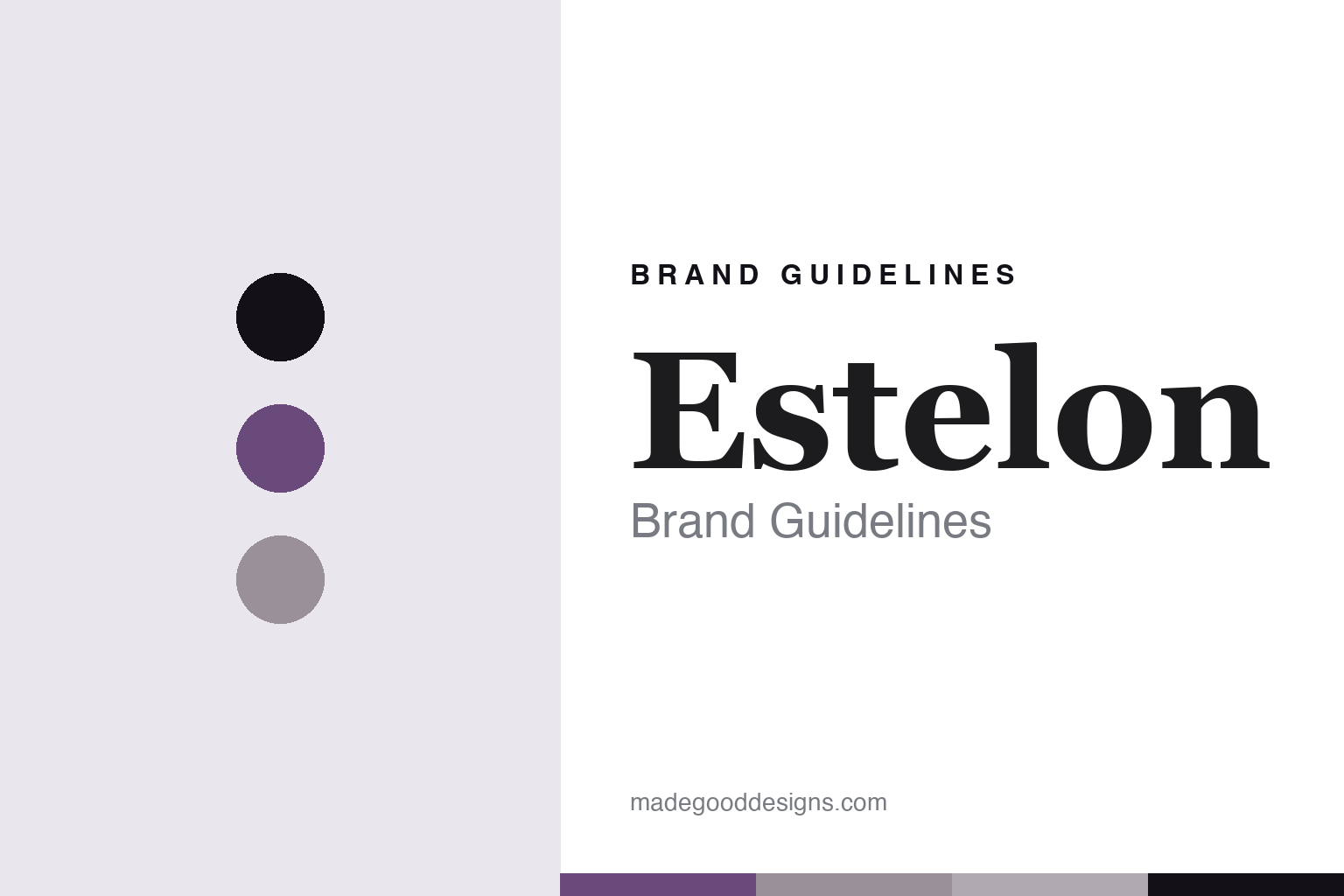
Estelon Brand Guidelines
The sculpted cabinet.
Aa
Two constants: an amethyst-and-marble palette and a sculptural serif register. Abstract homage — not an Estelon cabinet or wordmark.
The sculpted cabinet
Estelon hand-builds sculptural loudspeakers from a marble-based composite in Tallinn, Estonia.
Estelon is a lesson in a form as the identity. An Estonian family maker in Tallinn, it builds high-end loudspeakers with sculptural, curvaceous cabinets moulded from a proprietary marble-based composite — striking, monolithic shapes that look more like sculpture than hi-fi. Sound, made a sculpture.
Its identity is the sculpted cabinet. Estelon’s flowing, one-piece composite cabinets are the work it is known for. A form, made a signature. A maker whose speaker is first of all an object.
(Honest notes, so the story stays precise. Estelon was founded in 2010 by Alfred Vassilkov, its founder and chief designer, and is an independent, family-run Estonian company — run with his two daughters, one of whom is CEO, and we say daughters rather than sons. Everything is designed and hand-built in Estonia. Its distinctive cabinet is moulded from a crushed-marble mineral composite that Vassilkov spent about three years developing — so we say “marble-based composite,” not carved or quarried marble — and the sculptural, non-parallel form is the engineering as much as the look. On drivers: it does not make its own; it sources and co-develops high-end ceramic and diamond drivers from the German specialist Accuton, so the cabinet and engineering are what is proprietary, not the drivers. Its cabinets and name are its IP, described but never reproduced, and there is no official brand hex — these tones are an unofficial interpretation. This is design commentary and does not promote any product.)
Colour
Estelon lives in an amethyst-and-marble palette. Click a swatch to copy the hex.
Estelon’s identity is sculptural, refined and modern — an amethyst, an ink, a marble, a stone, and a chalk. The palette leans amethyst and marble: the register of a jewel accent against stone-composite. It signals sculpture and refinement over convention. The honest caveat: with no published brand hex, these values are an original, unofficial interpretation, not first-party colours.
The lesson is an amethyst-and-marble palette signals a sculptural identity. Estelon’s world is a sculptural, refined, modern object. For designers, it is a reminder that a jewel accent against neutral stone can carry a brand built on form — the amethyst of a highlight against the marble-grey of a composite cabinet. Because these tones can fail as small text, keep type dark and let the colour live in the accents, palette and band. The takeaways: own a form; develop your own material; be honest about drivers; and treat any single hex as unofficial.
Typography
The register is a sculptural serif — fluid, elegant, refined.
Estelon’s identity carries a fluid, elegant, refined spirit — a sculpted object, not a boxy one. A sculptural serif captures the mood: soft, curved and high-contrast, the register of a flowing composite cabinet. Set in an amethyst-and-marble palette, the sculptural serif feels fluid and elegant — exactly the personality Estelon carries. It is sculptural rather than rigid, mirroring a curvaceous, one-piece form. (Estelon’s real cabinets and wordmark are things we describe but do not reproduce, and the exact typeface is not ours to use.) Because it is not ours to use, the honest description is “a sculptural-serif spirit,” shown here in a stand-in. The type behaves like the maker: fluid, elegant and refined.
Aa
A sculptural-serif spirit — fluid and elegant. (Specimen set in Fraunces, a sculptural-serif STAND-IN; NOT the Estelon wordmark or any cabinet design.)
A form as identity
Estelon stands for the sculpted cabinet.
Estelon is a lesson in making a form the identity. An amethyst-and-marble palette, a sculptural serif and flowing composite cabinets make form the whole maker — sculptural, refined and modern. The form is the differentiator. The differentiator is a genuine, developed material and shape — a crushed-marble composite moulded into a monolithic, non-parallel cabinet, engineered as much as styled, in a family workshop.
Put to work, the identity is form as engineering. A maker building in this spirit would develop its own material, make the form both beautiful and functional, and be candid about what it makes and what it sources, so the customer buys into a sculpture that also works. It would let the silhouette be the brand, so that a cabinet is recognised across a room before any badge. The lesson Estelon teaches is that a distinctive, engineered form can build a brand: the composite gives it substance, and the sculpture gives it identity. The form is the personality, and the material is the proof.
For designers and brand-builders, Estelon offers a clear takeaway: own a form and develop the material behind it. The lessons: own a shape; develop your own material; be honest about drivers; and be candid about the story. It is also a reminder to stay accurate: Estelon is an independent, family-run Estonian maker in Tallinn, founded in 2010 by Alfred Vassilkov and run with his daughters, hand-building sculptural cabinets from a marble-based composite and using sourced Accuton drivers — with the palette here an unofficial interpretation. Estelon made the sculpted cabinet the maker — proof that a form can be the difference.
Explore & save
Keep Estelon’s identity on hand — save it to a board in the Made Good inspiration library.
Estelon identity set
Pin the amethyst-and-marble palette and the sculptural-serif register to your own board.