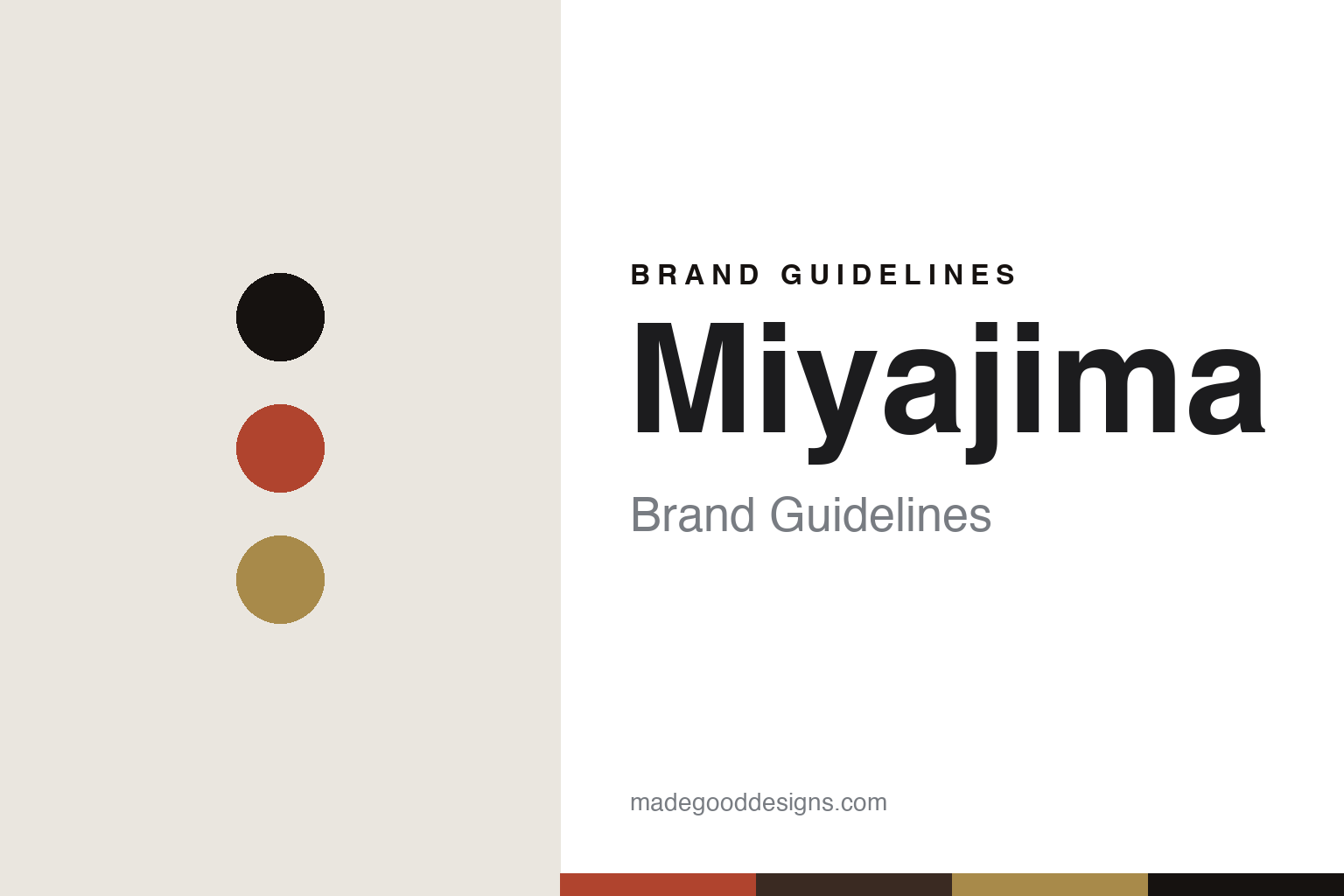
Miyajima Brand Guidelines
The cross-ring.
Aa
Two constants: a vermilion-and-blackwood palette and an artisan sans register. Abstract homage — not a Miyajima cartridge or wordmark.
The cross-ring
Miyajima hand-builds cross-ring phono cartridges, and famous mono ones, in Fukuoka, Japan.
Miyajima is a lesson in an invention as the identity. A small Japanese workshop in Fukuoka, it hand-builds moving-coil phono cartridges around its own patented cross-ring system — and is especially famous for mono cartridges — often in wood bodies of African blackwood and bamboo. Playback, made a hand-built, wooden object.
Its identity is the cross-ring. Miyajima’s patented cross-ring motor and its wood-bodied cartridges are the work it is known for. An invention, made a signature. A workshop the size of a family.
(Honest notes, so the story stays precise. Miyajima Laboratory was founded in 1980 by Noriyuki Miyajima, who remains owner and chief designer; it is a small, roughly six-person family workshop across two generations. Everything is hand-built in Japan, in Fukuoka. Its signature is a genuine invention — the patented cross-ring system, which places the cantilever’s fulcrum at the centre of the coil — and it is best known for mono cartridges, alongside wood-bodied stereo models such as the Kansui and Madake. One naming note: “Miyajima Laboratory” is the export brand while “Otono-Edison” is the domestic parent name for the same Fukuoka operation, and the model is the Kansui, not “Kansai.” Its designs and name are its IP, described but never reproduced, and there is no official brand hex — these tones are an unofficial interpretation. This is design commentary and does not promote any product.)
Colour
Miyajima lives in a vermilion-and-blackwood palette. Click a swatch to copy the hex.
Miyajima’s identity is crafted, warm and Japanese — a vermilion, an ink, a blackwood, a bamboo, and a chalk. The palette leans vermilion and blackwood: the register of a Japanese red against dark hardwood. It signals craft and tradition over show. The honest caveat: with no published brand hex, these values are an original, unofficial interpretation, not first-party colours.
The lesson is a vermilion-and-blackwood palette signals a crafted, Japanese identity. Miyajima’s world is a small, hand-made, wooden object. For designers, it is a reminder that a warm red and a dark wood can carry a brand built on craft — the vermilion of a Japanese seal and the blackwood of a cartridge body. Because these tones can fail as small text, keep type dark and let the colour live in the accents, palette and band. The takeaways: own an invention; work in wood; keep it hand-built; and treat any single hex as unofficial.
Typography
The register is an artisan sans — clean, warm, human.
Miyajima’s identity carries a clean, warm, human spirit — a hand-made object, not a mass one. An artisan sans captures the mood: even, humane and quiet, the register of a small workshop’s hand-built cartridge. Set in a vermilion-and-blackwood palette, the artisan sans feels clean and warm — exactly the personality Miyajima carries. It is human rather than clinical, mirroring a hand-built, wooden cartridge. (Miyajima’s real cartridges and wordmark are things we describe but do not reproduce, and the exact typeface is not ours to use.) Because it is not ours to use, the honest description is “an artisan-sans spirit,” shown here in a stand-in. The type behaves like the maker: clean, warm and human.
Aa
An artisan-sans spirit — clean and warm. (Specimen set in Jost, an artisan-sans STAND-IN; NOT the Miyajima wordmark or any cartridge design.)
An invention as identity
Miyajima stands for the cross-ring.
Miyajima is a lesson in making an invention the identity. A vermilion-and-blackwood palette, an artisan sans and cross-ring cartridges make a single invention the whole maker — crafted, warm and human. The invention is the differentiator. The differentiator is a genuine, patented idea — a cross-ring motor — realised by hand at the tiny scale of a phono cartridge in a family workshop.
Put to work, the identity is an invention as the brand. A maker building in this spirit would own one real, patented idea rather than a spec sheet, hand-build at the scale that matters, and keep the craft in the family, so the customer buys into engineering rather than marketing. It would let a specialism others neglect — the mono cartridge — become its territory, so that a narrow focus reads as authority. It would treat wood, red and hand-assembly as one coherent identity, so that the object looks like the workshop that made it. The lesson Miyajima teaches is that a genuine invention plus a family workshop can build a brand: the cross-ring gives it substance, and the Fukuoka making gives it credibility. The invention is the personality, and the making is the proof.
For designers and brand-builders, Miyajima offers a clear takeaway: own an invention and hand-build it. The lessons: own the idea; work small and by hand; keep it in the family; and be honest about the story. It is also a reminder to stay accurate: Miyajima Laboratory is an independent Japanese workshop founded in 1980 by Noriyuki Miyajima, hand-building patented cross-ring cartridges — and famous mono ones — in Fukuoka, with the palette here an unofficial interpretation. Miyajima made the cross-ring the maker — proof that an invention can be the difference.
Explore & save
Keep Miyajima’s identity on hand — save it to a board in the Made Good inspiration library.
Miyajima identity set
Pin the vermilion-and-blackwood palette and the artisan-sans register to your own board.