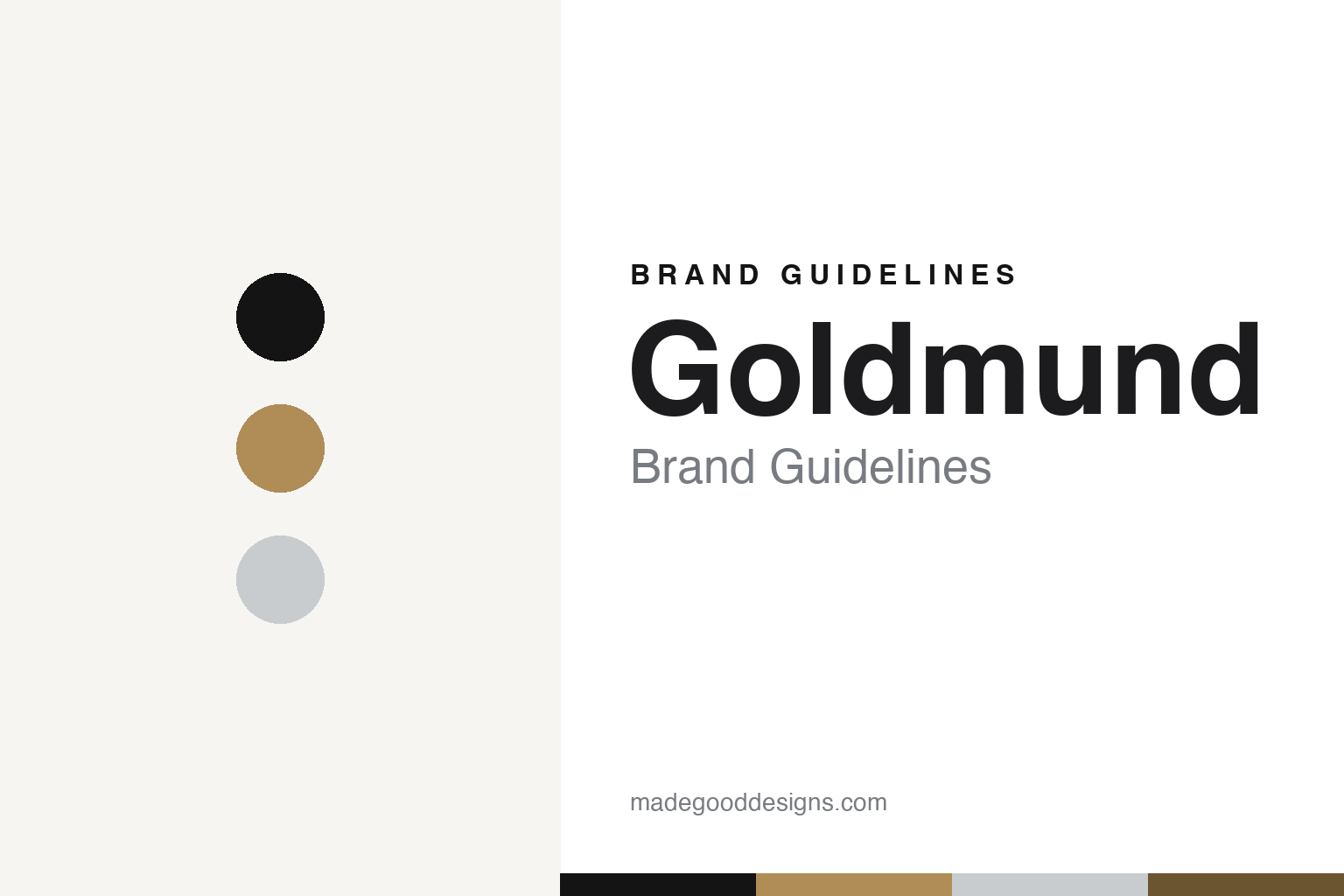
Goldmund Brand Guidelines
The French-born turntable maker that became a Geneva audio house.
Aa
Two constants: a bronze, aluminium and black palette and a spaced geometric capitals register. Abstract homage — not a Goldmund product or mark; no component, logo or nameplate is reproduced.
Born in France
A tonearm, two brothers and a move to Geneva.
Goldmund is known as a Geneva company, and today it is one, but it did not begin there. The company’s own timeline says Goldmund was founded in France in 1978, and that its first product was the T3, a servo-controlled tangential tonearm that moves across the record in a straight line rather than swinging on a pivot. Stereophile’s Jim Austin, reviewing Goldmund’s Telos 2800 amplifiers, writes that the company grew out of a French firm called Architectures et Physiques Appliquées, which developed that arm. Memorial articles published by HiFi Pig and StereoNET in December 2025 credit the founding to two researchers they call the Levy brothers.
The name most often attached to Goldmund is Michel Reverchon, and he is regularly called its founder; StereoNET’s obituary headline does so. He was not. Born in 1945, Reverchon grew up in a musical family — his father ran a photography and hi-fi shop in Paris, StereoNET says — and he worked at IBM, where he rose to regional director. According to Stereophile, he became involved in marketing the T3 through Mark Levinson and then bought the business. The date varies: Goldmund’s timeline and Stereophile give 1980, while HiFi Pig and StereoNET give 1981.
Reverchon moved the company to Geneva, which Stereophile says was “to benefit from the country’s local precision craftsmanship.” In a factory-visit feature published around the launch of the Telos 5000 amplifier, 6moons found Goldmund in an unsigned building in an industrial zone near the French border, with 15 employees, four of them full-time engineers. Reverchon told the magazine he had chosen the area because it was the centre of the Swiss watch industry, with high-tech subcontractors able to supply thousands of custom parts; assembly and engineering stayed in-house. Asia, the magazine reported, made up 83 per cent of revenue.
Colour
Mechanical grounding, the Apologue and the Telos amplifiers.
For its first decade Goldmund was a turntable company. Its timeline lists the Studio turntable of 1979, with an acrylic platter and what the company calls “Mechanical Grounding,” the idea of draining vibration away from the record through the structure — a principle it still describes as central to everything it makes. The Reference turntable followed at the Consumer Electronics Show in 1983. For the Reference’s 25th anniversary Goldmund built the Reference II, and Stereophile’s report from CES 2007 was headlined “Goldmund’s $300k Turntable.”
Electronics arrived in 1987 with the Mimesis 2 preamplifier and Mimesis 3 power amplifier, and the same year brought the company’s best-known object, the Apologue loudspeaker, designed by the Italian designer Claudio Rotta Loria. The company says it was a three-way passive speaker in lacquered wood, made in only 50 pairs, and that a pair was selected for the permanent collection of the Museum of Modern Art in New York; we could not check MoMA’s catalogue ourselves, so we give that as Goldmund’s claim. Digital products followed from 1990 with the Alizé converter, the Mimesis 10 and the Mimesis 36 CD transport, then the Epilogue speakers with metal-alloy cabinets in 1994. StereoNET dates the first Telos amplifiers to 1992; the Telos 5000, a 5,000-watt mono amplifier, came in 2009, the company says, and the first active speaker, the Mini Logos Active, in 2003.
The look has shifted with time, from lacquered wood to machined metal. In 2022 Goldmund introduced a new speaker collection that it describes as a break from its conventional styling. Wallpaper* reported in September 2024 that the designer Cécile Barani had created the forms of the Gaia, a column of stacked aluminium enclosures about 2.1 metres tall, and the Pulp, small cylindrical aluminium wireless speakers in black or grey, and called aluminium “the company’s signature.”
Typography
Swiss hi-fi and its makers.
Switzerland’s audio reputation was built largely on professional machines. Stefan Kudelski made the first Nagra tape recorder in 1951, and it became the standard for film sound from the 1960s to the 1990s, English Wikipedia says; the brand now belongs to Audio Technology Switzerland, near Lausanne. Willi Studer founded Studer in Zurich in 1948 and registered the Revox name for consumer equipment in 1951. Thorens is older still: it was registered at Sainte-Croix, in Vaud, in 1883.
Austria’s record centres on Vienna. AKG was founded there in the late 1940s by Rudolf Görike and Ernst Pless; its owner, Harman, closed its Vienna operations in 2017. Pro-Ject, founded by Heinz Lichtenegger in 1991, designs its turntables at Mistelbach, in Lower Austria, and makes them in the Czech Republic, Slovakia and Germany.
Vienna is now the trade’s meeting place too. In September 2024 the High End Society announced that its HIGH END show would leave Munich after 2025, StereoNET reported; the first Vienna edition was held at the Austria Center Vienna from 4 to 7 June 2026.
According to their own websites, Goldmund is at Satigny and darTZeel at Vessy, both in the canton of Geneva; CH Precision is at Préverenges, near Lausanne; Soulution’s maker, Spemot, is at Dulliken, in the canton of Solothurn; Piega is at Horgen, on Lake Zurich; Revox, Swiss by origin, is now run from Villingen-Schwenningen in Germany; and Vienna Acoustics is at Weigelsdorf, south of Vienna.
This guide sets out what can be checked about each brand — who founded it, who owns it, and what it says about where its products are made — and marks clearly what rests only on the company’s own word.
Aa
Spaced geometric capitals, the register of the Goldmund wordmark. (Specimen set in Jost, a geometric sans STAND-IN; NOT the Goldmund logo.)
Goldmund SA
From a family business to a family office.
The Swiss commercial register shows how the company was held. The company now called GOLDMUND SA was registered for years as Digital Audio SA, with Reverchon as sole director and later president; its seat moved from Plan-les-Ouates to Meyrin and, in 2017, to Montreux. In 2018, Stereophile writes, management and then ownership passed from Reverchon, who was ill, to Yohann Segala, whom the magazine describes as his son-in-law. Reverchon left the board in January 2024, the same month the company took the Goldmund name. In April 2024 Goldmund announced Carsten Roth as chief executive, naming Segala as owner of the Goldmund Group.
A year later the company changed hands. On 15 April 2025 the French investment firm Siparex announced that it had financed the purchase of Goldmund by Pythagore Investment, a Swiss holding of three families, from Segala and his family; the new owners would run the group directly and push into Europe and the United States, where Goldmund is still little represented. The release says most sales are made in Asia through specialist distributors. Register notices from April and May 2025 name Marius Chapel as president and move the seat to Satigny, a commune in the canton of Geneva; in December 2025 Roth’s signing powers were removed. Michel Reverchon died on 1 October 2025.
On where the products are made, the 2025 release says they are assembled by hand in the brand’s Swiss workshop, and the logo on it reads “Swiss Made” beneath a G set in a square and the name in widely spaced capitals, in a bronze tone. We give that as the company’s account; 6moons’ earlier visit described Swiss-made parts from subcontractors and assembly in-house.
For a design guide, Goldmund shows how a brand can keep one engineering idea constant while its look moves from lacquered wood to anodised metal. Compare Nagra, another Swiss audio name that has changed hands, and darTZeel, its Geneva neighbour. For this guide we use bronze, aluminium grey and black with a geometric sans, an unofficial interpretation; no product or logo is reproduced.
Explore & save
Keep Goldmund’s identity on hand — save it to a board in the Made Good inspiration library.
Goldmund identity set
Pin the Goldmund bronze, aluminium and black palette and the spaced geometric capitals register to your own board.